A few million years ago, our ancestors stopped climbing trees and started walking upright, on two feet. To work out how and when this happened, researchers look for fossils -- and recently they found a surprising set of foot bones in Ethiopia. The foot is about 3.4 million years old, making it roughly the same age as 'Lucy' and her species, Australopithecus afarensis. But while Lucy's species had feet much like modern humans, the new foot has an opposable big toe, like a chimp. So do the foot bones represent a new species of hominin? Watch the video and decide.
Read the original research paper: www.nature.com/nature/journal/v483/n7391/full/nature10922.html
Thursday, March 29, 2012
Interesting video and paper from Nature
From the Nature video feed:


Thursday, March 22, 2012
The ‘Annie Hypothesis’: Did the Death of His Daughter Cause Darwin to ‘Give up Christianity’?
 The paper that I wrote with John van Wyhe on what we call "the Annie Hypothesis" is now out here:
Here is the abstract:
This article examines one of the most widely believed episodes in the life of Charles Darwin, that the death of his daughter Annie in 1851 caused the end of Darwin's belief in Christianity, and according to some versions, ended his attendance of church on Sundays. This hypothesis, it is argued, is commonly treated as a straightforward true account of Darwin's life, yet there is little or no supporting evidence. Furthermore, we argue, there is sufficient evidence that Darwin's loss of faith occurred before Annie's death.
During peer review, the paper was criticised for mixing history with historiography and for being overly positivist, but what can you expect of a scientist! We are all positivists!
Sadly, the paper is not open access: if anyone wants a copy but cannot access it, please email me (m.pallen@bham.ac.uk).
Allow me to thank John van Wyhe for beating the paper into shape and nursing it through to publication!
Other previous posts on this topic:
Friday, February 17, 2012
Rap Guide to Evolution: new "I'm a African" video
Back in the run-up to the Darwin bicentenary year, I persuaded Canadian Lit-Hop artist Baba Brinkman (creator of the Rap Canterbury Tales) to "do for for Darwin what he had done for Chaucer". He rose to the challenge majestically to create the Rap Guide to Evolution and I was thrilled to experience his premier performances at small poetry workshop in Hinxton near Cambridge in early 2009. The video below provides a glimpse of this earliest version of the show. In the week that followed I arranged for Baba to tour England, with shows in Cambridge, London, Birmingham and Shrewsbury.
Since then the various songs have undergone "descent with modification", with two versions of the album now out there (original and revised) and a sell-out live show which ran off Broadway for many months. Also, thanks to an encounter during the very first performance, Baba won financial support from the Wellcome Trust (and did a bit of his own crowd-funding) to create educational and entertaining videos to accompany each track. This has been a slow process, as he has to wait for the animators and actors to find time in their busy schedules to contribute, but the videos have been steadily appearing on YouTube and a dedicated website.
When I first suggested that Baba create the Rap Guide to Evolution, I asked if he could do something to communicate and even celebrate the Out-of-Africa theory, i.e. the idea first proposed by Chris Stringer and others that all modern non-African humans are descended from a small band of humans who left Africa 60-70 thousand years ago (pace John Hawks and Svante Paabo who now emphasise that a few percent of the non-African human genomes originated from archaic hominins from outside Africa). To me this theory gelled nicely with the pan-Africanism that permeates both reggae (check out this Black Uhuru track) and some rap music. Baba did a great job on this, with his track "I'm a African".
A few months back Baba visited Birmingham to perform the Rap Guide to Evolution for our students. During his visit he solicited my help in finding a multi-racial cast of volunteers to appear in the video for "I'm a African". From amongst students and colleagues, we managed to find two Indians, two Greeks, an Afghan, a Chinese, a number of Europeans (including me!), plus some people with African ancestry more recent than 70Kya, all willing to lip-sync along to the track against a green background, hastily assembled Blue-Peter-fashion from some card and sticky tape. Filming all this within our Centre for Systems Biology was a truly surreal experience!
Well, yesterday, just as Nick Loman was stoking our other blog up to blistering heat with the news of Oxford Nanopore, I received a note from Baba saying that the video for "I'm a African" was now finished and available online. So, here it is! Enjoy! Mine is the ugly mug a few seconds in!
A few notes on the video:
1. It's "I'm a African" rather than "I'm an African" for good reason, as Baba explains here.
2. The track is modelled on a track from Pan-Africanist Hip-Hop group Dead Prez. Listen to that track here if you want to compare and contrast.
3. Be sure to wait right until the end of Baba's video to see the architect of the out-of-Africa theory, Chris Stringer, make a cameo appearance, thanks to some footage I captured when he visited the University of Birmingham!
4. I suspect that the Dead Prez track was influenced by a speech "I'm an African" by Thabo Mbeki. Although later deeply flawed as a president, in 1996 Mbeki gives a great speech.
5. A few years back, in similar vein, with a Jamaican colleague, I created "Light be Thrown", a celebration in reggae format of our recent African origins and Darwin's predictions about how light will be thrown on human origins.
Saturday, December 10, 2011
Evolutionary Chemistry: from Darwinism to drugs
Most therapeutic drugs work by binding to proteins and interfering with their function. A key challenge for chemists working in the pharmaceutical industry is to discover new medicinal chemicals that fit important protein targets, rather like a key fits a lock. The traditional way to do this is to take a long hard look at the protein “lock” and then rationally design a chemical “key” that fits it. However, analogies with biological evolution have recently inspired an alternative approach: evolutionary chemistry.
Instead of attempting rational drug design, the evolutionary chemist simply generates a massive pool of variable DNA-like starting molecules (analogous to the variation that underlies biological natural selection). When these are then introduced to the target protein, only a small fraction of the molecules bind (the selection step). However, various chemical tricks then allow the chemist to amplify this population of molecules (the reproduction step). The amplified molecules are then used as the starting point for a subsequent round of selection and amplification. After several rounds of selection, the molecular mixture is greatly enriched for aptamers, molecules that bind tightly and specifically to the chosen target.
Instead of attempting rational drug design, the evolutionary chemist simply generates a massive pool of variable DNA-like starting molecules (analogous to the variation that underlies biological natural selection). When these are then introduced to the target protein, only a small fraction of the molecules bind (the selection step). However, various chemical tricks then allow the chemist to amplify this population of molecules (the reproduction step). The amplified molecules are then used as the starting point for a subsequent round of selection and amplification. After several rounds of selection, the molecular mixture is greatly enriched for aptamers, molecules that bind tightly and specifically to the chosen target.
This evolutionary approach, called SELEX, has already led to the development of one useful drug, Pegaptanib (with the trade name Macugen), which has been licensed as a medicine to treat a common cause of blindness (age-related macular degeneration). But this is just the start: evolutionary chemistry is all set to deliver additional medically useful aptamers in the next few years that will target heart disease or cancer. For example, the US company Archemix has a developed lead aptamer, ARC1779, which acts as a potent, selective antagonist of von Willebrand Factor (vWF), with potential for use as an anticoagulant or antithrombotic agent (http://www.ncbi.nlm.nih.gov/pubmed/19479665). It is currently undergoing evaluation in clinical trials in patients diagnosed with acute coronary syndrome undergoing percutaneous coronary intervention.
For an unusual attempt to communicate how SELEX works (albeit applied to discovering new diagnostics rather than drugs), take a look at this video of the winning entry in the Dance you PhD competition of 2010!
Tuesday, November 22, 2011
Darwin's Pilgrims: The Video
In February 2009, I hosted 'Darwin's Pilgrims": a visit to England by two Americans with links to the Dover Pennsylvania trial, Cynthia Sneath and Lauri Lebo, and Canadian Lit Hop artist Baba Brinkman to celebrate Darwin's 200th birthday. The trip involved a "pilgrimage" to Darwin-related sites and a series of performances in English cities, including the premiere of the Rap Guide to Evolution. Previous blog posts captured the spirit of the event
- http://roughguidetoevolution.blogspot.com/2009/02/guest-blog-from-lauri-lebo-darwins.html
- http://roughguidetoevolution.blogspot.com/2009/02/guest-blog-from-lauri-lebo-darwins_13.html
- http://roughguidetoevolution.blogspot.com/2009/02/guest-blog-from-lauri-lebo-darwins_842.html
- http://roughguidetoevolution.blogspot.com/2009/02/guest-blog-from-lauri-lebo-darwins_16.html
But this is the first time I have presented the complete video, covering trips to Malvern, Cambridge and London, even though I finished it a couple of years ago. I hope you enjoy the footage and the great music! For a bunch of non-believers, we spent a lot of time in churches!
Monday, November 21, 2011
Don’t want to believe in evolution?
Is it possible to be a rationalist (a believer in the laws of logic) but not believe in evolution? Just about! But only just!
There are several philosophical show stoppers that bring rational argument to a halt.
Perhaps requiring the least mental gymnastics is the "Omphalos hypothesis", so-named after an 1857 book by English naturalist (and local Worcester man) Philip Gosse. Gosse argued that even if creation occurred from nothing, the creator would necessarily leave traces of previous existence that had never actually occurred. Although Adam was never hooked up to a placenta, he required a navel ("omphalos" in Greek) because it made him a complete human being. Similarly, God must have created trees with rings that they never grew and rocks with a fossil record of life that never actually existed.
This kind of thinking has drawn adverse responses from Catholic scientist Ken Miller and the "Zoo Rabbi" Natan Slifkin, who both reject it as depicting God as a dishonest charlatan. A secular response, Last Thursdayism, proposes, that by this logic, the world might just as easily have been created last Thursday, but with the appearance of age such as false memories and fictitious history books. There is even a parody religion, The Church of Last Thursday.
The first real philosophical show stopper is metaphysical solipsism: the belief that you, the reader, is all there is and that this blog and this author, this world and the evolution of life in it, are all just figments of your imagination. However, it is scarcely possible to hold this belief in your mind for even a minute and, as English philosopher Bertrand Russell once pointed out, solipsism
But why suppose you ever had a body in the first place, why not suppose you are a disembodied brain created yesterday with false memories of a biological world built by evolution? Some cosmologists are seriously discussing the idea of Boltzmann brains, self-conscious entities that arise from random fluctuations in vacuum energy (named after Austrian physicist Ludwig Boltzmann, who suggested that the whole universe resulted from such a fluctuation). If the universe lasts long enough, such entities are inevitable, say the cosmologists. But why stop at a brain—viewing yourself as a Boltzmann-brain-in-a-vat breaks none of the laws of physics and also gets you off the hook of having to believe in evolution.
A more general case of the brain-in-a-vat idea is the simulation hypothesis. According to this viewpoint, popularized by the Matrix films, we are all living in a simulated reality, run on a computer powerful enough to create a internally consistent simulation, so detailed that it could not be distinguished from “real” reality. Swedish philosopher Nick Bostrom argues that it is more likely than not that we are living in such a simulation. His argument rests on the assumption that any sufficiently advanced civilization capable of creating simulations that contained intelligent individuals would be unlikely to restrict itself to a single simulation, instead, it would run billions of them. Thus, he asks, why suppose that we are the one civilization that develops the simulations rather than one of the billions run in simulation? Richard Dawkins points out that this merely pushes the need for evolution back stage as the only plausible source of the intelligences running the simulation.
Mathematical physicist Frank Tipler has controversially attempted to interweave cosmology, simulation and religion. He posits that as the universe comes to an end in a singularity, the computational capacity of the universe will outrun time, so that an intelligent civilization could run an infinite simulation within a finite time. Tipler borrows a term from Pierre Teilhard de Chardin to describe this final state of infinite information the Omega point. Recently, Tipler has come to identify his Omega point with God and to equate the associated infinite simulation with the resurrection of the dead. But why not assume we are already dead in Tipler’s sense, i.e. already living in his Omega point simulation and thus free to dispense with any direct evolutionary explanation for our own origins?
How is an evolutionary biologist to respond to all this? The obvious response is to adapt a line from George Orwell and say that you have to be a real philosopher to believe all that, no scientist could be so foolish! In fact, insofar as none of these scenarios is verifiable, they fall outside the realm of science and bring no additional explanatory power. So, you don't really have any excuses for dismissing evolution! Wise up and smell the cladogenesis!
The first real philosophical show stopper is metaphysical solipsism: the belief that you, the reader, is all there is and that this blog and this author, this world and the evolution of life in it, are all just figments of your imagination. However, it is scarcely possible to hold this belief in your mind for even a minute and, as English philosopher Bertrand Russell once pointed out, solipsism
“is rejected in fact even by those who mean to accept it. I once received a letter from an eminent logician… saying that she was a solipsist, and was surprised that there were no others. Coming from a logician and a solipsist, her surprise surprised me.”One modern variant on solipsism is the brain-in-a-vat idea, taken seriously by, among others, Berkeley philosopher Barry Stroud. In this scenario, your brain has been removed from your body, placed in a vat of life-sustaining liquid and your neurons hooked up to a supercomputer that provides you with a virtual reality indistinguishable from any “real” reality. So, the argument goes, if you are in a vat, all your conclusions about evolution in the real world are false. And, as you have no way of knowing whether you are in a vat or not, this leaves you free to doubt the reality of evolution.
But why suppose you ever had a body in the first place, why not suppose you are a disembodied brain created yesterday with false memories of a biological world built by evolution? Some cosmologists are seriously discussing the idea of Boltzmann brains, self-conscious entities that arise from random fluctuations in vacuum energy (named after Austrian physicist Ludwig Boltzmann, who suggested that the whole universe resulted from such a fluctuation). If the universe lasts long enough, such entities are inevitable, say the cosmologists. But why stop at a brain—viewing yourself as a Boltzmann-brain-in-a-vat breaks none of the laws of physics and also gets you off the hook of having to believe in evolution.
A more general case of the brain-in-a-vat idea is the simulation hypothesis. According to this viewpoint, popularized by the Matrix films, we are all living in a simulated reality, run on a computer powerful enough to create a internally consistent simulation, so detailed that it could not be distinguished from “real” reality. Swedish philosopher Nick Bostrom argues that it is more likely than not that we are living in such a simulation. His argument rests on the assumption that any sufficiently advanced civilization capable of creating simulations that contained intelligent individuals would be unlikely to restrict itself to a single simulation, instead, it would run billions of them. Thus, he asks, why suppose that we are the one civilization that develops the simulations rather than one of the billions run in simulation? Richard Dawkins points out that this merely pushes the need for evolution back stage as the only plausible source of the intelligences running the simulation.
Mathematical physicist Frank Tipler has controversially attempted to interweave cosmology, simulation and religion. He posits that as the universe comes to an end in a singularity, the computational capacity of the universe will outrun time, so that an intelligent civilization could run an infinite simulation within a finite time. Tipler borrows a term from Pierre Teilhard de Chardin to describe this final state of infinite information the Omega point. Recently, Tipler has come to identify his Omega point with God and to equate the associated infinite simulation with the resurrection of the dead. But why not assume we are already dead in Tipler’s sense, i.e. already living in his Omega point simulation and thus free to dispense with any direct evolutionary explanation for our own origins?
How is an evolutionary biologist to respond to all this? The obvious response is to adapt a line from George Orwell and say that you have to be a real philosopher to believe all that, no scientist could be so foolish! In fact, insofar as none of these scenarios is verifiable, they fall outside the realm of science and bring no additional explanatory power. So, you don't really have any excuses for dismissing evolution! Wise up and smell the cladogenesis!
Sunday, November 20, 2011
Bio380 Human Evolution Genes and Genomes Bioinformatics Practical
Bio380 Human Evolution Bioinformatics Practical 2011
Follow this link to the entry for the FOXP2 chimpanzee protein:
Return to the Blast search result. Scroll through the results. In the segment of the query spanning residues 241-698, how many differences does the chimp protein show from the following:
Orang utan (Pongo pygmaeus) Gorilla (Gorilla gorilla)
Lar gibbon (Hylobytes lar) Macaque (Macaca mulatta)
Horse (Equus cabellus) Mouse (Mus musculus)
Humans (Homo sapiens)
http://www.uniprot.org/uniprot/Q8MJA0Take a minute to explore the information on the page.
- Q. What is the evidence that this gene is functional in the chimpanzee?
- Q. Why is this entry called FOXP2_PANTR
- Q. What does the Forkhead domain do?
- Q. What is unusual about the first third of the protein sequence?
- Q. What is a FASTA sequence?
Open in a new tab and go to http://www.ncbi.nlm.nih.gov/BLAST/
Select “protein blast”
Search for “foxp2_human”
Spend some time exploring the information therein, while you wait for the Blast search to finish.
Select “protein blast”
- Q. What is BLAST?
- Q. What does this do?
Search for “foxp2_human”
Spend some time exploring the information therein, while you wait for the Blast search to finish.
Return to the Blast search result. Scroll through the results. In the segment of the query spanning residues 241-698, how many differences does the chimp protein show from the following:
Orang utan (Pongo pygmaeus) Gorilla (Gorilla gorilla)
Lar gibbon (Hylobytes lar) Macaque (Macaca mulatta)
Horse (Equus cabellus) Mouse (Mus musculus)
Humans (Homo sapiens)
PS: use the sequence with header "FoxP2_Human"
This paper suggests that the human sequence undergoes an additional post-translational modification compare to the chimp sequence
Search for FoxP2, then click on the first entry and explore the information therein, particularly that under the Evolution heading.
http://dx.doi.org/10.1016/j.jhevol.2007.07.006
Speed-read the abstract and introduction
http://www.cell.com/current-biology/abstract/S0960-9822(07)02065-9
The genome of James Watson, Nobel laureate and co-discoverer of the structure of DNA can be found here: http://jimwatsonsequence.cshl.edu/
- Q. What differences do you find?
- Q. How conservative or radical are the changes in amino-acid properties?
This paper suggests that the human sequence undergoes an additional post-translational modification compare to the chimp sequence
- Q. What is this difference and how significant is likely to be?
Search for FoxP2, then click on the first entry and explore the information therein, particularly that under the Evolution heading.
- Q. Does this confirm or deny any of your previous conclusions?
http://dx.doi.org/10.1016/j.jhevol.2007.07.006
Speed-read the abstract and introduction
- Q. On the basis of this, would you expect Neandertals to be able to speak?
- Q. What would you expect their FoxP2 gene to look like?
http://www.cell.com/current-biology/abstract/S0960-9822(07)02065-9
- Q. What do you conclude?
- http://itre.cis.upenn.edu/~myl/languagelog/archives/005038.html
- http://johnhawks.net/weblog/reviews/neandertals/neandertal_dna/foxp2_krause_el_sidron_2007.html
- http://johnhawks.net/weblog/reviews/genetics/brain/foxp2-bushman-variant-2010.html
- http://johnhawks.net/weblog/reviews/denisova/foxp2-denisova-humanlike-2011.html
- http://blogs.discovermagazine.com/loom/2011/11/14/neanderthal-neuroscience/
- http://discovermagazine.com/2011/oct/08-the-brain-language-fossils-buried-in-your-cells/article_print
- Q. Do your conclusions change?
- Q. Are blogs are useful source of scientific information?
The genome of James Watson, Nobel laureate and co-discoverer of the structure of DNA can be found here: http://jimwatsonsequence.cshl.edu/
Follow these links
- http://www.independent.co.uk/news/science/fury-at-dna-pioneers-theory-africans-are-less-intelligent-than-westerners-394898.html
- http://www.nytimes.com/2007/12/12/science/12watson.html?_r=1
- http://isteve.blogspot.com/2007/12/james-watson-and-passing.html
- http://johnhawks.net/weblog/topics/biotech/testing/watson_african_dna_2007.html
- Q. Is Jim Watson a black man?
- A single gene disorder (the “butt-head racist gene”?)
- A polygenic disoder (the “butt-head racist gene complex”?)
- The racist culture in which he grew up?
Sunday, November 6, 2011
Darwin and Mendel: The Great What If?
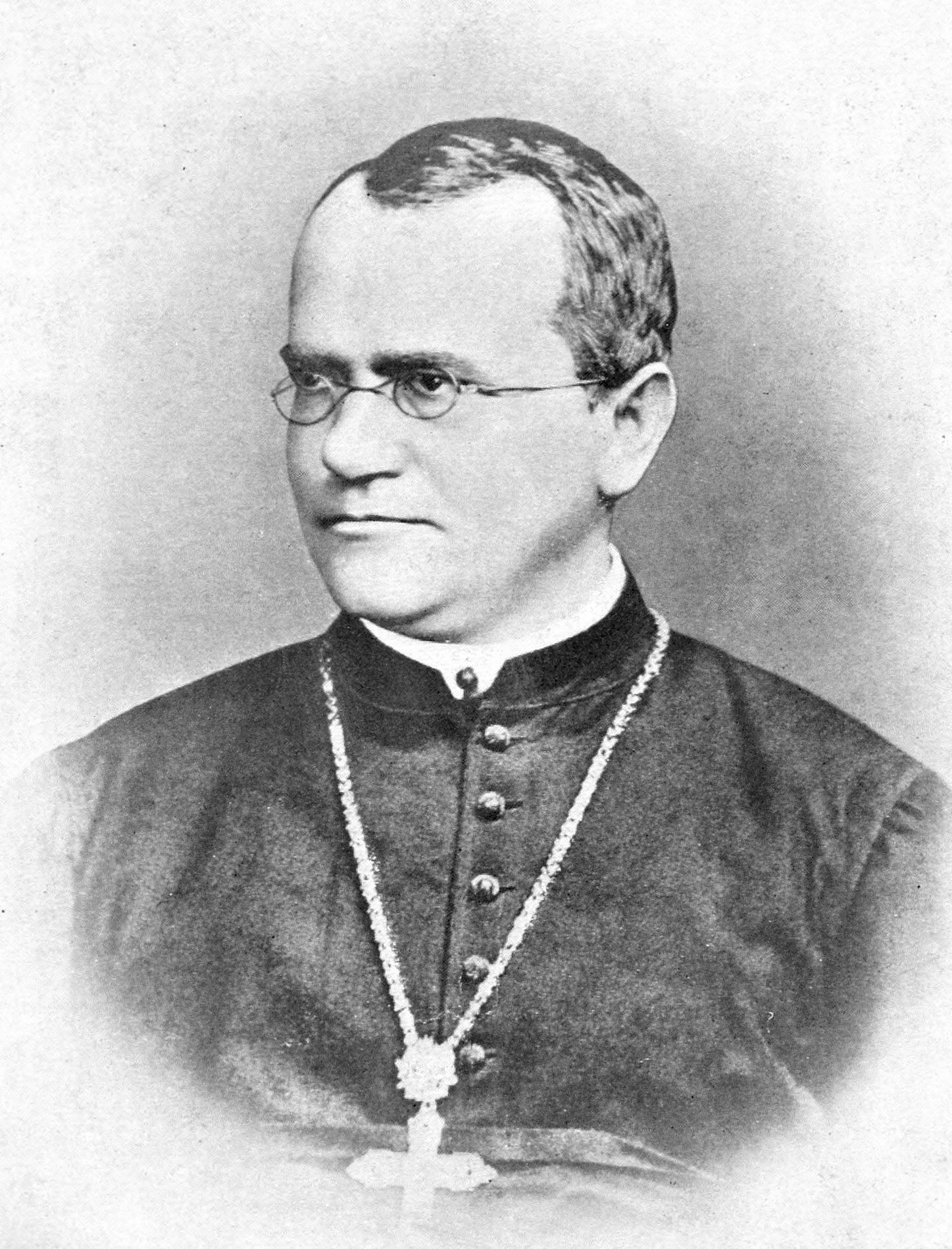
Charles Darwin and Gregor Mendel were contemporaries. One of the great “what ifs” in the history of science is “what if Darwin and Mendel had met to discuss each other’s work, or, at least, had exchanged notes?”
The closest they came to meeting was in the summer of 1862, when Mendel visited England to attend the International Exhibition, a world fair held in South Kensington. Charles Darwin was less than twenty miles away, but their paths never crossed as the Darwins were stuck at home, nursing their son Leonard through scarlet fever.
Mendel read a German translation of Darwin’s Origin before publishing his seminal paper in 1865, but he did not see any connection between his work and Darwin’s. It has been claimed that Mendel’s paper sat on a shelf at Down House, unread, but this is just a myth. Although Darwin possessed two books that briefly referred to Mendel’s work, there is no evidence that he read the relevant sections; in one of the books, the pages are clearly uncut. Darwin leant one of these two books to his friend George Romanes, who used it to write an encyclopedia entry, priming another myth: that Darwin wrote about Mendel in the Encyclopaedia Britannica.
How close was Darwin to discovering Mendel’s laws of inheritance? As early as 1838, Darwin scribbled in his notes a question that, in retrospect, seems pregnant with potential: “Do races of peas become intermixed & gardener have hybrid seedlings?” In a letter written to Wallace in February 1866, Darwin recognizes that inheritance can be non-blending:
“My dear Wallace… I do not think you understand what I mean by the non-blending of certain varieties… I crossed the Painted Lady and Purple sweetpeas, which are very differently coloured varieties, and got, even out of the same pod, both varieties perfect but not intermediate.”
Furthermore, as Chinese plant scientist Yongsheng Liu has pointed out, Darwin describes experiments that are uncannily similar to Mendel’s, in his 1868 work Variation Under Domestication:
“Now I crossed the peloric snapdragon… with pollen of the common form; and the later, reciprocally, with peloric pollen. I thus raised two great beds of seedlings, and not one was peloric. The crossed plants, which perfectly resembled the common snapdragon, were allowed to sow themselves, and out of a hundred and twenty-seven seedlings, eighty-eight proved to be common snapdragons, two were in an intermediate condition between the peloric and normal state, and thirty-seven were perfectly peloric, having reverted to the structure of their one grandparent…”
The ratio, at 2.4 to 1, is close enough statistically to conform to an expectation of 3 to 1, so this might count as a glimpse by Darwin of Mendel’s first law.
But given that Mendel himself did not recognize the universality of his own work, it is unfair to expect Darwin or anyone else to do so, particularly in the face of less easily interpreted results from crosses in other species of plants and animals. Instead, the modern synthesis of Darwin's and Mendel's work had to wait until the mid-Twentieth Century.
Bibliography
The extent of Charles Darwin’s knowledge of Mendel by Andrew Sclater
The Monk in the Garden: The Lost and Found Genius of Gregor Mendel, the Father of Genetics by Robin Marantz Henig
Wednesday, October 12, 2011
The Rough Guide to Darwin
As part of my attempt to put all my talks, whether for teaching or research online, I have put these two talks I gave yesterday in Oxford on to YouTube.
The Rough Guide to Darwin
http://www.youtube.com/watch?v=4yHHoCivCT0
Talk given to doctoral students in Oxford 11th Oct 2011
Covers Darwin's early life, including wayward youth, before discussing his major work, impact and legacy
Warning: Explicit discussion of Darwin and sexuality. "Let's get Downe and dirty with Darwin!"
Ignore grey screen YouTube snafu at very beginning. Soon sorts itself out.
From Darwin to Drug Resistance
http://www.youtube.com/watch?v=4iVQK9sYr2M
Talk given to doctoral students in Oxford 11th Oct 2011
Brief review of Darwin's legacy and evolutionary thinking in bacteriology.
Ignore grey screen YouTube snafu at very beginning. Soon sorts itself out.
Friday, October 7, 2011
Wallace: Darwin’s Rival or Ambassador?
 Alfred Russel Wallace (1823-1913) was born in Llanbadoc, near the Welsh town of Usk and grew up in Hertfordshire. He worked as an apprentice surveyor for the six years. During a brief spell as schoolmaster in Leicester, Wallace met entomologist Henry Bates and developed an interest in natural history. He worked for several more years as a surveyor/engineer. Then, inspired by Humboldt and Darwin, Wallace set off with Bates on an expedition to Brazil. In 1852, after four years collecting specimens and surveying the Rio Negro, Wallace set off back to England. At sea, a fire forced Wallace to abandon his specimen collection and, adrift, he spent ten days in a lifeboat, awaiting rescue.
Back safe in England, an insurance payment supported him while he wrote papers and forged links with naturalists, including Darwin. In 1854, Wallace embarked on an expedition to the Malay Archipelago (present-day Malaysia and Indonesia). During this six-year excursion, Wallace collected over a 100,00 specimens, discovered the discontinuity between the kinds of plants and animals found in the northern part of the archipelago and those found in the south (now called the Wallace line), and, crucially, hit upon the idea of evolution by natural selection independently of Darwin. Wallace’s experiences were written up as a lively travelogue, The Malay Archipelago.
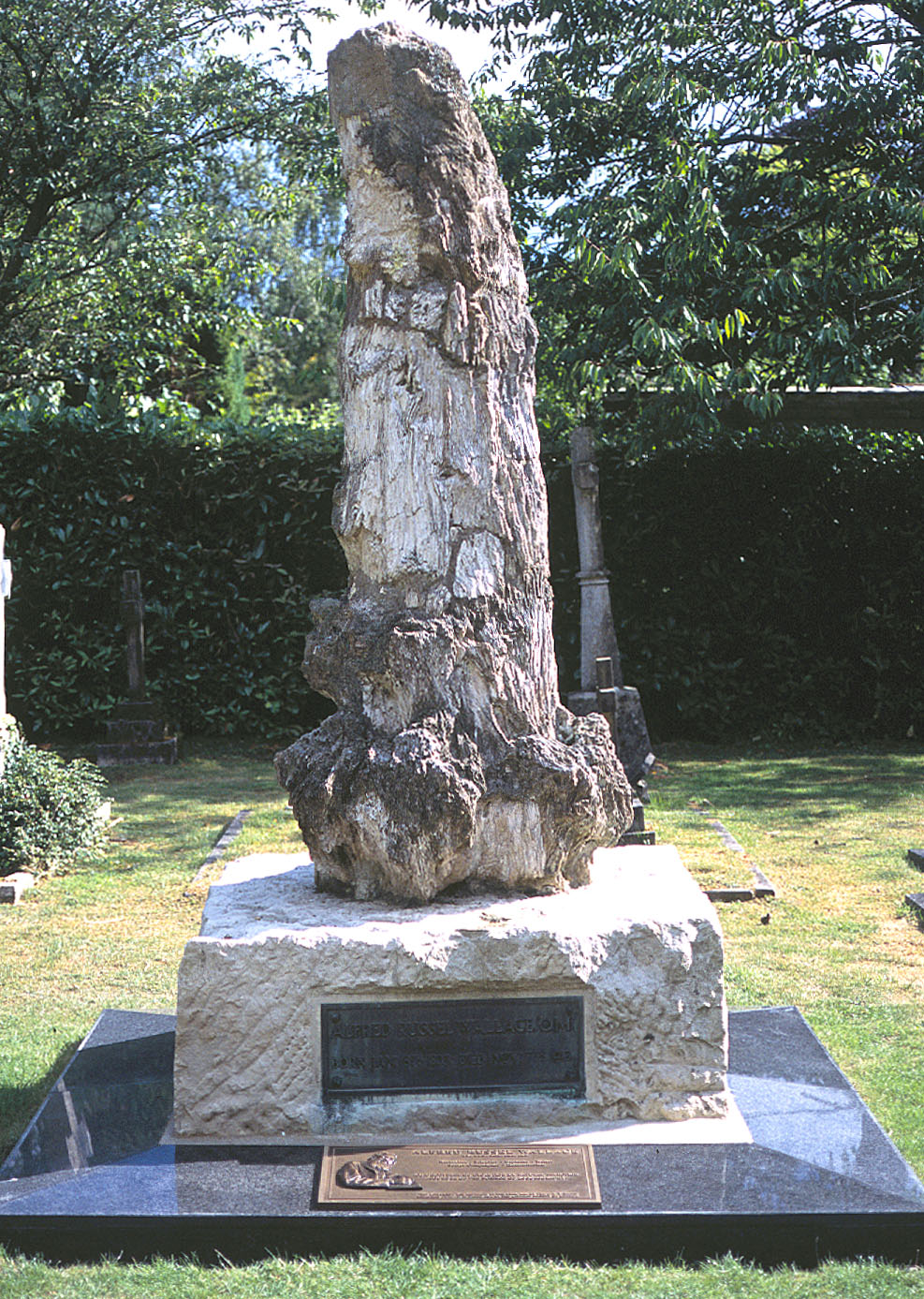 During his middle years Wallace was beset with financial problems, which we largely alleviated in 1881 by a government pension that Darwin helped him obtain. In late life, Wallace extended his work on biogeography, became an early environmentalist and toured the US promoting evolution and natural selection. In old age, he settled in Broadstone, a suburb of Poole in Dorset. He is buried in Broadstone cemetery in a grave capped with a (rather phallic!?) fossil tree trunk and block of limestone.
Although often cast as Darwin’s rival, Wallace remained a loyal and lifelong supporter of Darwin, accepted Darwin’s claim to priority, dedicated The Malay Archipelago to Darwin and even entitled his major book on evolution Darwinism. Wallace was an altogether more colourful character than Darwin, but also rather more flakey. Wallace adopted spiritualism and unlike Darwin, expounded a progressive, teleological view of evolution, with the universe working towards the birth of the human spirit. He rejected natural selection as an explanation of the human mind, instead favouring interventions from the “unseen world of spirit”. He became a socialist and an opponent of smallpox vaccination. He got tangled up in disputes as to whether the earth was flat (in the Bedford Level experiment, he showed it wasn’t) or whether there were canals on Mars (he argued there weren’t). It is clear that, had Darwin died in South America, “Wallaceism” would have turned out quite different from Darwinism!
Further Online Reading
The Alfred Russel Wallace web page: http://www.wku.edu/~smithch/index1.htm
Image Rights
Wallace Grave George W. Beccaloni: Creative Commons Attribution 3.0 Unported

Saturday, October 1, 2011
Open Education and Bio380 lecture on Neanderthals
This academic year I have set myself the goal of making all my lecture available for all, in the public domain, via YouTube and maybe also Slideshare. The technical side of doing this is fairly straightforward (capture a screen movie via QuickTime), but the major hassle is ensuring and documenting permissions for all images. In my first attempt, I quickly realised that putting this information on the same slides as the images led to cluttered chaos, so I have piled them all up at the end of the talk.
It is unclear to me what the rules are about using material from published papers, but cannot see how authors would not want students to know about their work. So, in general, I am proceeding along the course of it is easier to apologise afterwards rather than ask permission in advance. If anyone objects to anything I have done, let me know and I will remove the offending material from the public domain. Also, if anyone has tips on how to do all this as efficiently and fairly as possible, please let us know via the comments. Ditto if you want to send words of encouragement!
It will be interesting to see if anyone other than my own students look at this stuff, but here we go, the game's afoot! Information wants to be free!
It will be interesting to see if anyone other than my own students look at this stuff, but here we go, the game's afoot! Information wants to be free!
Here is my first lecture for this year from the Bio380 course: Waking the Dead, on Neanderthals and their influence on the modern human gene pool. Enjoy!
Slidecast via YouTubeSlides via SlideshareBio380 Human Evolution: Waking the deadView more presentations from Mark Pallen
Great Read at Birmingham: Captain Kirkup and Chris Stringer
AV material associated with this week's Great Read at Birmingham events.
Captain Kirkup on Evolution and Game Theory
Video of the talk and subsequent Q&A : http://www.youtube.com/watch?v=15gxMlQQ6AA
Slides to go with this: http://www.youtube.com/watch?v=RTk9_DlOpcQ
(Open these in a separate window as they will need to be manually paused and progressed forward: sorry no synchronised slidecast available)
Chris Stringer on The Origin of Our Species
Podcast of the talk via YouTube (publicly available): http://www.youtube.com/watch?v=QryLIaRORlU
Sunday, September 25, 2011
Live tweets from Great Read at Birmingham opening event
Here are the live tweets from Great Read at Birmingham opening event, sorted from earliest to latest
65. mjpallen: #grab2011 ken miller up on stage; textbook author, daughter had to read his book at school; she gave up biology for history :-)
64. mjpallen: #grab2011 Ken testified in George and Pennsylvania; pervasive problem in US education and local politics; evolution in Ohio local politics
63. mjpallen: #grab2011 “vote for proevolution candidate you vote for sin“ 2 of republican presidential candidates creationist; creationist museums
62. mjpallen: #grab2011 antievolution bills pop up all over; problem coming to UK and Germany; Uk scientists published letter defending evolution
61. mjpallen: #grab2011 creationist conference in Malvern, UK; now describing Dover trial why lawsuit? 1st amendment http://t.co/VffLhax0
60. mjpallen: #grab2011 Ken lead witness in Dover trial Goals: show ID not science; show it is religion.
59. mjpallen: #grab2011 Conservative judge, so ID people thought easy time coming
58. mjpallen: #grab2011 > 9 hours cross examination: like PhD viva over and over again. Trial showed collapse of ID as credible theory; icons of ID trashed
57. mjpallen: #grab2011 ID claim: evo cannot make irreducibly complex systems; Michael Behe; missing part makes it nonfunctional; mousetrap example
56. mjpallen: #grab2011 flagellar components alone have no function say ID ppl. Only designer can make it. But even Darwin knew of change of function
55. mjpallen: #grab2011 testable to see if flagellar components can do anything if not all together; take away all but 10 parts of flagellum; still works
54. mjpallen: #grab2011 works as type III secretion system; counters irreducible complexity claim. ID is wrong! Cites Pallen and Matzke paper. testability
53. mjpallen: #grab2011 ID textbook Pandas and People; textbook evolved from creationist book with "creation" changed to ID; Barbara Forest testimony
52. mjpallen: #grab2011 1987 book changed because creationism deemed in law religious; Dover trail covered by BBC in War on Science; showing clip fr Nova
51. mjpallen: #grab2011 "judgment day" overblown rhetoric in nova show; received award; back to Dover case; Dec 20 2005; verdict ID not science!
50. mjpallen: #grab2011 struggle continues; "only a theory" book written to contain antirationalism antiscience; US lagging in science & math; Nature edop
49. pathogenomenick: Ken miller shows this great antievolution poster #GRAB2011 http://t.co/ur6sP88h http://t.co/ur6sP88h
48. mjpallen: #grab2011 whoisyourcreator.com nonsense on web; abundance of human fossils; Darwin's tree from Origin dead ringer for human evo tree!
47. mjpallen: #grab2011 new findings all the time; e.g. A. sediba; Matzke study on hominin brain size; sustained increase in brain size; no gap in record
46. mjpallen: #grab2011 chimp genome confirms predictions from elsewhere; chromosomes 46 in man; 48 in great apes; chr 2 is fusion of two chimp chromosome
45. mjpallen: #grab2011 fused chromsome has telomere in middle; 2 centromeres; one inactive; DNA seqs are facts; no ID explanation for this
44. mjpallen: #grab2011 evolution doesn't imply Dawkinsism acc to Miller. Dan Dennett says God/evo not compatible; Miller says yes; Dobzhansky was X-ian
43. mjpallen: #grab2011 nothing in biology makes sense in light of evolution; Dobzh also supported compatabilitism; evo is process of creation he said
42. mjpallen: #grab2011 pope says evolution God do mix! St Augustine wrote universe evolved; Miller says scientists question 5th C mystic; but Mendel monk
41. mjpallen: #grab2011 Mendel did expts even tho religious Augustinian; Darwin not religious; agnostic not atheist; said that theism and evo compatible
40. mjpallen: #grab2011 http://t.co/ANooECt7 Now cites Darwin first notebook tree; then closing words of Origin See also http://t.co/0gdYwcOP http://t.co/ANooECt7http://t.co/0gdYwcOP
39. mjpallen: #grab2011 John Hawks now on the stage; science changes year by year; ancient genomes teach us about our own gene functions
38. mjpallen: #grab2011 focus on late stages in human evolution <1m years; Neanderthal means "brute" in vernacular;not fair; Darwin met Neanderthal fr Gib
37. mjpallen: #grab2011 Neander valley ripped up by mining; site was carpark; dug up in 2000 or so; found new remains; jigsaw fit to old bones; DNA found
36. mjpallen: #grab2011 Haekel drew mad trees; Homo stupidus for Neanderthals! now lots of evidence of culture; bone techn; shells w. holes for ornament;
35. mjpallen: #grab2011 cut feathers from birds; Neander hyoid bone suggests they talked; reconstruction of voice like Dame Edna/Steve Perry/Journey :-)
34. pathogenomenick: Lol at John hawks' impression of neandertals communicating: a rendition of don't stop believing by journey #GRAB2011
33. GreatReadatBham: @johnhawks just sang to us as Journey in describing the voice of Neanderthals #GRAB2011
32. mjpallen: #grab2011 Neander trading across long distances; cultural and complex. Vindija cave perfect site; shin bone yielded lots of DNA; 1.4x genome
31. GreatReadatBham: follow @mjpallen live feed #GRAB2011
30. mjpallen: #grab2011 more evidence from DNA than from all fossil record; some redheads MCR1 mutations unique to Neanders, not same as AMHs. not all red
29. mjpallen: #grab2011 Siberia at edge of range; low DNA variability among Neanderthals; genealogy possible; 100s of specimens; healed fractures seen
28. mjpallen: #grab2011 bony injuries in Neanders same as rodeo riders; amputation of arm; blind, lame; hunting large mammals; even rhinos; tough life
27. mjpallen: #grab2011 ambush hunters like cougars; chronic disabilities; osteoA; starch grains fr tooth calculus; lots of new science here, cannibalism?
26. mjpallen: #grab2011; men in one site all related; women not. enamel hypoplasia; starvation; dead kids; synchrotron scanning of life history
25. mjpallen: #grab2011 neanderthals live fast die young; Denisova cave in Altai mountains; rugged country; horse country; vertical limestone; few caves
24. mjpallen: #grab2011 David Reich calls it magical place; cold place zero deg C; like fridge; chimney over cave; size of lecture theatre with high roof
23. mjpallen: #grab2011 sheep layer on top; beneath that remains of human; bracelets; pinky bone has yielded best ancient DNA ever! But only 6% DNA human
22. mjpallen: #grab2011 79% DNA no hit Neander mitochondrial DNA variation low; Denisovan DNA is outgroup to humans and Neanderthals; tooth yielded same
21. mjpallen: #grab2011 does Neander and Denisovan DNA survive in humans? ABO polymorphisms for >2m years; not useful; need to find consistent patterns
20. mjpallen: #grab2011 Neanderthal genes more often resemble non-Africans; 3% of our genomes; skeletal evidence of mixture too from mandibular foramen
19. mjpallen: #grab2011 paper out any moment shows Denisovan DNA in Melanesians and Aborigines at 5% or less. Long distance away! Mystery.
18. mjpallen: #grab2011 we don't know what Denisovan skeletons looked like; missing popn movements; mixtures now established between AMH and archaics
17. mjpallen: #grab2011 evidence of admixture in East African pygmies, unkn source. Neanderthals and Denisovans form clade; how can this info be useful?
16. mjpallen: #grab2011 we can explain some heritability; mentions Galton @uniBirmingham alumnus; 300 genes now explain 20% of height variation
15. mjpallen: #grab2011 Hawks using Neander and Denisova genomes to discover new genes underling phenotypes in modern humans; showing genetic maps; HAR1
14. mjpallen: #grab2011 human accelerated region; humans very diff from other primates here; Denisova diff from humans and Neanders in HAR1! Moreancestral
13. mjpallen: #grab2011 Hawks now comparing his own genome to Neanderthals! His androgen receptor is Neanderthal and may make him bald!
12. mjpallen: #grab2011 Hawks now closing with ode to power of evolutionary thinking! and phew can take rest from live tweeting. Thanks for listening! Bye
11. GreatReadatBham: #grab2011 evolution organises knowledge, including complex, real-world data about Neanderthals per @johnhawks
10. pathogenomenick: @mjpallen: #grab2011 Hawks now comparing his own genome to Neanderthals!" impressively nerdy python output in slide :)
9. gilbertjacka: RT @pathogenomenick: Ken miller shows this great antievolution poster #GRAB2011 http://t.co/ur6sP88h http://t.co/ur6sP88h
8. GreatReadatBham: #grab2011 thanks to @johnhawjohn and Ken Miller for a great launch to GRAB 2011 on evolution @unibirmingham
7. pathogenomenick: Wonder if freshers know how lucky they are to see ken miller and John hawks in 1 day- not all biology lectures will be like that! #GRAB2011
6. scienceboy86: RT @GreatReadatBham: #grab2011 thanks to @johnhawjohn and Ken Miller for a great launch to GRAB 2011 on evolution @unibirmingham
5. GreatReadatBham: And thanks to all the great @unibirmingham students who came along! #grab2011
4. JoshRosenau: RT @mjpallen: #grab2011 "vote for proevolution candidate you vote for sin!" 2 of republican presidential candidates creationist; creationist museums
3. JoshRosenau: RT @mjpallen: #grab2011 new findings all the time; e.g. A. sediba; Matzke study on hominin brain size; sustained increase in brain size; no gap in record
2. johnhawks: RT @GreatReadatBham: #grab2011 evolution organises knowledge, including complex, real-world data about Neanderthals per @johnhawks
1. GreatReadatBham: #grab2011 next event Cap Benjamin Kirkup US Army on evolution of antibiotic resistance 5pm Tues 27/9 Poyntyng Large
Darwin's Shrewsbury
Brief tour of Darwin sights in Shrewsbury for speakers at Great Read at Birmingham initiative. Sights include Darwin shopping centre, stained glass window of Darwin in McDonalds, Unitarian chapel, Darwin's schools and his birthplace (The Mount).
http://youtu.be/iI1a2qybmlU
http://youtu.be/iI1a2qybmlU
Visiting Down House with Randal Keynes
I have now received two VIP tours of Down House with Randal Keynes (Darwin's great-great-grandson) as tour guide. Randal's mellifluous voice, sharp intellect and wide-ranging knowledge of Darwin's life, science and family make these trips an unforgettable treat!
Last Friday I visited with three eminent American speakers at the Great Read at Birmingham initiative: Ken Miller, John Hawks and Captain Ben Kirkup. John Hawks has already blogged on the experience here: http://johnhawks.net/weblog/hawks/travel/down-house-visit-2011.html
Last February, I visited with Eugenie Scott from the NCSE.
Below are links to YouTube videos of both trips. Watch them and fall under Randal's spell as he guides us through Darwin's home and gardens, his life and family.
Tour of Down House with Randal Keynes for Great Read at Birmingham speakers
Tour of Down House with Randal Keynes and Eugenie Scott
Relevant links
- http://www.birmingham.ac.uk/welcome/grab.aspx
- http://en.wikipedia.org/wiki/Eugenie_Scott
- http://ncse.com/
- http://en.wikipedia.org/wiki/Kenneth_R._Miller
- http://johnhawks.net/
- http://pathogenomics.bham.ac.uk/staff/mpallen.html
- http://en.wikipedia.org/wiki/Randal_Keynes
- http://www.birmingham.ac.uk/index.aspx
- http://www.english-heritage.org.uk/daysout/properties/home-of-charles-darwin-down-house/
Subscribe to:
Posts (Atom)