Deputy Pro-Chancellor, Vice Chancellor, my fellow Graduates, Graduands and guests,
My thanks first to Professor Raine for his citation tracing all my relations and explaining my interests in conservation and science heritage.
Fellow Graduands, I’ve come here today to join you in this wonderful ceremony with a strong sense of the excitement of Birmingham Biosciences in 2012, your success in your courses, and what now lies ahead for you all in all the different fields in which you’ll be putting to use all the knowledge and understanding you’ve gained here through your studies.
For myself, thinking of links with the past as I do so often in my work on science heritage, the Lunar Society of Birmingham comes first to mind. Among its members were Joseph Priestley, Matthew Boulton, Josiah Wedgwood and Erasmus Darwin, scientists, doctors, manufacturers and inventors, each with different interests and skills, and all glad to talk freely together about their many interests. There must now be many echoings of those discussions in the collaborations that take place between the many teams in the School of Biosciences as they work today across its wide range of interests. I guess the School is working so well now just as the Lunar Society did before partly because these open exchanges are good ways to do innovative, productive science.
But why should young scientists like you today bother with science in history? Why do I and others go on about Darwin and the other historical figures?
I can suggest many answers. I’ll give you one of them quickly now because for me it’s one of the strongest, it starts here in Birmingham, and numbers of you may perhaps recognize the point one day in some scientific investigation you carry out or hear about.
So, there’s one meaning of science - its conclusions, the body of latest knowledge. There’s another meaning – the process, how the explanations are developed, tested and agreed.
On the process, Joseph Priestley was living here in the 1770s and in his experiments on electricity and gases he always used equipment that was cheap and easy to obtain, and described his experiments clearly and simply so that anyone could repeat them or vary them as they wanted. He was hoping to find clear and simple explanations that anyone else could test so that they could carry on from there. And he felt that the more experiments could be done by more people, the better the conclusions would be. Also, the best explanations would often be the simplest ones because with simplicity often came greater explanatory power. The value and power of his classic experiments on both electricity and gases were linked with these features of his method.
Now Charles Darwin, in his experimental work on plants and insects at his home in Kent some eighty years later, followed Priestley’s method exactly in all these respects, including simplicity for explanatory power.
When we look at the two men’s achievements together now, we can see a valuable approach that was used with great effect in two outstanding contributions to science. Yes of course, science has come a long way since then, but I’d suggest that key elements of that approach may still have great value in many areas of science today.
Deputy Pro-Chancellor, I’m deeply grateful for the honour you have conferred on me today, and for the special link it gives me now with Birmingham and its heritage of science.
Showing posts with label Charles Darwin. Show all posts
Showing posts with label Charles Darwin. Show all posts
Monday, July 9, 2012
Visit of Randal Keynes part two
Following on from the previous post, Randal has now sent me the speech he gave while receiving his honorary doctorate. Here it is:


Saturday, July 7, 2012
Visit of Randal Keynes to University of Birmingham
On July 4th 2012, it was my pleasure to host a visit by honorary graduand Randal Keynes, with his wife Zelfa and mother Anne, to the University of Birmingham. Their day here included lunch with the Vice-Chancellor and others, a trip to the Special Colletions and Archives, along with Alice Roberts to see a first edition Origin of Species (thanks to Sue Worrall), and a visit to the Lapworth Museum of Geology (thanks to Ivan Sansom).
Randal received an honorary doctorate at the School of Biosciences graduation ceremony and the day concluded with a photo shoot of Darwin-descendent Randal alongside Huxley-descendent Adam Tickell, plus strawberries and champagne in the VC's office.
Here is a video record of selected snippets from the day:
Unfortunately I was not allowed to film the graduation ceremony, nor does the University seem to realise that "information wants to be free", so the only way to get footage of the ceremony is to fork out for a DVD!
At the graduation ceremony, Randal gave a speech in which he highlighted the links between the Lunar Society of Birmingham, his ancestors (Erasmus and Charles Darwin), Joseph Priestley and the birth of the scientific method. Randal was introduced with a speech from University orator Professor John Raine, which John wrote with help from Randal and myself. A hypertext-linked version of the speech follows.
Randal received an honorary doctorate at the School of Biosciences graduation ceremony and the day concluded with a photo shoot of Darwin-descendent Randal alongside Huxley-descendent Adam Tickell, plus strawberries and champagne in the VC's office.
Here is a video record of selected snippets from the day:
Unfortunately I was not allowed to film the graduation ceremony, nor does the University seem to realise that "information wants to be free", so the only way to get footage of the ceremony is to fork out for a DVD!
At the graduation ceremony, Randal gave a speech in which he highlighted the links between the Lunar Society of Birmingham, his ancestors (Erasmus and Charles Darwin), Joseph Priestley and the birth of the scientific method. Randal was introduced with a speech from University orator Professor John Raine, which John wrote with help from Randal and myself. A hypertext-linked version of the speech follows.
Chancellor, Vice Chancellor, Graduates, Graduands and Guests,
The concept of conservation is one that associates equally with the natural environment of plants and animals and with the human-created world of architecture and buildings. Most conservationists usually work in one arena or the other, but today before us stands an individual whose contribution spans both and who can therefore properly be described as a conservationist in the most comprehensive and generic of senses.
Randal is from a renowned lineage of English families – notably the Keyneses, the Adrians, the Darwins and the Wedgwoods. Born on July 29th 1948, he is a great nephew of the eminent economist, John Maynard Keynes; and he is also the great-great-grandson of naturalist Charles Darwin. In 1839 Charles Darwin had married Emma Wedgwood, descendant of Josiah Wedgwood the 18th century founder of industrialised pottery manufacture, and who, along with his friend Erasmus Darwin and other prominent Midlands figures, were founding members of the Lunar Society of Birmingham which played such an important role in science for the Industrial Revolution.
Randal’s father was the eminent Cambridge physiologist Professor Richard Darwin Keynes and his father, Sir Geoffrey Langdon Keynes, was a distinguished surgeon and scholar whose work in developing blood transfusion saved thousands of lives in the First World War. On the other side of his family, Randal’s mother, Mrs Anne Pinsent Keynes, whom we are delighted to welcome here in the Great Hall with us today, is also of very distinguished lineage. Her mother, Hester, was Lady Adrian, a renowned penal reformer, and her father, Lord Adrian, was a Nobel Prize-winner in 1932 for his discoveries about the workings of the nerve cell.
And Anne’s grandmother was Birmingham’s own Dame Ellen Pinsent – who is 1911 was the first woman to be elected to the City of Birmingham Council, and a pioneer in the education of children with special needs. She, for one, would have been delighted that last year Ofsted found the special school named after her in South Birmingham – The Dame Ellen Pinsent School – to be ‘outstanding’. Dame Ellen was awarded an honorary MA by this University in 1919, while her husband – Anne’s grandfather - Hume Chancellor Pinsent – a solicitor in this city, was Treasurer of this University until his retirement in 1913.
It is also a great pleasure today to welcome Randal’s wife Zelfa Hourani. Unfortunately their two offspring – Soumaya and Skandar – are otherwise engaged today. Soumaya works as an economist and Skandar is at university (and is widely known, having played the character of Edmund Pevensie in the three Nania films – The Lion, the Witch and the Wardrobe, Prince Caspian; and Voyage of the Dawn Treader.
But back to Randal. As a boy, he spent many of his summer holidays with his Darwin-side grandmother at her home in the Suffolk countryside, and it was there that he gained some of his earliest insights on his family ancestry as she talked of the holidays she had spent as a child with her grandmother at the Darwins’ home of Down House, just south of London. But it was some years later before Randal’s imagination was stirred to discover more about his Darwinian heritage. Indeed, for most of his adolescent years, Randal had found the pressures of his ancestry somewhat oppressive. When it came to university, for example, he broke away from the family tradition of reading science at Cambridge to study philology and anthropology at Oxford.
On graduating he decided upon a DPhil, to explore the anthropological connections between some ideas in Anglo-Saxon and Ancient Icelandic writings. But when an attractive job came up in the Ministry of Defence he decided instead to join the civil service where he went on to pursue the significant part of his career. As well as working at the MoD in London, he had secondments to Northern Ireland during ‘The Troubles’ and so, last week he will no doubt have particularly appreciated the reconciliation of former foes epitomised in that historic handshake.
He also served for a spell with the Parliamentary Ombudsman and in 1992 he was awarded an OBE for his work at the MoD during the Gulf War. It was while a civil servant that he began to devote more and more of his spare time to aspects of conservation. He became active in the Victorian Society, campaigning for the protection and restoration of our outstanding Victorian and Edwardian architectural heritage. And his campaigning took on a personal dimension in the 1980s, when the neighbourhood in which he lived, just east of Kings Cross station, became the subject of clearance proposals to make way for the new channel tunnel rail link into central London. Randal was at the forefront of a well-organised campaign – and which also involved debate in Parliament – that led to the line being re-routed into the adjacent St Pancras station, now the marvellous ‘St Pancras International’ with its fabulously restored Gilbert Scott-designed hotel on the front. Meanwhile, Randal’s previously condemned neighbourhood was sympathetically regenerated – and the full story of its rescue and conservation can be read in a soon-to-be-published book, King’s Cross: A Sense of Place, which includes a chapter by Randal.
Since then, his attentions have turned to another piece of architectural heritage – again one in which Randal could claim a personal interest – Charles’ Darwin’s Down House in North Kent – where the great naturalist had spent the last forty years of his life, undertaken many of his studies of natural life and written his ‘Origin of Species’. Here, the conservation challenge has been to withstand the pressures for property development over the very landscape where Charles Darwin had conducted so many of his investigations of animals, insects and birds and where he had built his evidence base for his Theory of Evolution. To this end, Randal has provided the case which the Government has now put to UNESCO to make Down House and its surroundings a World Heritage Site for the history of science. More than this, Randal has played a leading role in gathering together and researching all the surviving material about Darwin’s life and work at Down House.
His own family home had itself been something of a treasure-house of Darwinian material and, in his adult years, he took on the task of sifting systematically through his father’s inherited pieces. In doing so, in a chest of drawers, he happened upon a writing case that had belonged to Charles Darwin’s daughter, Annie, containing her pale yellow ribbon stitched with small glass beads, her goose-feather quills with which she wrote, her sealing wax, a thick lock of her fine brown hair, a fold of paper on which was written ‘April 23rd 1851’ - the date of Annie’s death at the age of just ten - and a leaf from a pocket book with a map of the churchyard in Malvern where she is buried. The story of that personal tragedy and the experience that influenced Darwin’s revolutionary understanding of humankind’s place in nature, has been painstakingly researched by Randal and crafted into his biography ‘Annie’s Box’, first published in 2001, and described by one literary critic as ‘ the best non-fiction book I have read all year’.
And of course Randal’s research on Darwin and his commitment to conservation has had to encompass the Galapagos Islands – which unlike Down House, already enjoys the status of being a World Heritage Site. Even so, the archipelago is still facing extreme dangers as a result of rapid growth in eco-tourism and immigration from the Ecuadorean mainland. Randal is a member of the Board of Directors of The Charles Darwin Foundation for the Galapagos Islands – an international scientific organization that leads the science for the conservation of their uniquely valuable wildlife. He travels there frequently and is focusing particularly on communicating the Island’s story and its inestimable importance to the world.
He is also a Board member of the Charles Darwin Trust which promotes the use of Darwin’s inspiration in science education. He works hard helping young people around the world to grasp the legacy of Darwin through his life in science and, in the Darwin bicentenary year, he took part in the national Evolving Words initiative, which here in Birmingham culminated in poetry recitals by children from inner city neighbourhoods. He has also provided invaluable support to the Rap Guide to Evolution, a Wellcome Trust-sponsored celebration of Darwin’s life and legacy through the unlikely medium of Hip Hop!
Chancellor, there are, as indicated, significant connections between Randal’s family and this great University and City of Birmingham. Indeed, his ancestors in the Lunar Society were part of a select group of individuals that could perhaps be said to have provided the genesis for the modern world here in the heart of England. Charles Darwin’s statue is, of course, to be found in the line of distinguished individuals that form the frieze over the entrance to this Aston Webb building, and our special archive collections here include a first-edition copy of his ‘Origin of Species’. But irrespective of such historical connections, the contribution of Randal Keynes to conservation, to education and to outreach, locally, nationally and internationally, itself deserves to be recognized and marked by this University – an institution that shares with him a commitment to diligent research and to respecting, protecting and making best use of important heritage.
So to you, and to the University, I present Randal Hume Keynes, deemed worthy to be awarded the degree of Doctor of the University, Honoris Causa.
Sunday, November 6, 2011
Darwin and Mendel: The Great What If?
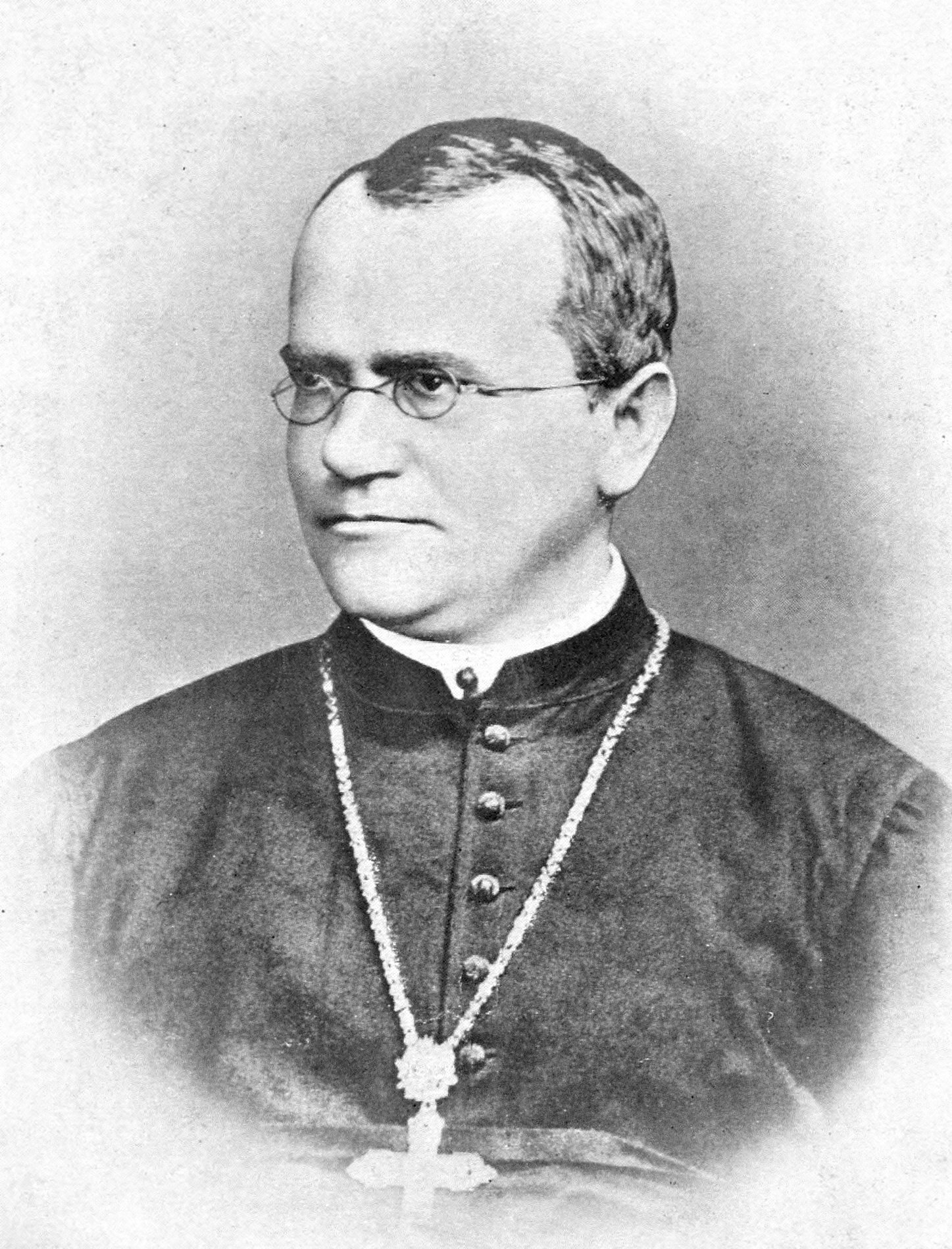
Charles Darwin and Gregor Mendel were contemporaries. One of the great “what ifs” in the history of science is “what if Darwin and Mendel had met to discuss each other’s work, or, at least, had exchanged notes?”
The closest they came to meeting was in the summer of 1862, when Mendel visited England to attend the International Exhibition, a world fair held in South Kensington. Charles Darwin was less than twenty miles away, but their paths never crossed as the Darwins were stuck at home, nursing their son Leonard through scarlet fever.
Mendel read a German translation of Darwin’s Origin before publishing his seminal paper in 1865, but he did not see any connection between his work and Darwin’s. It has been claimed that Mendel’s paper sat on a shelf at Down House, unread, but this is just a myth. Although Darwin possessed two books that briefly referred to Mendel’s work, there is no evidence that he read the relevant sections; in one of the books, the pages are clearly uncut. Darwin leant one of these two books to his friend George Romanes, who used it to write an encyclopedia entry, priming another myth: that Darwin wrote about Mendel in the Encyclopaedia Britannica.
How close was Darwin to discovering Mendel’s laws of inheritance? As early as 1838, Darwin scribbled in his notes a question that, in retrospect, seems pregnant with potential: “Do races of peas become intermixed & gardener have hybrid seedlings?” In a letter written to Wallace in February 1866, Darwin recognizes that inheritance can be non-blending:
“My dear Wallace… I do not think you understand what I mean by the non-blending of certain varieties… I crossed the Painted Lady and Purple sweetpeas, which are very differently coloured varieties, and got, even out of the same pod, both varieties perfect but not intermediate.”
Furthermore, as Chinese plant scientist Yongsheng Liu has pointed out, Darwin describes experiments that are uncannily similar to Mendel’s, in his 1868 work Variation Under Domestication:
“Now I crossed the peloric snapdragon… with pollen of the common form; and the later, reciprocally, with peloric pollen. I thus raised two great beds of seedlings, and not one was peloric. The crossed plants, which perfectly resembled the common snapdragon, were allowed to sow themselves, and out of a hundred and twenty-seven seedlings, eighty-eight proved to be common snapdragons, two were in an intermediate condition between the peloric and normal state, and thirty-seven were perfectly peloric, having reverted to the structure of their one grandparent…”
The ratio, at 2.4 to 1, is close enough statistically to conform to an expectation of 3 to 1, so this might count as a glimpse by Darwin of Mendel’s first law.
But given that Mendel himself did not recognize the universality of his own work, it is unfair to expect Darwin or anyone else to do so, particularly in the face of less easily interpreted results from crosses in other species of plants and animals. Instead, the modern synthesis of Darwin's and Mendel's work had to wait until the mid-Twentieth Century.
Bibliography
The extent of Charles Darwin’s knowledge of Mendel by Andrew Sclater
The Monk in the Garden: The Lost and Found Genius of Gregor Mendel, the Father of Genetics by Robin Marantz Henig
Friday, October 7, 2011
Wallace: Darwin’s Rival or Ambassador?
 Alfred Russel Wallace (1823-1913) was born in Llanbadoc, near the Welsh town of Usk and grew up in Hertfordshire. He worked as an apprentice surveyor for the six years. During a brief spell as schoolmaster in Leicester, Wallace met entomologist Henry Bates and developed an interest in natural history. He worked for several more years as a surveyor/engineer. Then, inspired by Humboldt and Darwin, Wallace set off with Bates on an expedition to Brazil. In 1852, after four years collecting specimens and surveying the Rio Negro, Wallace set off back to England. At sea, a fire forced Wallace to abandon his specimen collection and, adrift, he spent ten days in a lifeboat, awaiting rescue.
Back safe in England, an insurance payment supported him while he wrote papers and forged links with naturalists, including Darwin. In 1854, Wallace embarked on an expedition to the Malay Archipelago (present-day Malaysia and Indonesia). During this six-year excursion, Wallace collected over a 100,00 specimens, discovered the discontinuity between the kinds of plants and animals found in the northern part of the archipelago and those found in the south (now called the Wallace line), and, crucially, hit upon the idea of evolution by natural selection independently of Darwin. Wallace’s experiences were written up as a lively travelogue, The Malay Archipelago.
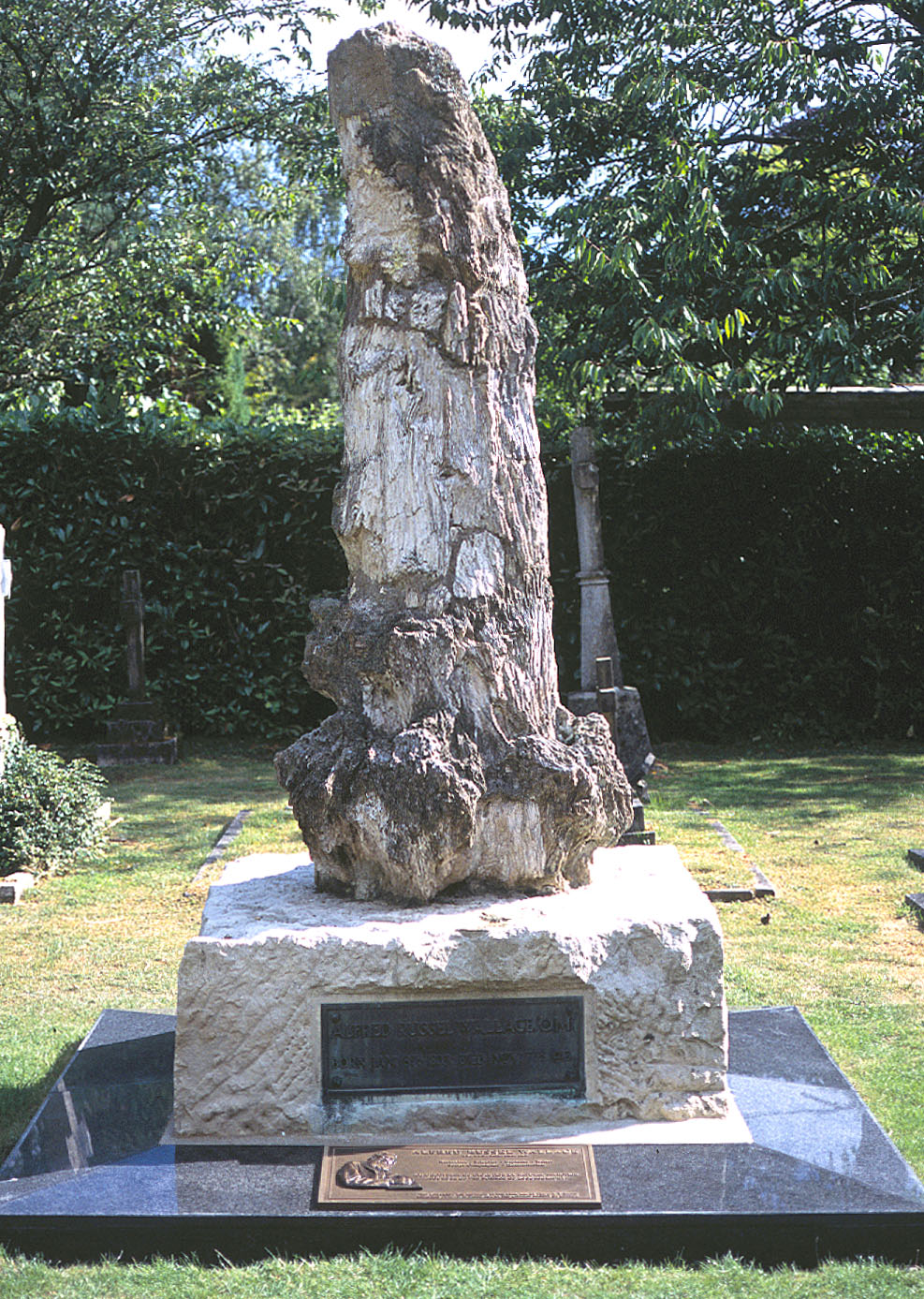 During his middle years Wallace was beset with financial problems, which we largely alleviated in 1881 by a government pension that Darwin helped him obtain. In late life, Wallace extended his work on biogeography, became an early environmentalist and toured the US promoting evolution and natural selection. In old age, he settled in Broadstone, a suburb of Poole in Dorset. He is buried in Broadstone cemetery in a grave capped with a (rather phallic!?) fossil tree trunk and block of limestone.
Although often cast as Darwin’s rival, Wallace remained a loyal and lifelong supporter of Darwin, accepted Darwin’s claim to priority, dedicated The Malay Archipelago to Darwin and even entitled his major book on evolution Darwinism. Wallace was an altogether more colourful character than Darwin, but also rather more flakey. Wallace adopted spiritualism and unlike Darwin, expounded a progressive, teleological view of evolution, with the universe working towards the birth of the human spirit. He rejected natural selection as an explanation of the human mind, instead favouring interventions from the “unseen world of spirit”. He became a socialist and an opponent of smallpox vaccination. He got tangled up in disputes as to whether the earth was flat (in the Bedford Level experiment, he showed it wasn’t) or whether there were canals on Mars (he argued there weren’t). It is clear that, had Darwin died in South America, “Wallaceism” would have turned out quite different from Darwinism!
Further Online Reading
The Alfred Russel Wallace web page: http://www.wku.edu/~smithch/index1.htm
Image Rights
Wallace Grave George W. Beccaloni: Creative Commons Attribution 3.0 Unported

Sunday, September 25, 2011
Darwin's Shrewsbury
Brief tour of Darwin sights in Shrewsbury for speakers at Great Read at Birmingham initiative. Sights include Darwin shopping centre, stained glass window of Darwin in McDonalds, Unitarian chapel, Darwin's schools and his birthplace (The Mount).
http://youtu.be/iI1a2qybmlU
http://youtu.be/iI1a2qybmlU
Visiting Down House with Randal Keynes
I have now received two VIP tours of Down House with Randal Keynes (Darwin's great-great-grandson) as tour guide. Randal's mellifluous voice, sharp intellect and wide-ranging knowledge of Darwin's life, science and family make these trips an unforgettable treat!
Last Friday I visited with three eminent American speakers at the Great Read at Birmingham initiative: Ken Miller, John Hawks and Captain Ben Kirkup. John Hawks has already blogged on the experience here: http://johnhawks.net/weblog/hawks/travel/down-house-visit-2011.html
Last February, I visited with Eugenie Scott from the NCSE.
Below are links to YouTube videos of both trips. Watch them and fall under Randal's spell as he guides us through Darwin's home and gardens, his life and family.
Tour of Down House with Randal Keynes for Great Read at Birmingham speakers
Tour of Down House with Randal Keynes and Eugenie Scott
Relevant links
- http://www.birmingham.ac.uk/welcome/grab.aspx
- http://en.wikipedia.org/wiki/Eugenie_Scott
- http://ncse.com/
- http://en.wikipedia.org/wiki/Kenneth_R._Miller
- http://johnhawks.net/
- http://pathogenomics.bham.ac.uk/staff/mpallen.html
- http://en.wikipedia.org/wiki/Randal_Keynes
- http://www.birmingham.ac.uk/index.aspx
- http://www.english-heritage.org.uk/daysout/properties/home-of-charles-darwin-down-house/
Thursday, August 11, 2011
Darwin: serial plagiarizer or revolutionary genius?
Stephen Jay Gould once joked that “precursoritis" (or should it be "precursorism") is the bane of historiography. Nonetheless, it is clear that there were precursors to Darwin in describing natural selection and other components of his theory of evolution.
Sources and related links
In 1941, Conway Zirkle wrote a remarkable (and long) paper Natural Selection before the "Origin of Species" (available in full via Google books) in which he collated and discussed over two dozen descriptions of natural selection and associated ideas that pre-dated Darwin.
Although most of these earlier authors lacked Darwin’s clear conception of the implications of natural selection for the origin of species, some of their passages are strikingly prescient of Darwin’s ideas. Take, for example, this passage from French freethinker Jean-Jacques Rousseau (1712–78):
Or this passage from the German philosopher Johann Gottfried Herder (1744–1803):
In the Temple of Nature, Charles Darwin’s grandfather, Erasmus Darwin provides a poetic description of the Struggle for Existence, culminating in a graphic rhyming couplet:
While in Zoonomia he obliquely references Sexual Selection and Natural Selection:
Two other early descriptions of natural selection have been unearthed since Zirkle’s paper. One comes from a densely written inaccessible book (Principles of Knowledge: see review here) by one of Darwin’s heroes, the geologist James Hutton, who rejected evolution of species, but described natural selection:
The second comes from an unlikely source—Natural Theology (1809), where William Paley (the irritant that gave rise to Darwin's pearl) proposed natural selection, only later to reject it:
Charles Darwin acknowledged the role of earlier thinkers such as Geoffrey St. Hilaire in very first edition of the Origin. He also clearly drew inspiration from agriculturalist Sir John Sebright, who he cites several times for his work on breeding. However, Darwin fails to mention in publication a passage penned by Sebright in 1809
… children, bringing with them into the world the excellent constitution of their parents, and then confirming it by the same exercises which first produced it, would thus acquire all that strength and vigour, of which the human frame is capable. Nature in this case treats them exactly as Sparta treated the children of her citizens: those of them who came well formed into the world, she renders strong and robust, and destroys all the rest...
Or this passage from the German philosopher Johann Gottfried Herder (1744–1803):
In short, every species extends its possession of the Earth in proportion to its capacity, cunning, strength, or courage… the whole creation is at war, and the most opposite powers are found so close to each other… Each strives with each, as each is pressed upon; each must provide for his own subsistence, and defend his own life. Why acts Nature thus and why does she thus crowd her creatures one upon another? Because she would produce the greatest number and variety of living beings in the least space, so that one crushes another,and an equilibrium of powers can alone produce peace in the creation.
In the Temple of Nature, Charles Darwin’s grandfather, Erasmus Darwin provides a poetic description of the Struggle for Existence, culminating in a graphic rhyming couplet:
In ocean's pearly haunts, the waves beneath
Sits the grim monarch of insatiate Death;
The shark rapacious with descending blow
Darts on the scaly brood, that swims below;
The crawling crocodiles, beneath that move,
Arrest with rising jaw the tribes above; 60
With monstrous gape sepulchral whales devour
Shoals at a gulp, a million in an hour.
—Air, earth, and ocean, to astonish'd day
One scene of blood, one mighty tomb display!
From Hunger's arm the shafts of Death are hurl'd,
And one great Slaughter-house the warring world!
While in Zoonomia he obliquely references Sexual Selection and Natural Selection:
The birds, which do not carry food to their young, and do not therefore marry, are armed with spurs for the purpose of fighting for the exclusive possession of the females, as cocks and quails. It is certain that these weapons are not provided for their defence against other adversaries, because the females of these species are without this armour. The final cause of this contest amongst the males seems to be, that the strongest and most active animal should propagate the species, which should thence become improved.
Two other early descriptions of natural selection have been unearthed since Zirkle’s paper. One comes from a densely written inaccessible book (Principles of Knowledge: see review here) by one of Darwin’s heroes, the geologist James Hutton, who rejected evolution of species, but described natural selection:
If an organised body is not in the situation and circumstances best adapted to its sustenance and propagation, then, in conceiving an indefinite variety among the individuals of that species, we must be assured, that, on the one hand, those which depart most from the best adapted constitution, will be most liable to perish, while, on the other hand, those organised bodies, which most approach to the best constitution for the present circumstances, will be best adapted to continue, in preserving themselves and multiplying the individuals of their race.
The second comes from an unlikely source—Natural Theology (1809), where William Paley (the irritant that gave rise to Darwin's pearl) proposed natural selection, only later to reject it:
There is another answer which has the same effect as the resolving of things into chance; which answer would persuade us to believe, that the eye, the animal to which it belongs, every other animal, every plant, indeed every organized body which we see, are only so many out of the possible varieties and combinations of being, which the lapse of infinite ages has brought into existence; that the present world is the relict of that variety: millions of other bodily forms and other species having perished, being by the defect of their constitution incapable of preservation, or of continuance by generation.
Charles Darwin acknowledged the role of earlier thinkers such as Geoffrey St. Hilaire in very first edition of the Origin. He also clearly drew inspiration from agriculturalist Sir John Sebright, who he cites several times for his work on breeding. However, Darwin fails to mention in publication a passage penned by Sebright in 1809
The greatest number of females will, of course, fall to the share of the most vigorous males; and the strongest individuals of both sexes, by driving away the weakest, will enjoy the best food, and the most favourable situations, for themselves and for their offspring. A severe winter, or a scarcity of food, by destroying the weak and the unhealthy, has had all the good effects of the most skilful selection.even though Darwin alluded to it in his C notebook of1838:
Sir J. Sebright — pamphlet most important showing effects of peculiarities being long in blood.++ thinks difficulty in crossing race — bad effects of incestuous intercourse. — excellent observations of sickly offspring being cut off so that not propagated by nature. — Whole art of making varieties may be inferred from facts stated
Two others were credited only in later editions of the Origin for their prior descriptions of natural selection. William Wells was a Scottish-American physician who described the role of natural selection in the evolution of humans in the appendix to an essay on dew published in 1818, while Patrick Matthew was a Scottish fruit grower who proposed natural selection as mechanism of evolution in his On Naval Timber and Arboriculture (1831) over a quarter-century before Darwin and Wallace.
So, it is clear that Darwin was not the first to propose all the ideas that made up later came to be known as the Darwinian Theory of Evolution. However, any attempt to detract from his revolutionary achievements by arguing that he was simply a serial plagiarist or intellectual scavenger is as senseless as claiming that Shakespeare was a second-rate playwright merely because he reused some old existing plotlines!!
So, it is clear that Darwin was not the first to propose all the ideas that made up later came to be known as the Darwinian Theory of Evolution. However, any attempt to detract from his revolutionary achievements by arguing that he was simply a serial plagiarist or intellectual scavenger is as senseless as claiming that Shakespeare was a second-rate playwright merely because he reused some old existing plotlines!!
It was Darwin’s genius to weave many disparate ideas (such as variation under domestication, Malthusian population pressure and the oddities of biogeography) into a unique combination that is still largely thought to be accurate today, while other combinations of similar concepts, for example, Lamarck's or Spencer's theories of evolution, have been abandoned.
In addition, Darwin was able to articulate these ideas, and the evidence for them, with such unprecedented clarity and forcefulness that within a few short years most naturalists and much of the wider society had come to accept biological evolution as a fact, proven beyond reasonable doubt. Furthermore, there is an abundant documentary evidence trail to show that Darwin generally did not rely on precursors in his thinking, and where he did, he acknowledged it.
Peter Bowler, Professor of History of Science at Queen’s University Belfast makes the point forcefully in his book Evolution, the History of an Idea:
Peter Bowler, Professor of History of Science at Queen’s University Belfast makes the point forcefully in his book Evolution, the History of an Idea:
“Simple priority is not enough to earn a thinker a place in the history of science: one has to develop the idea and convince others of its value to make a real contribution. Darwin's notebooks confirm that he drew no inspiration from Matthew or any of the other alleged precursors.”Darwin’s own son Frank Darwin made a similar point in the first Galton Lecture in 1914 (albeit moaning about Weismann gaining credit when Francis Galton had priority over on the continuity of the germ cell) :
“In science the credit goes to the man who convinces the world, not to the man to whom the idea first occurs. Not the man who finds a grain of new and precious quality, but to him who sows it, reaps it, grinds it and feeds the world on it”The last word on this subject should go to Darwin himself, who in an 1860 letter to Rev. Baden Powell (father of the scoutmaster) states that
"No person, not even the most ignorant, could suppose that I meant to arrogate to myself the origination of the doctrine that species had not been independently created. The only novelty in my work is the attempt to show how species become modified, and to a certain extent how the theory of descent explains certain large classes of facts; and in these respects I received no assistance from my predecessors."
Sources and related links
Thursday, July 28, 2011
Darwin’s captain: Robert FitzRoy

Robert FitzRoy (1805–65) entered the Royal Navy at age thirteen and, after passing exams with full marks, moved quickly up the ranks. In 1828, he became temporary captain of the Beagle, returning the ship to England in October 1830. The following May, FitzRoy stood unsuccessfully as Tory candidate for Ipswich. A few weeks later, the Beagle and her captain were commissioned for a second South American Survey.
Fitzroy knew that he was prone to bouts of morbid depression and was haunted by two recent suicides. The first was that of his uncle Viscount Castlereagh, a brilliant but controversial politician who, as Foreign Secretary, had helped bring peace to Europe in the wake of the Napoleonic Wars (Shelley damns him in his brilliant Masque of Anarchy). In 1822, Castlereagh fell victim to a real or imagined gay sex scandal, claiming to the king that he was being blackmailed. His mind unhinged, three days later he slit his own throat with a letter opener.
The second incident occurred a few years later, during the Beagle’s first survey of the southern hemisphere under the command of Captain Pringle Stokes. In August 1828, during the gloomy southern winter, Stokes locked the door to his cabin, shot himself in the head, and then took an agonizing twelve days to die.
Mindful of these dangerous precedents, FitzRoy took Darwin along as his gentleman companion and changed the course of history. Nonetheless, FitzRoy did succumb to despair part way through the second Beagle journey, resigning his captaincy for a short while before being persuaded to resume command.
But FitzRoy was more than just a bit player in Darwin’s story. In the 1840s, he served as the Tory MP for Durham before serving disastrously as the second Governor of New Zealand – during his term, the colony almost became bankrupt and a new war broke out.
However, FitzRoy is justly celebrated for his pioneering contributions to meteorology: he invented the storm glass (a device for predicting the weather), developed new and improved barometers and invented weather forecasts and gale warnings for fisherman.

FitzRoy retired in 1863 with the rank of Vice-Admiral. But, at the age of sixty, the depression he had so feared aboard the Beagle finally caught up with him – one morning, FitzRoy got out of bed, went to his washroom and, echoing his uncle’s demise, slit his own throat with a razor.
Sunday, July 17, 2011
Last resting place of Charles Darwin rediscovered
OK, so you are wondering what I am going on about with that title, as we all know that Charles Darwin (1809-1882), the famous naturalist and father of evolution is buried in Westminster Abbey!?!
Charles Darwin the elder is also notable because Erasmus Darwin claimed, after his son's death, that Charles had discovered the usefulness of digitalis/foxglove before William Withering, who is usually credited with this discovery (and who used to work here in Birmingham). This led to a longstanding feud between these two members of the Lunar Society of Birmingham.
And now to title of this post.
Click on the two links above to see quite how far apart the two sites are.
But I am talking about the first Charles Darwin, the naturalist's uncle, who lived from 1758 to 1778. This Charles Darwin was the eldest son of Erasmus Darwin and Mary Pole (who incidentally died from an overdose of morphine). Here is what the younger Charles Darwin wrote about his uncle:
"His [Erasmus's] eldest son, Charles (born September 3, 1758), was a young man of extraordinary promise, but died (May 15, 1778) before he was twenty-one years old from the effects of a wound received whilst dissecting the brain of a child. He inherited from his father a strong taste for various branches of science, for writing verses, and for mechanics. "Tools were his playthings," and making machines was one of the first efforts of his ingenuity, and one of the first sources of his amusement." *He also inherited stammering. With the hope of curing him, his father sent him to France when about eight years old (1766-67), with a private tutor, thinking that if he was not allowed to speak English for a time, the habit of stammering might be lost; and it is a curious fact that in after years when speaking French he never stammered. At a very early age he collected specimens of all kinds. When sixteen years old he was sent for a year to Oxford, but he did not like the place, and "thought (in the words of his father) that the vigour of the mind languished in the pursuit of classical elegance, like Hercules at the distaff, and sighed to be removed to the robuster exercise of the medical school of Edinburgh."He stayed three years at Edinburgh, working hard at his medical studies, and attending "with diligence all the sick poor of the parish of Waterleith, and supplying them with the necessary medicines." The Esculapian Society awarded him its first gold medal for an experimental enquiry on pus and mucus. Notices of him appeared in various journals; and all the writers agree about his uncommon energy and abilities. He seems, like his father, to have excited the warm affection of his friends. Professor Andrew Duncan, in whose family vault Charles was buried, cut a lock of hair from the corpse, and took it to a jeweller, whose apprentice, afterwards the famous Sir H. Raeburn, set it in a locket for a memorial.* The venerable professor spoke to me about him with the warmest affection forty-seven years after his death, when I was a young medical student in Edinburgh. The inscription on his tomb, written by his father, says, with more truth than is usual on such occasions: "Possessed of uncommon abilities and activity, he had acquired knowledge in every department of medical and philosophical science, much beyond his years." 'Harveian Discourse,' by Professor A. Duncan, 1824.Dr. [Erasmus] Darwin was able to reach Edinburgh before Charles died, and had at first hopes of his recovery; but these hopes, as he informed my father, "with anguish, soon disappeared. Two days afterwards he wrote to Wedgwood to the same effect, ending his letter with the words, God bless you, my dear friend, may your children succeed better." Two and a half years afterwards he again wrote to Wedgwood, I am rather in a situation to demand than to administer consolation."
A more detailed description of CD the elder's death strongly supports a diagnosis of meningococcal disease:
"About the end of April, Mr. Darwin had employed the greatest part of a day in accurately dissecting the brain of a child which had died of hydrocephalus, and which he had attended during its life. That very evening he was seized with severe head-ach. This, however, did not prevent him from being present in the Medical Society, where he mentioned to Dr. Duncan the dissection he had made, and promised the next day to furnish him with an account of all the circumstances in writing. But the next day, to his headach there supervened other febrile symptoms. And, in a short time, from the hemorrhagies, petechial eruption, and foetid loose stools which occurred,his disease manifested a very putrescent tendency."
And now to title of this post.
In a previous post (The evolutionary tourist in Edinburgh), I claimed that Charles Darwin senior was buried in St. Cuthbert’s Church, located in Lothian Road, at the eastern end of Princes Street. Now I have just received an email from veteran Wikipedian Dave Souza, who writes:
"Today an anon editor helpfully pointed out that we'd both got the wrong kirk, the Duncan family vault was in the graveyard of the Chapel of Ease built for St Cuthbert's Church on the South side of Edinburgh, and later renamed the Buccleuch Parish Church Burying Ground. It's sited at 33 Chapel Street, not far from the Old College of the University of Edinburgh."
So all we need now is for an enthusiastic Darwin fan in Edinburgh to visit the graveyard and capture a photo of CD the elder's tomb and I will post it here!
Sunday, September 27, 2009
First thoughts on "Creation"
Yesterday afternoon, I went to see "Creation", the new film out centred on Charles Darwin's relationships with his wife and his daughter, Annie. I guess I am in a unique position in writing this as I am sitting about two hundred yards from Montreal House in Malvern, where Annie died in 1851 and I live on land that was once part of the estate of the Lodge, the house in which Darwin and his family (including Annie) stayed for a few months in 1849.
But geographical proximity is not the real issue here--I have been far too close psychologically and intellectually to Darwin and his life, and Annie's role in it, for far too long to ever approach the movie as most viewers will. With that in mind, I was preparing to be disappointed, but in fact for the most part I enjoyed the movie, as did my children, because I remembered to tell myself that it was a work of imagination not historical biography.
There are lots of minor historical inaccuracies in the film, but as Eugenie Scott has pointed out, "Creation" will bring many aspects of Darwin's life, particularly his family life, to a wider audience, including the tragic loss of his daughter here in Malvern and the misery of his chronic illness. The acting is great, particularly Martha West as Annie and real husband and wife team Paul Bettany and Jennifer Connelly as Charles and Emma. And the lavish cinematography is a treat.
There were two things in the film I did not like. One was the way in which it flitted from one part of Darwin's life to another, back and forth across the decades. I would have preferred a simpler narrative. But more problematic was the way in which the film inter-linked Darwin's various struggles, intellectual and emotional, when as far as I am aware they were never linked. For example, there is no evidence that the death of Annie Darwin had any effect whatsoever on Darwin's work on the Origin of Species. And it is unclear to me whether differences in attitude to religion between Charles and Emma Darwin, which were clearly raised as an issue around the time of their marriage, persisted as a problem in their relationship as late as the film suggests, i.e. into the late 1850s. I may be wrong and will have to look into this, but the level of emotional intensity on Darwin's part in the film on this issue strikes me as off-kilter.
But all-in-all, a good film which I advise you to go and see! At the very least, it will banish the tired icon of Darwin as merely an old man with a bushy beard!
But geographical proximity is not the real issue here--I have been far too close psychologically and intellectually to Darwin and his life, and Annie's role in it, for far too long to ever approach the movie as most viewers will. With that in mind, I was preparing to be disappointed, but in fact for the most part I enjoyed the movie, as did my children, because I remembered to tell myself that it was a work of imagination not historical biography.
There are lots of minor historical inaccuracies in the film, but as Eugenie Scott has pointed out, "Creation" will bring many aspects of Darwin's life, particularly his family life, to a wider audience, including the tragic loss of his daughter here in Malvern and the misery of his chronic illness. The acting is great, particularly Martha West as Annie and real husband and wife team Paul Bettany and Jennifer Connelly as Charles and Emma. And the lavish cinematography is a treat.
There were two things in the film I did not like. One was the way in which it flitted from one part of Darwin's life to another, back and forth across the decades. I would have preferred a simpler narrative. But more problematic was the way in which the film inter-linked Darwin's various struggles, intellectual and emotional, when as far as I am aware they were never linked. For example, there is no evidence that the death of Annie Darwin had any effect whatsoever on Darwin's work on the Origin of Species. And it is unclear to me whether differences in attitude to religion between Charles and Emma Darwin, which were clearly raised as an issue around the time of their marriage, persisted as a problem in their relationship as late as the film suggests, i.e. into the late 1850s. I may be wrong and will have to look into this, but the level of emotional intensity on Darwin's part in the film on this issue strikes me as off-kilter.
But all-in-all, a good film which I advise you to go and see! At the very least, it will banish the tired icon of Darwin as merely an old man with a bushy beard!
Sunday, September 6, 2009
The Darwin Song Project
I have to confess that there is not much folk music in my iTunes library, but last week my copy of the Darwin Song Project CD arrived. And I am impressed!
The Darwin Song Project is the fruit of a frenetic collaboration between eight of the world's top folk artists, who composed the 17 songs of the album during a week-long retreat in a Shropshire farmhouse and then performed them in the new Theatre Severn in Darwin's home town Shrewsbury in March this year.
Even though it incorporates the Annie hypothesis, my favourite song on the album is the Dylanesque "Kingdom Come", which investigates how differences in religious belief divided Charles from his wife Emma. It opens with what must be a unique first line--an account of the life cycle of ichneumonid wasps, parasitic wasps that lay their eggs in the flesh of living caterpillars and which troubled Darwin!
Another delight is this mock-Country number, "We'll him down". I dedicate this YouTube link to all my friends from Dover, Pennsylvania (Lauri, Cyndi, Tammy and Nick)! Let's hope their Creationist compatriots realise that the song is ironic!
Videos for three other songs from the project are also available on YouTube. You can find out more about the project from its website and from this BBC Radio 4 show. And you can place your order for the CD here.
The Darwin Song Project is the fruit of a frenetic collaboration between eight of the world's top folk artists, who composed the 17 songs of the album during a week-long retreat in a Shropshire farmhouse and then performed them in the new Theatre Severn in Darwin's home town Shrewsbury in March this year.
Even though it incorporates the Annie hypothesis, my favourite song on the album is the Dylanesque "Kingdom Come", which investigates how differences in religious belief divided Charles from his wife Emma. It opens with what must be a unique first line--an account of the life cycle of ichneumonid wasps, parasitic wasps that lay their eggs in the flesh of living caterpillars and which troubled Darwin!
Another delight is this mock-Country number, "We'll him down". I dedicate this YouTube link to all my friends from Dover, Pennsylvania (Lauri, Cyndi, Tammy and Nick)! Let's hope their Creationist compatriots realise that the song is ironic!
Videos for three other songs from the project are also available on YouTube. You can find out more about the project from its website and from this BBC Radio 4 show. And you can place your order for the CD here.
[Review of the album from The Guardian.]
Monday, August 17, 2009
Lamarck, Darwin and the Tree of Life
There has been some interesting discussion in the blogosphere as to whether Lamarck beat Darwin to the Tree of Life metaphor:
Elenchus Zoophytorum (1766):
Augustin Augier in 1801 deserves credit for this description of a phylogenetic tree:

- http://scienceblogs.com/geneticfuture/2009/08/lamarck_beat_darwin_to_the_tre.php
- http://www.genetic-inference.co.uk/blog/?p=505
I am due to speak on this subject at the upcoming Society for General Microbiology meeting in Edinburgh, so I was intrigued to read these posts.
Here is my own quick-fire rather disorganised contribution to the argument, quickly cribbed off my Powerpoint slides, with a shameless inattention to sources:
It seems that Pallas did indeed come up with this metaphor in words before Lamarck and Darwin, even though he didn't draw a tree. This is what he wrote in
At omnium optime Arboris imagine adumbraretur Corporum organicorum Systema, quae a radice statim, e simplicissimis plantis atque ani- malibus duplicem, varie contiguum proferat truncum, Animalem & Vegetabilem; Quorum prior, per Mollusca pergat ad Pisces, emisso magno inter haec Insectorum laterali ramo, hinc ad Amphibia; & extremo cacumine Quadrupedia sustineret, Aves vero pro laterali pariter magno ramo infra Quadrupedia exsereret.
“But the system of organic bodies is best of all represented by an image of a tree which immediately from the root would lead forth out of the most simple plants and animals a double, variously contiguous animal and vegetable trunk; the first of which would proceed from molluscs to fishes, with a large side branch of insects sent out between these, hence to amphibians and at the farthest tip it would sustain the quadrupeds, but below the quadrupeds it would put forth birds as an equally large side branch.”
Augustin Augier in 1801 deserves credit for this description of a phylogenetic tree:
‘‘A figure like a genealogical tree appears to be the most proper to grasp the order and gradation of the series or branches which form classes or families. This figure, which I call a botanical tree, shows the agreements which the different series of plants maintain amongst each other, although detaching themselves from the trunk; just as a genealogical tree shows the order in which different branches of the same family came from the stem to which they owe their origin.’
see http://www.bio.sdsu.edu/faculty/archibald/Archibald08JHBonline.pdf for a depiction of Augier's tree. In fact, this article in general is an excellent source of information on the whole issue of evolutionary trees and in particular draws attention to a paleontological chart from 1840 that looks a lot like an evolutionary tree.
Chambers in his Vestiges of the Natural History of Creation has something that looks a bit like an evolutionary tree, although it is probably best described as a developmental tree. Follow this link: http://darwin-online.org.uk/content/frameset?viewtype=text&itemID=A2&pageseq=215
Note that Darwin's first depiction of an evolutionary tree is arguably not the oft-quoted "I think" figure, but these "coral of life" depiction that appears a few pages earlier in his notebook.
And finally, Wallace hit on the metaphor independently. One can dispute whether his tree-like diagrams on the classification of birds really count as evolutionary trees, but his verbal description in the article he published in 1855 clearly pre-date Darwin's published descriptions of the tree of life and add the appealing analogy of the human vascular system:
On the law which has regulated the Introduction of New Species. Annals and Magazine of Natural History, including Zoology, Botany, and Geology 16: (September): 184-196.Interestingly, Wallace is now buried under a huge fossilised tree:
“We are also made aware of the difficulty of arriving at a true classification, even in a small and perfect group;—in the actual state of nature it is almost impossible, the species being so numerous and the modifications of form and structure so varied, arising probably from the immense number of species which have served as antitypes for the existing species, and thus produced a complicated branching of the lines of affinity, as intricate as the twigs of a gnarled oak or the vascular system of the human body. Again, if we consider that we have only fragments of this vast system, the stem and main branches being represented by extinct species of which we have no knowledge, while a vast mass of limbs and boughs and minute twigs and scattered leaves is what we have to place in order, and determine the true position each originally occupied with regard to the others, the whole difficulty of the true Natural System of classification becomes apparent to us.”
[NB we all know it is really a huge fossil phallus ;-) ]
But the last word goes to Darwin, with his melodic prose:
The affinities of all the beings of the same class have sometimes been represented by a great tree. I believe this simile largely speaks the truth... As buds give rise by growth to fresh buds, and these, if vigorous, branch out and overtop on all sides many a feebler branch, so by generation I believe it has been with the great Tree of Life, which fills with its dead and broken branches the crust of the earth, and covers the surface with its ever branching and beautiful ramifications.
Sunday, July 5, 2009
The surprising spread of the Annie hypothesis
As I have pointed out in previous posts, I have been working on a paper on the unsubstantiated claim that his daughter Annie's death led to Darwin's abandonment of Christianity. Once the paper is press, I will present my analysis of just what flimsy evidence the "Annie hypothesis" was based on by its originator, James Moore. But for now, let's just take a look at how far this modern "Darwin myth" has spread and how many people have suckered by it (even Carl Zimmer has been taken in!).
Note, I use the term "myth" not so much in the sense of "false story" although I do think it is false, or at least unfalsifiable, but more because so many people wish to draw moral lessons from it. Most people seem far more comfortable with the idea that Darwin gave up Christianity only after something as traumatic as the death of a daughter, rather for the mostly dry intellectual reasons he cites in his Autobiography.
Anyhow, here is a draft of a table from the paper, showing quite how far the "Annie hypothesis" has spread. If you know of any additional striking examples of its presentation in print or on screen, please let us know by adding comments.
Table 1 Selected examples of the Annie Hypothesis in print, on screen and online
| | Year | Quotations and context |
| In Print | | |
| 1859 and All That: Remaking the Story of Evolution-and-Religion James R. Moore | 1982 | "Perhaps it was the "bitter and cruel" death in 1851 of ten-year-old Annie, his favourite child, just a month after he had read the moral challenge to that doctrine in Francis Newman's "excellent" spiritual Autobiography Faith, that prompted Darwin, as he later said, to give up Christianity once and for all." |
| Of Love and Death: Why Darwin 'gave up Christianity', James Moore | 1989 | See text of paper for discussion (in preparation). |
| Darwin, Desmond and Moore | 1991 | Account of Annie’s illness and death interspersed with interpolations about Darwin’s loss of faith. |
| Charles Darwin, Voyaging. Janet Browne. | 1995 | “His sense of God had virtually disappeared along with his daughter Anne.” |
| Rebecca Stetoff, , Charles Darwin And The Evolution Revolution | 1996 | "Darwin's own Christianity, never very deeply held, gradually eroded as he worked out his theory of natural selection; the remnants of his faith were wiped out entirely by the suffering and death of his daughter Annie in 1851. Later in life he described himself as an Agnostic--one who questions but does not flatly deny the existence of God. ... [Annie's] death destroyed the last lingering remnants of Darwin's Christianity." |
| Evolution, The Triumph of an Idea, Carl Zimmer | 2001 | “He could no longer believe that Anne’s soul was in heaven, that her soul had survived her unjustified death. It was then, 13 years after Darwin discovered natural selection, that he gave up Christianity” |
| Annie's Box Randal Keynes | 2001 | "After Annie's death, Charles set the Christian faith firmly behind him." |
| Emma Darwin, Edna Healey | 2001 | “The death of Annie confirmed Charles’s loss of faith” |
| Darwin and the Barnacle, Rebecca Stott | 2003 | “Perhaps he [Darwin] wanted to say what he was beginning to feel himself… that after death there was nothing—no God waiting to scour Annie’s record book…” |
| Darwin’s Origin of Species, A Biography, Janet Browne | 2006 | “Annie’s death may have finally tipped Darwin into disbelief” |
| The Reluctant Mr. Darwin, David Quammen | 2006 | “The death of Annie in 1851, following the death of his father three years ealier, marks an important point in Darwin’s long, quiet disengagement from religious belief and spirituality” |
| Darwin Loves You: Natural Selection and the Re-enchantment of the World, George Levine | 2008 | “But the hard experience of Annie’s death certainly had larger implications for his attitude toward religion, as James Moore has argued in his essay on this subject.” “That Anna [sic] died on Shakespeare’s birthday is a coincidence (is “intelligent design” an option?) of which I wish to take advantage, as I return to Darwin’s comment that Shakespeare had come to nauseate him.” |
| Rebel Giants, David Contosta | 2008 | “ For Charles, the death of this beautiful, kind, and beloved child was the last blow to any faith he had in God.” |
| “Call the Black Horses” from The Darwin Poems by Emily Ballou | 2009 | "You can safely put God to bed now/the way you can’t your daughter anymore./Tuck the sheets so tight he cannot move/and lock the bedroom door." |
| On Screen | | |
| The Voyage of Charles Darwin, BBC series | 1978 | Darwin voiceover on religion over funeral scene |
| The Devil's Chaplain, BBC documentary | 1991 | Moore stands over Annie's grave proclaiming that it was here that Darwin lost his Christian faith |
| Darwin's Dangerous Idea, PBS documentary | 2001 | Darwin family in black attends church, Darwin stays outside; Moore claims Annie's death destroyed Darwin's Christianity; claim repeated on PBS website |
| Darwin's Struggle: The Evolution of the Origin of Species BBC documentary | 2009 | Narrator states that after Annie's death "With his own belief in a Christian God already shaken, Darwin now severed his ties with traditional faith"; Moore links Darwin's statements in the Autobiography about the doctrine of damnation to anger at Annie's death. Moore claims links between Annie's death and "face of Nature" statements in Chapter III of Origin of Species, culminating in declaration "she suffered at Easter that others may live" |
| Did Darwin kill God? BBC Documentary | 2009 | Conor Cunningham bizarrely claims Annie died from cholera. Nick Spencer claims Annie's death once and for all finishes Darwin's Christian faith. |
| Creation (movie) | 2009 | Director's Statement: "The Darwin we meet in CREATION is a young, vibrant father, husband and friend whose mental and physical health gradually buckles under the weight of guilt and grief for a lost child. Ultimately it is the ghost of Annie, his adored 10 year-old daughter who leads him out of darkness and helps him reconnect with his wife and family." |
| Online | | |
| Wikipedia (accessed in 2009) | | http://en.wikipedia.org/wiki/Development_of_Darwin "With Annie's death Darwin lost all faith in a beneficent God and saw Christianity as futile. " |
Subscribe to:
Posts (Atom)