Deputy Pro-Chancellor, Vice Chancellor, my fellow Graduates, Graduands and guests,
My thanks first to Professor Raine for his citation tracing all my relations and explaining my interests in conservation and science heritage.
Fellow Graduands, I’ve come here today to join you in this wonderful ceremony with a strong sense of the excitement of Birmingham Biosciences in 2012, your success in your courses, and what now lies ahead for you all in all the different fields in which you’ll be putting to use all the knowledge and understanding you’ve gained here through your studies.
For myself, thinking of links with the past as I do so often in my work on science heritage, the Lunar Society of Birmingham comes first to mind. Among its members were Joseph Priestley, Matthew Boulton, Josiah Wedgwood and Erasmus Darwin, scientists, doctors, manufacturers and inventors, each with different interests and skills, and all glad to talk freely together about their many interests. There must now be many echoings of those discussions in the collaborations that take place between the many teams in the School of Biosciences as they work today across its wide range of interests. I guess the School is working so well now just as the Lunar Society did before partly because these open exchanges are good ways to do innovative, productive science.
But why should young scientists like you today bother with science in history? Why do I and others go on about Darwin and the other historical figures?
I can suggest many answers. I’ll give you one of them quickly now because for me it’s one of the strongest, it starts here in Birmingham, and numbers of you may perhaps recognize the point one day in some scientific investigation you carry out or hear about.
So, there’s one meaning of science - its conclusions, the body of latest knowledge. There’s another meaning – the process, how the explanations are developed, tested and agreed.
On the process, Joseph Priestley was living here in the 1770s and in his experiments on electricity and gases he always used equipment that was cheap and easy to obtain, and described his experiments clearly and simply so that anyone could repeat them or vary them as they wanted. He was hoping to find clear and simple explanations that anyone else could test so that they could carry on from there. And he felt that the more experiments could be done by more people, the better the conclusions would be. Also, the best explanations would often be the simplest ones because with simplicity often came greater explanatory power. The value and power of his classic experiments on both electricity and gases were linked with these features of his method.
Now Charles Darwin, in his experimental work on plants and insects at his home in Kent some eighty years later, followed Priestley’s method exactly in all these respects, including simplicity for explanatory power.
When we look at the two men’s achievements together now, we can see a valuable approach that was used with great effect in two outstanding contributions to science. Yes of course, science has come a long way since then, but I’d suggest that key elements of that approach may still have great value in many areas of science today.
Deputy Pro-Chancellor, I’m deeply grateful for the honour you have conferred on me today, and for the special link it gives me now with Birmingham and its heritage of science.
Showing posts with label Lunar Society. Show all posts
Showing posts with label Lunar Society. Show all posts
Monday, July 9, 2012
Visit of Randal Keynes part two
Following on from the previous post, Randal has now sent me the speech he gave while receiving his honorary doctorate. Here it is:


Saturday, July 7, 2012
Visit of Randal Keynes to University of Birmingham
On July 4th 2012, it was my pleasure to host a visit by honorary graduand Randal Keynes, with his wife Zelfa and mother Anne, to the University of Birmingham. Their day here included lunch with the Vice-Chancellor and others, a trip to the Special Colletions and Archives, along with Alice Roberts to see a first edition Origin of Species (thanks to Sue Worrall), and a visit to the Lapworth Museum of Geology (thanks to Ivan Sansom).
Randal received an honorary doctorate at the School of Biosciences graduation ceremony and the day concluded with a photo shoot of Darwin-descendent Randal alongside Huxley-descendent Adam Tickell, plus strawberries and champagne in the VC's office.
Here is a video record of selected snippets from the day:
Unfortunately I was not allowed to film the graduation ceremony, nor does the University seem to realise that "information wants to be free", so the only way to get footage of the ceremony is to fork out for a DVD!
At the graduation ceremony, Randal gave a speech in which he highlighted the links between the Lunar Society of Birmingham, his ancestors (Erasmus and Charles Darwin), Joseph Priestley and the birth of the scientific method. Randal was introduced with a speech from University orator Professor John Raine, which John wrote with help from Randal and myself. A hypertext-linked version of the speech follows.
Randal received an honorary doctorate at the School of Biosciences graduation ceremony and the day concluded with a photo shoot of Darwin-descendent Randal alongside Huxley-descendent Adam Tickell, plus strawberries and champagne in the VC's office.
Here is a video record of selected snippets from the day:
Unfortunately I was not allowed to film the graduation ceremony, nor does the University seem to realise that "information wants to be free", so the only way to get footage of the ceremony is to fork out for a DVD!
At the graduation ceremony, Randal gave a speech in which he highlighted the links between the Lunar Society of Birmingham, his ancestors (Erasmus and Charles Darwin), Joseph Priestley and the birth of the scientific method. Randal was introduced with a speech from University orator Professor John Raine, which John wrote with help from Randal and myself. A hypertext-linked version of the speech follows.
Chancellor, Vice Chancellor, Graduates, Graduands and Guests,
The concept of conservation is one that associates equally with the natural environment of plants and animals and with the human-created world of architecture and buildings. Most conservationists usually work in one arena or the other, but today before us stands an individual whose contribution spans both and who can therefore properly be described as a conservationist in the most comprehensive and generic of senses.
Randal is from a renowned lineage of English families – notably the Keyneses, the Adrians, the Darwins and the Wedgwoods. Born on July 29th 1948, he is a great nephew of the eminent economist, John Maynard Keynes; and he is also the great-great-grandson of naturalist Charles Darwin. In 1839 Charles Darwin had married Emma Wedgwood, descendant of Josiah Wedgwood the 18th century founder of industrialised pottery manufacture, and who, along with his friend Erasmus Darwin and other prominent Midlands figures, were founding members of the Lunar Society of Birmingham which played such an important role in science for the Industrial Revolution.
Randal’s father was the eminent Cambridge physiologist Professor Richard Darwin Keynes and his father, Sir Geoffrey Langdon Keynes, was a distinguished surgeon and scholar whose work in developing blood transfusion saved thousands of lives in the First World War. On the other side of his family, Randal’s mother, Mrs Anne Pinsent Keynes, whom we are delighted to welcome here in the Great Hall with us today, is also of very distinguished lineage. Her mother, Hester, was Lady Adrian, a renowned penal reformer, and her father, Lord Adrian, was a Nobel Prize-winner in 1932 for his discoveries about the workings of the nerve cell.
And Anne’s grandmother was Birmingham’s own Dame Ellen Pinsent – who is 1911 was the first woman to be elected to the City of Birmingham Council, and a pioneer in the education of children with special needs. She, for one, would have been delighted that last year Ofsted found the special school named after her in South Birmingham – The Dame Ellen Pinsent School – to be ‘outstanding’. Dame Ellen was awarded an honorary MA by this University in 1919, while her husband – Anne’s grandfather - Hume Chancellor Pinsent – a solicitor in this city, was Treasurer of this University until his retirement in 1913.
It is also a great pleasure today to welcome Randal’s wife Zelfa Hourani. Unfortunately their two offspring – Soumaya and Skandar – are otherwise engaged today. Soumaya works as an economist and Skandar is at university (and is widely known, having played the character of Edmund Pevensie in the three Nania films – The Lion, the Witch and the Wardrobe, Prince Caspian; and Voyage of the Dawn Treader.
But back to Randal. As a boy, he spent many of his summer holidays with his Darwin-side grandmother at her home in the Suffolk countryside, and it was there that he gained some of his earliest insights on his family ancestry as she talked of the holidays she had spent as a child with her grandmother at the Darwins’ home of Down House, just south of London. But it was some years later before Randal’s imagination was stirred to discover more about his Darwinian heritage. Indeed, for most of his adolescent years, Randal had found the pressures of his ancestry somewhat oppressive. When it came to university, for example, he broke away from the family tradition of reading science at Cambridge to study philology and anthropology at Oxford.
On graduating he decided upon a DPhil, to explore the anthropological connections between some ideas in Anglo-Saxon and Ancient Icelandic writings. But when an attractive job came up in the Ministry of Defence he decided instead to join the civil service where he went on to pursue the significant part of his career. As well as working at the MoD in London, he had secondments to Northern Ireland during ‘The Troubles’ and so, last week he will no doubt have particularly appreciated the reconciliation of former foes epitomised in that historic handshake.
He also served for a spell with the Parliamentary Ombudsman and in 1992 he was awarded an OBE for his work at the MoD during the Gulf War. It was while a civil servant that he began to devote more and more of his spare time to aspects of conservation. He became active in the Victorian Society, campaigning for the protection and restoration of our outstanding Victorian and Edwardian architectural heritage. And his campaigning took on a personal dimension in the 1980s, when the neighbourhood in which he lived, just east of Kings Cross station, became the subject of clearance proposals to make way for the new channel tunnel rail link into central London. Randal was at the forefront of a well-organised campaign – and which also involved debate in Parliament – that led to the line being re-routed into the adjacent St Pancras station, now the marvellous ‘St Pancras International’ with its fabulously restored Gilbert Scott-designed hotel on the front. Meanwhile, Randal’s previously condemned neighbourhood was sympathetically regenerated – and the full story of its rescue and conservation can be read in a soon-to-be-published book, King’s Cross: A Sense of Place, which includes a chapter by Randal.
Since then, his attentions have turned to another piece of architectural heritage – again one in which Randal could claim a personal interest – Charles’ Darwin’s Down House in North Kent – where the great naturalist had spent the last forty years of his life, undertaken many of his studies of natural life and written his ‘Origin of Species’. Here, the conservation challenge has been to withstand the pressures for property development over the very landscape where Charles Darwin had conducted so many of his investigations of animals, insects and birds and where he had built his evidence base for his Theory of Evolution. To this end, Randal has provided the case which the Government has now put to UNESCO to make Down House and its surroundings a World Heritage Site for the history of science. More than this, Randal has played a leading role in gathering together and researching all the surviving material about Darwin’s life and work at Down House.
His own family home had itself been something of a treasure-house of Darwinian material and, in his adult years, he took on the task of sifting systematically through his father’s inherited pieces. In doing so, in a chest of drawers, he happened upon a writing case that had belonged to Charles Darwin’s daughter, Annie, containing her pale yellow ribbon stitched with small glass beads, her goose-feather quills with which she wrote, her sealing wax, a thick lock of her fine brown hair, a fold of paper on which was written ‘April 23rd 1851’ - the date of Annie’s death at the age of just ten - and a leaf from a pocket book with a map of the churchyard in Malvern where she is buried. The story of that personal tragedy and the experience that influenced Darwin’s revolutionary understanding of humankind’s place in nature, has been painstakingly researched by Randal and crafted into his biography ‘Annie’s Box’, first published in 2001, and described by one literary critic as ‘ the best non-fiction book I have read all year’.
And of course Randal’s research on Darwin and his commitment to conservation has had to encompass the Galapagos Islands – which unlike Down House, already enjoys the status of being a World Heritage Site. Even so, the archipelago is still facing extreme dangers as a result of rapid growth in eco-tourism and immigration from the Ecuadorean mainland. Randal is a member of the Board of Directors of The Charles Darwin Foundation for the Galapagos Islands – an international scientific organization that leads the science for the conservation of their uniquely valuable wildlife. He travels there frequently and is focusing particularly on communicating the Island’s story and its inestimable importance to the world.
He is also a Board member of the Charles Darwin Trust which promotes the use of Darwin’s inspiration in science education. He works hard helping young people around the world to grasp the legacy of Darwin through his life in science and, in the Darwin bicentenary year, he took part in the national Evolving Words initiative, which here in Birmingham culminated in poetry recitals by children from inner city neighbourhoods. He has also provided invaluable support to the Rap Guide to Evolution, a Wellcome Trust-sponsored celebration of Darwin’s life and legacy through the unlikely medium of Hip Hop!
Chancellor, there are, as indicated, significant connections between Randal’s family and this great University and City of Birmingham. Indeed, his ancestors in the Lunar Society were part of a select group of individuals that could perhaps be said to have provided the genesis for the modern world here in the heart of England. Charles Darwin’s statue is, of course, to be found in the line of distinguished individuals that form the frieze over the entrance to this Aston Webb building, and our special archive collections here include a first-edition copy of his ‘Origin of Species’. But irrespective of such historical connections, the contribution of Randal Keynes to conservation, to education and to outreach, locally, nationally and internationally, itself deserves to be recognized and marked by this University – an institution that shares with him a commitment to diligent research and to respecting, protecting and making best use of important heritage.
So to you, and to the University, I present Randal Hume Keynes, deemed worthy to be awarded the degree of Doctor of the University, Honoris Causa.
Friday, April 3, 2009
Celebrating Matthew Boulton in 2009
 2009 is not just the bicentenary of the births of Charles Darwin and Abraham Lincoln and the death of Thomas Paine, but also the 200th anniversary of the death of Matthew Boulton, the English manufacturer, Lunar Society member, Fellow of the Royal Society and close friend of Charles Darwin's grandfathers, Erasmus Darwin and Josiah Wedgwood.
 Boulton was one of Birmingham's most famous sons. He established a foundry in Soho, to the north of the city centre (now in Handsworth), where he pioneered the manufacture of metal artwork. Through his collaboration with, and financial support for, James Watt, Boulton played a pivotal role in turning the "Boulton and Watt" steam engine into a commercial success and thus ushering in Britain's emergence as the first industrialised nation.
It was my great pleasure last year to accompany Emma Darwin, the novelist, during a visit to Boulton's home, Soho House, which is now a museum, which re-creates vividly his life and that of his fellow "lunaticks", who often met during the nights of the full moon at Boulton's home--the moonlight ensured a safe ride home (to Stoke on Trent for Wedgwood or to Lichfield for Erasmus Darwin).
A range of Boulton celebratory activities are underway this year (see http://matthewboulton2009.org), including a conference organised by my own university, The University of Birmingham. Unfortunately, it occurs at precisely the same time as the Cambridge Darwin Festival (to which I have already paid my subscription). But if you are sick and tired of Darwin and instead want to celebrate Matthew Boulton, contact Professor Peter Jones in the Department of Modern History on P.M.JONES@bham.ac.uk.
Wednesday, October 1, 2008
The Effector Detector and a Common Love of Science
I have a new name: the effector detector!
This has just appeared in The Scientist: Effector Detector, which is a kind of follow up on a paper that I my team and my collaborators published a couple of years ago in PNAS.
This has just appeared in The Scientist: Effector Detector, which is a kind of follow up on a paper that I my team and my collaborators published a couple of years ago in PNAS.
I had a little advance warning that this commentary was going to appear, but didn't get the chance to see it or comment on it in advance. The coverage seems rather superficial, and it neglects the important role that our Japanese collaborator Toru Tobe (from the University of Osaka) played in the work, which was just as important as mine (if not more so). But it is nice to be noticed!
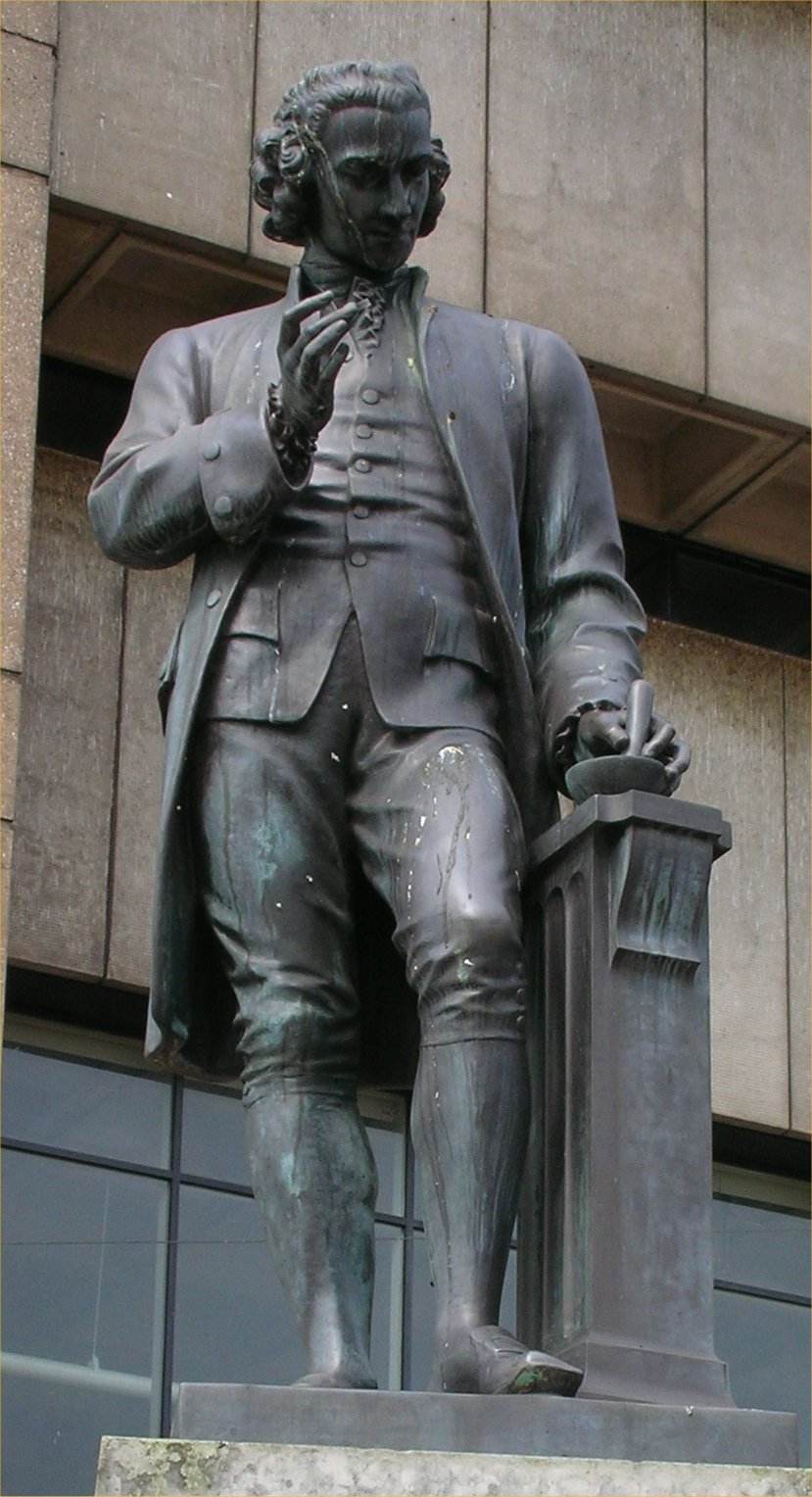
Another nice thing about our original PNAS paper, aside from the science, was the international character of the team, which included scientists born in the UK, New Zealand, Israel, Iraq, France and Japan drawn from Christian, Jewish, Muslim and Shinto or Buddhist backgrounds. As local Birmingham scientist Joseph Priestley (discoverer of oxygen and religious and political radical; statue in Birmingham shown left) said in 1793 of the Lunar Society of Birmingham:
*Priestley used the old-fashioned term "Mohammetans", but I have translated his sentence into modern English.
"We were united by a common love of Science, which we thought sufficient to bring together persons of all distinctions, Christians, Jews, Muslims* and Heathens, Monarchists and Republicans."
*Priestley used the old-fashioned term "Mohammetans", but I have translated his sentence into modern English.
Tuesday, September 2, 2008
Darwin's Descendants: a Legacy in Science and the Arts

I am starting to turn my mind to organising next year's Darwin Day in Birmingham--the big one, for Darwin's 200th birthday. So far, I have Dover trial journalist Lauri Lebo pencilled in as one of the star attractions, but will sort out a fuller programme in the next week or two.
For last year's Darwin Day, it was my great pleasure to host visits to Birmingham of Dame Gillian Beer and Emma Darwin--the former an expert on Darwin's influence on the novel, the latter a Darwin descendent who writes novels.
I managed to persuade Emma to visit Birmingham more on grounds of nostalgia (she did her undergraduate degree in Drama here in the 1980s) and because of an interest in her 18th century forebears, than through any desire to be involved in Darwin Day
Emma has her own website and a blog of her own (This Itch of Writing) detailing the writer's art. She has published two novels: The Mathematics of Love, which I have read and enjoyed, and most recently, A Secret Alchemy, which I have not yet tried.
During her visit, I took Emma to Soho House (Matthew Boulton's old house, now a museum), just north of Birmingham city centre, where the Lunar Society used to meet. When we visited the sitting room, I pointed out: "so this is where your great-great-great-great-grandfather met with your other great-great-great-great-grandfather!"
Emma told me she had once visited a meeting of Josiah Wedgwood descendants, where everyone was given a badge with a number on it, representing the line of descent from Josiah 1st (1 for first child, 1.1. for first child of first child etc). She pointed out that she was a member of the exclusive group of descendants who could wear two badges (one line of descent via Emma Darwin, nee Wedgwood, the other via Charles Darwin and his mother, Susanna Darwin, nee Wedgwood).
Emma doesn't much like being lumped in as an honorary Darwin—she has written an amusing account of the reception of her first novel, which focused as much on her name and ancestry as her prose. Nonetheless, for our Darwin Day, she gave a well written and well presented talk on the Darwin legacy in science and the arts, which not only took in the remarkable achievements of the Darwin descendants, but also provided her own personal view of what it is like to be in such a family. She has given me permission to put her talk on the web—it was initially going to go on a planned Darwin Day website, which has not yet materialised, so I am sharing it with you here. Read on, and if you like it, buy Emma's books and sign up to her blog!
DARWIN’S DESCENDANTS
A legacy in science and the arts
Thank you.
In my experience, people want Darwins to be scientists and they want to think that there’s a gulf – even an opposition – between scientific and artistic practice. But of course it’s not as simple as that. When my third cousin, the classicist and poet Ruth Padel, took her biologist mother Hilda to a poetry reading, Hilda said afterwards, ‘I see the point of poets now. They notice things.’ Hilda’s own mother Nora Barlow was a botanist: that respectably feminine outlet for scientifically-minded women in the 19th century. Nora’s cousin Gwen Raverat, the artist and wood engraver, who was born three years after her grandfather Charles Darwin’s death, wrote the classic memoir of growing up as a Darwin, Period Piece[i]. She, too, linked her creativity to a scientific kind of noticing that you will all recognise: observing that ‘The whole of a long life is spent learning to see, to know what one is looking at with one’s inner mind: not in gaining experience, but in losing it.’[ii]
But that’s at the most abstract level. More generally Darwin’s children were great readers, and individually appreciated music and the visual arts to some degree, but on the whole the atmosphere Gwen describes as ‘benevolently Philistine’. Her father Sir George Darwin was Plumian Professor of Astronomy at Cambridge, and she wrote of him and her four uncles:
They were apt to regard the arts as the inessential ornaments of Life: unimportant matters. But this is a superficial view of them: in their scientific work they showed many of the characteristics of the creative artist: the sense of style, of proportion; the passionate love of their subject; and, above all, the complete integrity and the willingness to take infinite trouble to perfect any piece of work.[iii]
Charles and Emma Darwin’s own children were of course descended from Wedgwoods through both parents, and Emma, it should be remembered, took piano lessons from Chopin and was brought up in an family as concerned with aesthetics as with science and industrial production. But as Gwen Raverat put it:
Darwins never cared enough about Art or Fashion, to be much interested in what was Right and Highbrow. When they bought an armchair they thought first of whether it would be comfortable and next of whether it would wear well; and then, a long way afterwards, of whether they themselves happened to like the look of it.[iv]
Of the other four sons, William became a banker, and Frank a botanist and his father’s biographer. Horace was a Major in the Royal Engineers, much involved with scientific projects, and later became President of the Royal Geographical Society, just as many a Darwin in both arts and sciences has gravitated towards the administration of their discipline. Leonard was an engineer whose odd little enterprise, known in the family as ‘The Shop’, became The Cambridge Scientific Instrument Company. Only Bessy, the traditional unmarried daughter, who seems to have had some kind of specific learning difficulty, made no professional mark on the world. Her older sister Etty – Henrietta – edited her father’s The Descent of Man[v] as well as her mother’s letters[vi] and private papers. In fact I have her to thank for my own name, as those latter two volumes were by my mother’s bed when I was born. Names, too, are part of the family self-consciousness: I tried, and very properly failed, to persuade my non-Darwin husband that a suitable name for our first child would be Erasmus.
And this family self-consciousness, this tendency to inwardness, can’t be denied. There is of course Period Piece, never out of print since it was published in 1952. And Frank’s son Bernard wrote, among many books about golf and sports, a memoir called The World that Fred Made,[vii] Fred being the gardener and co-experimenter with Charles in the laboratory that was the garden at Down. Gwen’s sister Margaret Keynes wrote The House By the River[viii] a history of their childhood home Newnham Grange, which is now Darwin College. Two more recent Darwin descendants, Matthew Chapman[ix] and William Pryor[x], grandsons respectively of the poet Frances Cornford and of Gwen Raverat, have written memoirs of their own, in which – to judge by the reviews – their ancestry appears to weigh heavily on their own lives.
As we move down the generations, the direct influence of Charles Darwin is diluted, but the awareness of the world grows ever greater: the Darwin industry is not going to get any smaller or less obvious as the bicentenary approaches. Another path that later generations have taken is of reflecting on Darwin and Darwinism itself. Matthew Chapman has also published an account of the 2005 Dover Pennsylvania trial of Intelligent Design[xi]. In the footsteps of Frank’s biography of his father, Randall Keynes, one of Margaret’s grandchildren, has written Annie’s Box, about Charles and Emma’s beloved eldest daughter who died aged eleven. He is now active in various Darwin-related projects.
But a closer look suggests that immediate family counts for more than the ever-more distant Ancestor. Of the great-grandchildren, it’s true that my father – a lawyer and diplomat – was a slight aberration in his own family: his four siblings were a crystallographer, an electronic engineer, a biologist and a civil engineer. But maybe it’s not so suprising: their father Sir Charles Darwin was with Rutherford when he split the atom, and while Head of the National Physical Laboratory worked at MIT on the development of radar, and their mother Katharine Pember was a mathematician, and the first female member of the Royal Astronomical Society. But Frank Darwin’s second wife was a lecturer in English Literature at Newnham: their daughter Frances Cornford became an extremely distinguished poet. Her older half-brother Bernard’s daughter Ursula Mommens is still a well-respected ceramicist, aged nearly a hundred, and his son Sir Robin Darwin was an artist and Principal of the Royal College of Art for over forty years. With Frances’s artist son Christopher Cornford as Dean, Robin presided over a notable revival of the College. Christopher’s older brother John Cornford was a poet and radical who was killed early in the Spanish Civil War, while Margaret and Geoffrey Keynes’s four sons follow their father’s combination of writing and biological science in varying proportions.
My own generation, the great-great grandchildren, reflects our Darwin and non-Darwin heredity: the list includes not only biologists, bankers, mathematicians, IT specialists, and a botanical illustrator turned botanist, but also lawyers, historians, musicians, film-makers, poets, a novelist, landscape designers, hospitality managers, and a sheep farmer who may have an unusual profession for a Darwin, but who has upheld another family tradition by marrying an equally Darwinian cousin.
But the traditions aren’t always either an advantage or a joke. The general impression that the whole family has always done good, serious work to the utmost of their considerable ability, has made a fair few of us rebel at some point against doing our homework or turning up at family weddings. Not for us the pride in being the first to go to university, to gain an honour or publish a book: someone’s always done it already, and a lot of the external world knows that too. That external world can even be offensive: I’ve been asked more than once if my novel would have been published were I not a Darwin, or whether I’m ‘obliged’ to ‘believe’ in Evolution.
The family habits of mind can also be a handicap. As Gwen Raverat’s biographer Frances Spalding put it[xii] even personal matters have always been discussed in what Frances Cornford described as ‘…a thoroughly weighing Darwinian manner’. Spalding goes on to say, ‘Behind these debates lay the assumption that family characteristics, such as persistence, intelligence and common sense, would inevitably arrive at an authoritative truth.’ But the truth of art isn’t the same kind of truth, as Gwen and Frances knew better than most. And there’s always a risk that one’s more a-rational, intuitive, un-logical creative processes are broken on the wheel of rational analysis and ruthlessly reasonable thought.
Somewhere in the middle, between those who base their careers on their ancestry, and those who struggle to get out from under it, are those of us who try to bend science and the Darwin industry to our own creative purposes. Ruth Padel, having become deeply involved with ecological issues, uses the Darwin name to gain publicity for her campaign to save the tiger and the ecological system of which it’s the top. My sister Carola Darwin, a singer by profession though originally a Cambridge-educated chemist, is involved in commissioning an opera, Children of Fire, which explores the encounter between Charles Darwin and the inhabitants of Tiera del Fuego. And though it annoys me when reviews of my work talk more about my ancestry than the book – it does happen – you could argue that I dropped myself in it. The thematic core of my novel The Mathematics of Love[xiii] is photography, and the first experiments in using light-sensitive substances to record images were made by Thomas Wedgwood, who died in 1806. The earliest part of my story is set, too late, in 1819. Luckily I also needed a doctor, and with the cavalier attitude to facts that is the fiction-writer’s privilege, used Tom Wedgwood’s brother-in-law, Robert Darwin, Charles’s father, not only to set a broken arm, but to offer the narrator, Stephen Fairhurst, and his artist and print-making friend, Lucy Durward, a personal introduction. In this passage,[xiv] set in a Brussels café, I wasn’t just borrowing my ancestors, I was taking their science, and putting it to my own creative and metaphorical ends.
After a while, I said, ‘Was your journey into Staffordshire a success?’
She nodded, and then words came to her tongue. ‘Indeed it was. They were most welcoming. Mr Wedgwood had taken the trouble to come back from his works at Etruria early only to show us his brother’s work – sun-pictures, he called them. My father and I were fascinated, although it was not easy to make out the images, for they must be kept in the dark, lest they darken further, and may only be looked at by candlelight. Mr Wedgwood explained how his brother brushed paper or white leather with nitrate of silver – in solution, you understand – and then the object to be copied was place on top of it, and the whole put in the sun. It took only a few minutes, he said, if the sunlight was strong enough.’ She pulled her chair close in, propped her elbows on the table, and continued. ‘You see, the nitrate of silver tarnishes by the agency of light, where the object does not protect it, even to the degree of translucency of each part of the object’
‘Rather as, when one lifts a long-fallen apple from the lawn, it leaves its mark in the pallor of the grass below.’
‘Yes! And of course, once the grass is again exposed, like the paper, the light darkens it once more. Only the sun-pictures are done in a matter of minutes, and they are so exact! Mr Wedgwood showed us one of a vine leaf. Every vein and stem was as clear as if I had drawn it, only white, of course, on a darkened ground, like a white-line wood engraving. My father was mainly interested in the precision of it, for he has an idea of copying prints automatically by such a process, but it was so beautiful, too! There were some pictures of insect wings, made through a sun microscope so that they appeared larger than in life. I almost feared that they would float off if I breathed too close.’ She paused, as if the mere recollection caused her to stop her breath.
‘And your sister, she accompanied you?’
‘Yes, but she stayed in the drawing room with Mrs Wedgwood and some of her daughters. She said they were charming, very easy and unaffected. But she could tell you more of them than I.’ She drank a little wine. ‘My father was disappointed because although Mr Thomas Wedgwood did try to copy prints with a camera obscura, time blurred the picture. My father and Mr Wedgwood agreed that there being so many difficulties precludes any profitable application of the process.’
I refilled both our glasses. Even Miss Durward’s concentration in drawing had quite a sober quality; I had not seen her face so animated for some time. ‘Tom Wedgwood tried muriate of silver too, his brother said, which turns pale lavender, and violet at the darkest, and in a matter of seconds even in twilight. But it is not so readily applied, because it is not soluble in water.’
A clatter from the back of the café made me aware that the waiter was lifting chairs onto tables, and that most of the other customers had departed. Miss Durward looked around her. ‘Goodness, it must be late.’
‘We should perhaps make our way back.’
‘I suppose we should,’ she said.
I signalled to the waiter and paid the reckoning. As we left the café she said, ‘The strangest thing was, to be able to make a picture of something real with no intervention – no agency – except the natural properties of the sun. The object creates its own image. Mr Wedgwood referred to the image as a simulacrum – a replicant. And then suddenly it has an independent life.’
‘It is like a ghost,’ I said. ‘The object is – may be – long lost, in another time. Its image lives on, in a different place – ’ I could not continue, for suddenly the image of my own love was too clearly before me for speech to be possible.
‘Yes,’ said Miss Durward. She tucked her hand into my arm, and I felt the thin firmness of her through my sleeve. ‘But only when it is kept in the dark.’
Thank you
© Emma Darwin 2008
[i] Raverat, G., Period Piece, London, Faber and Faber, 1952
[ii] Quoted in Spalding, F., Gwen Raverat, London, Harvill, 2001, p.viii
[iii] Raverat, G., Period Piece, London, Faber and Faber, 1952, this edition 1987, p.188
[iv] Raverat, G., Period Piece, p.126
[v] Darwin, C., The Descent of Man, London, John Murray, 1882
[vi] Litchfield, E., Emma Darwin: A Century of Family Letters, London, John Murray, 1915
[vii] Darwin, B., The World that Fred Made: an autobiography, London, Chatto & Windus, 1955
[viii] Keynes, M., The House by the River, Cambridge, Darwin College, 1976
[ix] Chapman, M., Trials of the Monkey: an accidental memoir, New York, Picador, 200
[x] Pryor, W., Survival of the Coolest, Clear Press, 2003
[xi] Chapman, M., 40 Days and 40 Nights: Darwin, Intelligent Design, God, OxyContin, and Other Oddities on Trial in Pennsylvania, New York, Harper Collins, 2007
[xii] Spalding, F., Gwen Raverat, p.162
[xiii] Darwin, E., The Mathematics of Love, London, Headline Review, 2006
[xiv] Darwin, E., The Mathematics of Love, London, Headline Review, 2006, p. 137 (adapted)
Subscribe to:
Posts (Atom)