Sunday, November 20, 2011

Bio380 Human Evolution Genes and Genomes Bioinformatics Practical


I have a bioinformatics practical class tomorrow and rather than hide it away, I thought I might as well share it with the world via this blog. Happy to receive comments on any mistakes or suggestions for improvements or additional reading.


Bio380 Human Evolution Bioinformatics Practical 2011


Follow this link to the entry for the FOXP2 chimpanzee protein:
http://www.uniprot.org/uniprot/Q8MJA0
Take a minute to explore the information on the page.
  • Q. What is the evidence that this gene is functional in the chimpanzee?
  • Q. Why is this entry called FOXP2_PANTR
  • Q. What does the Forkhead domain do?
Scroll down to the sequence at the bottom of the page
  • Q. What is unusual about the first third of the protein sequence?
Click on the pop-up Fasta view button
  • Q. What is a FASTA sequence?
Select the sequence that pops up and copy it to the clipboard. Then return to the previous window.

Open in a new tab and go to http://www.ncbi.nlm.nih.gov/BLAST/
Select “protein blast”
  • Q. What is BLAST?
Paste the FoxP2 FASTA sequence into the search box. Click on the algorithm parameters link, then tick the box indicating Filter low complexity regions
  • Q. What does this do?
Start the Blast search. The Blast search may take some time, so open a fresh tab and go to http://www.uniprot.org/
Search for “foxp2_human”
Spend some time exploring the information therein, while you wait for the Blast search to finish.

Return to the Blast search result. Scroll through the results. In the segment of the query spanning residues 241-698, how many differences does the chimp protein show from the following:
Orang utan (Pongo pygmaeus) Gorilla (Gorilla gorilla)
Lar gibbon (Hylobytes lar) Macaque (Macaca mulatta)
Horse (Equus cabellus) Mouse (Mus musculus)
Humans (Homo sapiens)
PS: use the sequence with header "FoxP2_Human"
  • Q. What differences do you find?
  • Q. How conservative or radical are the changes in amino-acid properties?
Go to http://www.nature.com/nature/journal/v418/n6900/full/nature01025.html
This paper suggests that the human sequence undergoes an additional post-translational modification compare to the chimp sequence
  • Q. What is this difference and how significant is likely to be?
Go to http://www.ncbi.nlm.nih.gov/omim
Search for FoxP2, then click on the first entry and explore the information therein, particularly that under the Evolution heading.
  • Q. Does this confirm or deny any of your previous conclusions?
Follow the link to this recent paper:
http://dx.doi.org/10.1016/j.jhevol.2007.07.006
Speed-read the abstract and introduction
  • Q. On the basis of this, would you expect Neandertals to be able to speak?
  • Q. What would you expect their FoxP2 gene to look like?
Follow this link to another recent paper
http://www.cell.com/current-biology/abstract/S0960-9822(07)02065-9
  • Q. What do you conclude?
Now read these blog entries
  • Q. Do your conclusions change?
  • Q. Are blogs are useful source of scientific information?

The genome of James Watson, Nobel laureate and co-discoverer of the structure of DNA can be found here: http://jimwatsonsequence.cshl.edu/

  • Q. Is Jim Watson a black man?
And, finally, is Watson’s recent gaffe on race more likely to be due to:
  1. A single gene disorder (the “butt-head racist gene”?)
  2. A polygenic disoder (the “butt-head racist gene complex”?)
  3. The racist culture in which he grew up?

Sunday, November 6, 2011

Darwin and Mendel: The Great What If?


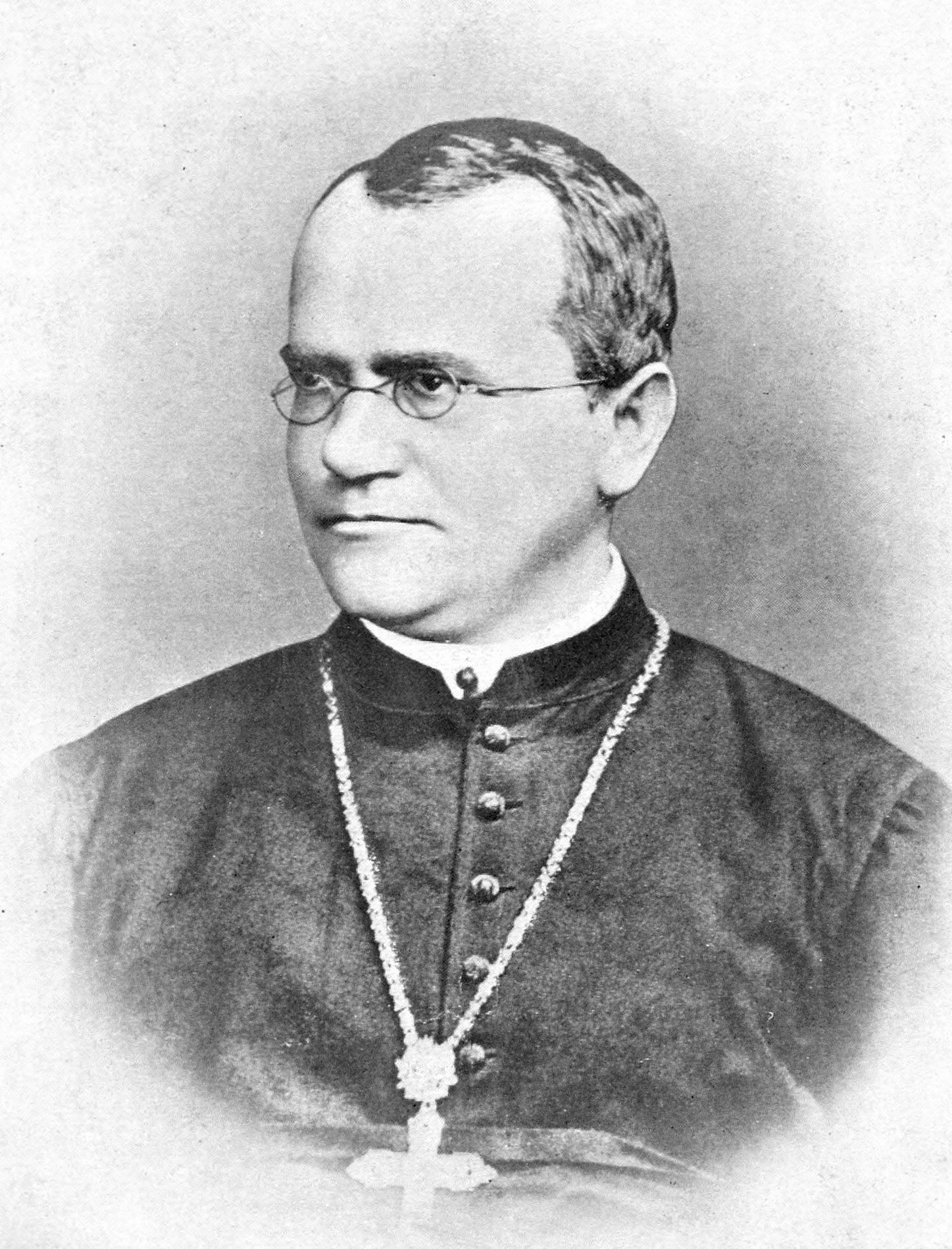
Charles Darwin and Gregor Mendel were contemporaries. One of the great “what ifs” in the history of science is “what if Darwin and Mendel had met to discuss each other’s work, or, at least, had exchanged notes?”

The closest they came to meeting was in the summer of 1862, when Mendel visited England to attend the International Exhibition, a world fair held in South Kensington. Charles Darwin was less than twenty miles away, but their paths never crossed as the Darwins were stuck at home, nursing their son Leonard through scarlet fever.

Mendel read a German translation of Darwin’s Origin before publishing his seminal paper in 1865, but he did not see any connection between his work and Darwin’s. It has been claimed that Mendel’s paper sat on a shelf at Down House, unread, but this is just a myth. Although Darwin possessed two books that briefly referred to Mendel’s work, there is no evidence that he read the relevant sections; in one of the books, the pages are clearly uncut. Darwin leant one of these two books to his friend George Romanes, who used it to write an encyclopedia entry, priming another myth: that Darwin wrote about Mendel in the Encyclopaedia Britannica.

How close was Darwin to discovering Mendel’s laws of inheritance? As early as 1838, Darwin scribbled in his notes a question that, in retrospect, seems pregnant with potential: “Do races of peas become intermixed & gardener have hybrid seedlings?” In a letter written to Wallace in February 1866, Darwin recognizes that inheritance can be non-blending:

“My dear Wallace… I do not think you understand what I mean by the non-blending of certain varieties… I crossed the Painted Lady and Purple sweetpeas, which are very differently coloured varieties, and got, even out of the same pod, both varieties perfect but not intermediate.”

Furthermore, as Chinese plant scientist Yongsheng Liu has pointed out, Darwin describes experiments that are uncannily similar to Mendel’s, in his 1868 work Variation Under Domestication:

“Now I crossed the peloric snapdragon… with pollen of the common form; and the later, reciprocally, with peloric pollen. I thus raised two great beds of seedlings, and not one was peloric. The crossed plants, which perfectly resembled the common snapdragon, were allowed to sow themselves, and out of a hundred and twenty-seven seedlings, eighty-eight proved to be common snapdragons, two were in an intermediate condition between the peloric and normal state, and thirty-seven were perfectly peloric, having reverted to the structure of their one grandparent…”

The ratio, at 2.4 to 1, is close enough statistically to conform to an expectation of 3 to 1, so this might count as a glimpse by Darwin of Mendel’s first law.

But given that Mendel himself did not recognize the universality of his own work, it is unfair to expect Darwin or anyone else to do so, particularly in the face of less easily interpreted results from crosses in other species of plants and animals. Instead, the modern synthesis of Darwin's and Mendel's work had to wait until the mid-Twentieth Century.

Bibliography

The extent of Charles Darwin’s knowledge of Mendel by Andrew Sclater

The Monk in the Garden: The Lost and Found Genius of Gregor Mendel, the Father of Genetics by Robin Marantz Henig


Wednesday, October 12, 2011

The Rough Guide to Darwin

As part of my attempt to put all my talks, whether for teaching or research online, I have put these two talks I gave yesterday in Oxford on to YouTube.

The Rough Guide to Darwin

http://www.youtube.com/watch?v=4yHHoCivCT0
Talk given to doctoral students in Oxford 11th Oct 2011
Covers Darwin's early life, including wayward youth, before discussing his major work, impact and legacy

Warning: Explicit discussion of Darwin and sexuality. "Let's get Downe and dirty with Darwin!"
Ignore grey screen YouTube snafu at very beginning. Soon sorts itself out.

From Darwin to Drug Resistance

http://www.youtube.com/watch?v=4iVQK9sYr2M
Talk given to doctoral students in Oxford 11th Oct 2011
Brief review of Darwin's legacy and evolutionary thinking in bacteriology.
Ignore grey screen YouTube snafu at very beginning. Soon sorts itself out.

Friday, October 7, 2011

Wallace: Darwin’s Rival or Ambassador?

Alfred Russel Wallace (1823-1913) was born in Llanbadoc, near the Welsh town of Usk and grew up in Hertfordshire. He worked as an apprentice surveyor for the six years. During a brief spell as schoolmaster in Leicester, Wallace met entomologist Henry Bates and developed an interest in natural history. He worked for several more years as a surveyor/engineer. Then, inspired by Humboldt and Darwin, Wallace set off with Bates on an expedition to Brazil. In 1852, after four years collecting specimens and surveying the Rio Negro, Wallace set off back to England. At sea, a fire forced Wallace to abandon his specimen collection and, adrift, he spent ten days in a lifeboat, awaiting rescue.

Back safe in England, an insurance payment supported him while he wrote papers and forged links with naturalists, including Darwin. In 1854, Wallace embarked on an expedition to the Malay Archipelago (present-day Malaysia and Indonesia). During this six-year excursion, Wallace collected over a 100,00 specimens, discovered the discontinuity between the kinds of plants and animals found in the northern part of the archipelago and those found in the south (now called the Wallace line), and, crucially, hit upon the idea of evolution by natural selection independently of Darwin. Wallace’s experiences were written up as a lively travelogue, The Malay Archipelago.


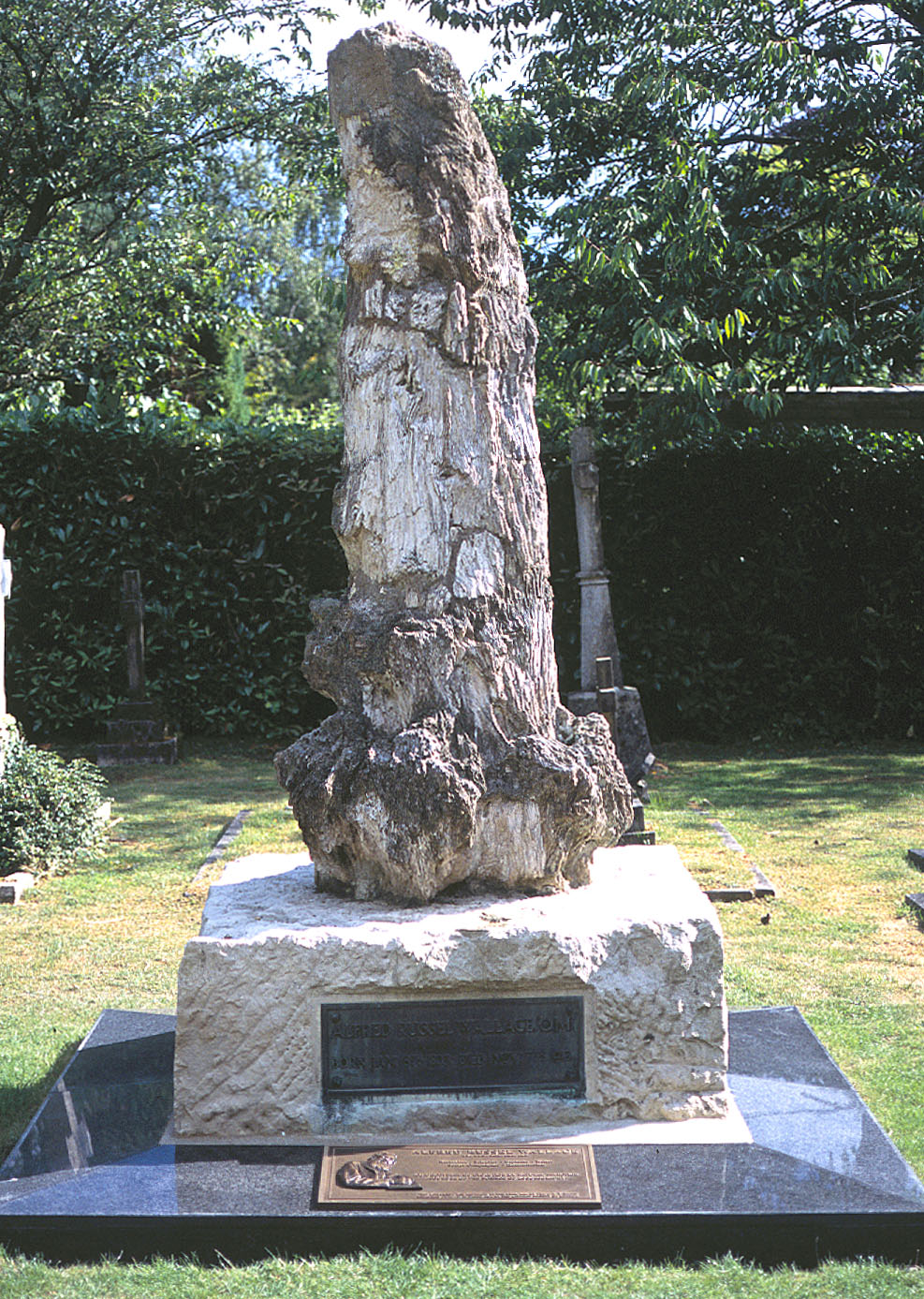
During his middle years Wallace was beset with financial problems, which we largely alleviated in 1881 by a government pension that Darwin helped him obtain. In late life, Wallace extended his work on biogeography, became an early environmentalist and toured the US promoting evolution and natural selection. In old age, he settled in Broadstone, a suburb of Poole in Dorset. He is buried in Broadstone cemetery in a grave capped with a (rather phallic!?) fossil tree trunk and block of limestone.

Although often cast as Darwin’s rival, Wallace remained a loyal and lifelong supporter of Darwin, accepted Darwin’s claim to priority, dedicated The Malay Archipelago to Darwin and even entitled his major book on evolution Darwinism. Wallace was an altogether more colourful character than Darwin, but also rather more flakey. Wallace adopted spiritualism and unlike Darwin, expounded a progressive, teleological view of evolution, with the universe working towards the birth of the human spirit. He rejected natural selection as an explanation of the human mind, instead favouring interventions from the “unseen world of spirit”. He became a socialist and an opponent of smallpox vaccination. He got tangled up in disputes as to whether the earth was flat (in the Bedford Level experiment, he showed it wasn’t) or whether there were canals on Mars (he argued there weren’t). It is clear that, had Darwin died in South America, “Wallaceism” would have turned out quite different from Darwinism!

Further Online Reading
The Alfred Russel Wallace web page: http://www.wku.edu/~smithch/index1.htm

Image Rights
Wallace Grave George W. Beccaloni: Creative Commons Attribution 3.0 Unported

Saturday, October 1, 2011

Open Education and Bio380 lecture on Neanderthals

This academic year I have set myself the goal of making all my lecture available for all, in the public domain, via YouTube and maybe also Slideshare. The technical side of doing this is fairly straightforward (capture a screen movie via QuickTime), but the major hassle is ensuring and documenting permissions for all images. In my first attempt, I quickly realised that putting this information on the same slides as the images led to cluttered chaos, so I have piled them all up at the end of the talk.

It is unclear to me what the rules are about using material from published papers, but cannot see how authors would not want students to know about their work. So, in general, I am proceeding along the course of it is easier to apologise afterwards rather than ask permission in advance. If anyone objects to anything I have done, let me know and I will remove the offending material from the public domain. Also, if anyone has tips on how to do all this as efficiently and fairly as possible, please let us know via the comments. Ditto if you want to send words of encouragement!

It will be interesting to see if anyone other than my own students look at this stuff, but here we go, the game's afoot! Information wants to be free!

Here is my first lecture for this year from the Bio380 course: Waking the Dead, on Neanderthals and their influence on the modern human gene pool. Enjoy!

Slidecast via YouTube


Slides via Slideshare

Great Read at Birmingham: Captain Kirkup and Chris Stringer

AV material associated with this week's Great Read at Birmingham events.

Captain Kirkup on Evolution and Game Theory

Video of the talk and subsequent Q&A : http://www.youtube.com/watch?v=15gxMlQQ6AA


Slides to go with this: http://www.youtube.com/watch?v=RTk9_DlOpcQ
(Open these in a separate window as they will need to be manually paused and progressed forward: sorry no synchronised slidecast available)

Chris Stringer on The Origin of Our Species
Podcast of the talk via YouTube (publicly available): http://www.youtube.com/watch?v=QryLIaRORlU

Sunday, September 25, 2011

Live tweets from Great Read at Birmingham opening event

Here are the live tweets from Great Read at Birmingham opening event, sorted from earliest to latest

66. mjpallen: @mjpallen @greatreadatbham @unibirmingham live tweet under #GRAB2011 hashtag
65. mjpallen: #grab2011 ken miller up on stage; textbook author, daughter had to read his book at school; she gave up biology for history :-)
64. mjpallen: #grab2011 Ken testified in George and Pennsylvania; pervasive problem in US education and local politics; evolution in Ohio local politics
63. mjpallen: #grab2011 “vote for proevolution candidate you vote for sin“ 2 of republican presidential candidates creationist; creationist museums
62. mjpallen: #grab2011 antievolution bills pop up all over; problem coming to UK and Germany; Uk scientists published letter defending evolution
61. mjpallen: #grab2011 creationist conference in Malvern, UK; now describing Dover trial why lawsuit? 1st amendment http://t.co/VffLhax0
60. mjpallen: #grab2011 Ken lead witness in Dover trial Goals: show ID not science; show it is religion.
59. mjpallen: #grab2011 Conservative judge, so ID people thought easy time coming
58. mjpallen: #grab2011 > 9 hours cross examination: like PhD viva over and over again. Trial showed collapse of ID as credible theory; icons of ID trashed
57. mjpallen: #grab2011 ID claim: evo cannot make irreducibly complex systems; Michael Behe; missing part makes it nonfunctional; mousetrap example
56. mjpallen: #grab2011 flagellar components alone have no function say ID ppl. Only designer can make it. But even Darwin knew of change of function
55. mjpallen: #grab2011 testable to see if flagellar components can do anything if not all together; take away all but 10 parts of flagellum; still works
54. mjpallen: #grab2011 works as type III secretion system; counters irreducible complexity claim. ID is wrong! Cites Pallen and Matzke paper. testability
53. mjpallen: #grab2011 ID textbook Pandas and People; textbook evolved from creationist book with "creation" changed to ID; Barbara Forest testimony
52. mjpallen: #grab2011 1987 book changed because creationism deemed in law religious; Dover trail covered by BBC in War on Science; showing clip fr Nova
51. mjpallen: #grab2011 "judgment day" overblown rhetoric in nova show; received award; back to Dover case; Dec 20 2005; verdict ID not science!
50. mjpallen: #grab2011 struggle continues; "only a theory" book written to contain antirationalism antiscience; US lagging in science & math; Nature edop
49. pathogenomenick: Ken miller shows this great antievolution poster #GRAB2011 http://t.co/ur6sP88h http://t.co/ur6sP88h
48. mjpallen: #grab2011 whoisyourcreator.com nonsense on web; abundance of human fossils; Darwin's tree from Origin dead ringer for human evo tree!
47. mjpallen: #grab2011 new findings all the time; e.g. A. sediba; Matzke study on hominin brain size; sustained increase in brain size; no gap in record
46. mjpallen: #grab2011 chimp genome confirms predictions from elsewhere; chromosomes 46 in man; 48 in great apes; chr 2 is fusion of two chimp chromosome
45. mjpallen: #grab2011 fused chromsome has telomere in middle; 2 centromeres; one inactive; DNA seqs are facts; no ID explanation for this
44. mjpallen: #grab2011 evolution doesn't imply Dawkinsism acc to Miller. Dan Dennett says God/evo not compatible; Miller says yes; Dobzhansky was X-ian
43. mjpallen: #grab2011 nothing in biology makes sense in light of evolution; Dobzh also supported compatabilitism; evo is process of creation he said
42. mjpallen: #grab2011 pope says evolution God do mix! St Augustine wrote universe evolved; Miller says scientists question 5th C mystic; but Mendel monk
41. mjpallen: #grab2011 Mendel did expts even tho religious Augustinian; Darwin not religious; agnostic not atheist; said that theism and evo compatible
40. mjpallen: #grab2011 http://t.co/ANooECt7 Now cites Darwin first notebook tree; then closing words of Origin See also http://t.co/0gdYwcOP http://t.co/ANooECt7http://t.co/0gdYwcOP
39. mjpallen: #grab2011 John Hawks now on the stage; science changes year by year; ancient genomes teach us about our own gene functions
38. mjpallen: #grab2011 focus on late stages in human evolution <1m years; Neanderthal means "brute" in vernacular;not fair; Darwin met Neanderthal fr Gib
37. mjpallen: #grab2011 Neander valley ripped up by mining; site was carpark; dug up in 2000 or so; found new remains; jigsaw fit to old bones; DNA found
36. mjpallen: #grab2011 Haekel drew mad trees; Homo stupidus for Neanderthals! now lots of evidence of culture; bone techn; shells w. holes for ornament;
35. mjpallen: #grab2011 cut feathers from birds; Neander hyoid bone suggests they talked; reconstruction of voice like Dame Edna/Steve Perry/Journey :-)
34. pathogenomenick: Lol at John hawks' impression of neandertals communicating: a rendition of don't stop believing by journey #GRAB2011
33. GreatReadatBham: @johnhawks just sang to us as Journey in describing the voice of Neanderthals #GRAB2011
32. mjpallen: #grab2011 Neander trading across long distances; cultural and complex. Vindija cave perfect site; shin bone yielded lots of DNA; 1.4x genome
31. GreatReadatBham: follow @mjpallen live feed #GRAB2011
30. mjpallen: #grab2011 more evidence from DNA than from all fossil record; some redheads MCR1 mutations unique to Neanders, not same as AMHs. not all red
29. mjpallen: #grab2011 Siberia at edge of range; low DNA variability among Neanderthals; genealogy possible; 100s of specimens; healed fractures seen
28. mjpallen: #grab2011 bony injuries in Neanders same as rodeo riders; amputation of arm; blind, lame; hunting large mammals; even rhinos; tough life
27. mjpallen: #grab2011 ambush hunters like cougars; chronic disabilities; osteoA; starch grains fr tooth calculus; lots of new science here, cannibalism?
26. mjpallen: #grab2011; men in one site all related; women not. enamel hypoplasia; starvation; dead kids; synchrotron scanning of life history
25. mjpallen: #grab2011 neanderthals live fast die young; Denisova cave in Altai mountains; rugged country; horse country; vertical limestone; few caves
24. mjpallen: #grab2011 David Reich calls it magical place; cold place zero deg C; like fridge; chimney over cave; size of lecture theatre with high roof
23. mjpallen: #grab2011 sheep layer on top; beneath that remains of human; bracelets; pinky bone has yielded best ancient DNA ever! But only 6% DNA human
22. mjpallen: #grab2011 79% DNA no hit Neander mitochondrial DNA variation low; Denisovan DNA is outgroup to humans and Neanderthals; tooth yielded same
21. mjpallen: #grab2011 does Neander and Denisovan DNA survive in humans? ABO polymorphisms for >2m years; not useful; need to find consistent patterns
20. mjpallen: #grab2011 Neanderthal genes more often resemble non-Africans; 3% of our genomes; skeletal evidence of mixture too from mandibular foramen
19. mjpallen: #grab2011 paper out any moment shows Denisovan DNA in Melanesians and Aborigines at 5% or less. Long distance away! Mystery.
18. mjpallen: #grab2011 we don't know what Denisovan skeletons looked like; missing popn movements; mixtures now established between AMH and archaics
17. mjpallen: #grab2011 evidence of admixture in East African pygmies, unkn source. Neanderthals and Denisovans form clade; how can this info be useful?
16. mjpallen: #grab2011 we can explain some heritability; mentions Galton @uniBirmingham alumnus; 300 genes now explain 20% of height variation
15. mjpallen: #grab2011 Hawks using Neander and Denisova genomes to discover new genes underling phenotypes in modern humans; showing genetic maps; HAR1
14. mjpallen: #grab2011 human accelerated region; humans very diff from other primates here; Denisova diff from humans and Neanders in HAR1! Moreancestral
13. mjpallen: #grab2011 Hawks now comparing his own genome to Neanderthals! His androgen receptor is Neanderthal and may make him bald!
12. mjpallen: #grab2011 Hawks now closing with ode to power of evolutionary thinking! and phew can take rest from live tweeting. Thanks for listening! Bye
11. GreatReadatBham: #grab2011 evolution organises knowledge, including complex, real-world data about Neanderthals per @johnhawks
10. pathogenomenick: @mjpallen: #grab2011 Hawks now comparing his own genome to Neanderthals!" impressively nerdy python output in slide :)
9. gilbertjacka: RT @pathogenomenick: Ken miller shows this great antievolution poster #GRAB2011 http://t.co/ur6sP88h http://t.co/ur6sP88h
8. GreatReadatBham: #grab2011 thanks to @johnhawjohn and Ken Miller for a great launch to GRAB 2011 on evolution @unibirmingham
7. pathogenomenick: Wonder if freshers know how lucky they are to see ken miller and John hawks in 1 day- not all biology lectures will be like that! #GRAB2011
6. scienceboy86: RT @GreatReadatBham: #grab2011 thanks to @johnhawjohn and Ken Miller for a great launch to GRAB 2011 on evolution @unibirmingham
5. GreatReadatBham: And thanks to all the great @unibirmingham students who came along! #grab2011
4. JoshRosenau: RT @mjpallen: #grab2011 "vote for proevolution candidate you vote for sin!" 2 of republican presidential candidates creationist; creationist museums
3. JoshRosenau: RT @mjpallen: #grab2011 new findings all the time; e.g. A. sediba; Matzke study on hominin brain size; sustained increase in brain size; no gap in record
2. johnhawks: RT @GreatReadatBham: #grab2011 evolution organises knowledge, including complex, real-world data about Neanderthals per @johnhawks
1. GreatReadatBham: #grab2011 next event Cap Benjamin Kirkup US Army on evolution of antibiotic resistance 5pm Tues 27/9 Poyntyng Large

Darwin's Shrewsbury

Brief tour of Darwin sights in Shrewsbury for speakers at Great Read at Birmingham initiative. Sights include Darwin shopping centre, stained glass window of Darwin in McDonalds, Unitarian chapel, Darwin's schools and his birthplace (The Mount).


http://youtu.be/iI1a2qybmlU

Visiting Down House with Randal Keynes

I have now received two VIP tours of Down House with Randal Keynes (Darwin's great-great-grandson) as tour guide. Randal's mellifluous voice, sharp intellect and wide-ranging knowledge of Darwin's life, science and family make these trips an unforgettable treat!

Last Friday I visited with three eminent American speakers at the Great Read at Birmingham initiative: Ken Miller, John Hawks and Captain Ben Kirkup. John Hawks has already blogged on the experience here: http://johnhawks.net/weblog/hawks/travel/down-house-visit-2011.html

Last February, I visited with Eugenie Scott from the NCSE.

Below are links to YouTube videos of both trips. Watch them and fall under Randal's spell as he guides us through Darwin's home and gardens, his life and family.


Tour of Down House with Randal Keynes for Great Read at Birmingham speakers


Tour of Down House with Randal Keynes and Eugenie Scott

Relevant links

Thursday, September 22, 2011

Adam Tickell on Thomas Henry Huxley at Great Read at Birmingham event

Professor Adam Tickell, PVC for Research and Knowledge Transfer, University of Birmingham, speaking at the launch of the Great Read at Birmingham initiative, September 22nd 2011

Video and text of the speech


Dear students,

I am sure that you have enjoyed the two excellent talks from our external speakers. First let me introduce myself. My name is Adam Tickell and I am Pro-Vice-Chancellor for Research here at the University of Birmingham, which means it is my job to ensure that the academics that lecture you produce the very best research that they can, on top of their excellent teaching.
Now, I know that Mark Pallen later in the term is going to tell you about Charles Darwin, who formulated the Theory of Evolution.

But it is worth stressing that Darwin was a retiring person who left the defence of his theory in the rough and tumble of Victorian society to others.

His most famous, and robust, advocate was a remarkable man called Thomas Henry Huxley, who was so vociferous in his defence of Darwin’s theory that he earned the nickname Darwin’s Bulldog.

Many of you will have heard of Huxley’s famous encounter in 1860 with the Bishop of Oxford, with the famous gibe about whether Huxley was descended from an ape via his grandmother or grandfather. In fact, that gibe was probably never uttered and one of the things you should learn in your three years is the importance of going beyond what is written in textbooks and newspapers and even academic publications and evaluating the evidence for yourselves!

But whatever the truth of that encounter, Huxley was a remarkable individual. Although he left school at the age of ten, he was a voracious reader and taught himself science, philosophy, history and German. An adventurer medic, who served as surgeon’s mate on the delightfully named HMS Rattlesnake, as it surveyed northern Australia and New Guinea. An expert on invertebrate comparative biology, authoring several papers that clarified some tricky taxonomy.

In 1854 Huxley took up a Chair of Natural History at the Royal College of Mines (now part of Imperial College), where for over thirty years he made valuable contributions to science and education in Britain. Huxley’s numerous achievements include his prescient classification of birds with dinosaurs (only recently recognized as correct), a treatise on the physical geography of the Thames valley, a classic book on crayfish and a biography of the Scottish philosopher David Hume. Huxley helped secularize schools, opened up adult education and transformed the academic activities of universities, viewing them as factories of new knowledge rather than storehouses of old. He even coined the word “agnostic”.

Huxley also left behind a treasure trove of aphorisms:

“After all, it is as respectable to be modified ape as to be modified dirt”

“Life is too short to occupy oneself with the slaying of the slain more than once”

“Science is organized common sense”

“The great tragedy of science is the slaying of a beautiful hypothesis by an ugly fact.”

From his biographer Edward Clodd, comes the greatest tribute of all: “It was worth being born to have known Huxley”!

But why, you may ask I am bigging it up so much for Huxley?

First, he is important in the history of ideas. Great ideas, like the theory of evolution, need to be argued over and Victorian society was, by no means, receptive to an explanation of life on earth that didn’t rely on God. Huxley’s advocacy of Darwin’s theory was powerfully influential.
Second, Huxley is important to the history of this University. Although the University on this campus dates back to 1900, before that, where the Birmingham Central Library now stands, there was something called the Mason Science College. This college was founded in 1875 by Sir Josiah Mason, a Birmingham industrialist and philanthropist, who made his fortune in making key rings, pens, and nibs. Mason College had several notable alumni before its incorporation into the University of Birmingham, including two prime ministers, Stanley Baldwin and Neville Chamberlain and a Nobel Prize winner Francis Aston.

But the key point is the foundation stone of Mason College was laid in 1880 by none other than Thomas Henry Huxley. So there is direct link between the institution in which you are enrolling and Darwin’s Bulldog! In Huxley’s honour, each year the university holds a Huxley Lecture, a tradition which goes back over a century. And of course, Darwin himself is built into the very fabric of our buildings, as a statue above the main entrance to the Aston Webb building.

Huxley gave a speech at the foundation of Mason College on the topic of “Science and Culture”. The speech makes interesting reading even today, packed full of sound bites and arguing that a scientific education was more important than a classical one. In it, Huxley delights in pouring scorn on the distinction between pure and applied research and suggests that the scientific method, which has proved so successful in the physical sciences, should be applied to the study of society.

My third reason for talking about Huxley is more personal.

Huxley died in 1895, but not before founding a family, that like the Darwin family was marked with a record of high achievement. He and his wife Henrietta had eight children. Like they Darwins they suffered the pain of losing a child in infancy. Two of Huxley’s daughters married the same man, the Pre-Raphalite painter John Collier, although not at the same time! You can see his paintings in the Tate gallery and Bridgman Art Library in London.

The most eminent of Huxley’s sons, Leonard, had six children by two wives. These included Julian Huxley – an evolutionary biologist who was not only the first director of UNESCO and a founder of the World Wildlife Fund, but also a eugenicist who – at least before the horrors of the holocaust – had unsavoury views about the rate at which what he called the lower strata reproduced. Julian was the brother of Aldous, who wrote Brave New World, and Andrew, who won the Nobel prize for his work on the physiology of nerves. One of Leonard’s grand-daughters, Angela Huxley, married a great-grandson of Charles Darwin, thus fusing these two notable lineages.

As I said, Thomas Huxley had eight children. His eldest daughter Jessica was lucky to survive scarlet fever when two years old, a disease which had killed her brother Noel. She grew up to marry Frederick Waller, who was architect to the Dean and Chapter of Gloucester Cathedral.

And now, I’m afraid, you will have to indulge me.

Jessie and Fred begat Oriana.

And Oriana begat Renée, Celia and Elvira.

And Renée wrote novels and married an Irish writer.

And I think you all might be able to guess where this is going when I tell you that the Irish writer was my grandfather Jerrard Tickell.

I have to say, I knew little of this as a child – my abiding memory of my grandmother is of her bringing packets of Rowntrees Fruit Gums when she came for Sunday lunch.

However, in the absence of fruit gums, I am very pleased to help kick off the Great Read at Birmingham initiative, which has so much to do with the legacy of Thomas Huxley and his closest associate, Charles Darwin.

I would like to close by quoting my great-great- great grandfather’s closing from his foundation speech, which calls on us, as his to praise Mason’s “crucial instance of wisdom” in establishing his Science College:

"In conclusion,” Huxley said, “I am sure that I make myself the mouthpiece of all present in offering to the venerable founder of the institution, which now commences its beneficent career, our congratulations on the completion of his work; and in expressing the conviction that the remotest posterity will point to it as a crucial instance of the wisdom which natural piety leads all men to ascribe to their ancestors."


Thursday, September 8, 2011

Great Read at Birmingham

This week, all the new undergraduates at the University of Birmingham (~6000 students) will receive a copy of the same book in their Welcome Packs and be asked to read it before arriving to encourage to engage with academic ideas and to create a shared experience for all new students. That book is The Rough Guide to Evolution!

The University believes that attending an institution like @uniBirmingham is about grappling with complex, multi-faceted, and even controversial ideas. As an academic community, the University welcomes and enjoys debate and hopes that this choice of book will stimulate discussion.

The idea behind the the Great Read at Birmingham initiative was proposed by the Vice-Chancellor, Professor David Eastwood, and is based on many successful similar programmes run in North America. But no British university has ever implemented a programme on this scale before!

There will be University-wide activities around the book during Welcome Week and the first term. Schools and departments will also use the book in study skills modules or in other ways.

Events kick off with Great Read at Birmingham Guest Talks in Welcome Week

Thursday 22 September 2011 15:30-17:00
As part of the Great Read at Birmingham initiative, "Rough Guide to Evolution" author Professor Mark Pallen welcomes two great speakers on evolution to our University, speaking back to back in Welcome Week in the Barber Institute Concert Hall.

This is open only to students at @uniBirmingham. Limited spaces available. First come, first served!

THE EVOLUTION WARS: WHY DO THEY CONTINUE AND WHY DO THEY MATTER?
Professor Ken Miller is a biochemist, textbook author, a Christian and an articulate spokesman for evolution. He played a key role laying out the evidence for evolution in the landmark Dover trial in 2005 and brings the full power of his engaging oratory to our first year students in his talk.


NATURAL SELECTION, NEANDERTHAL GENOMES AND THE MYSTERY OF DENISOVA CAVE
Professor John Hawks is an expert on human evolution and a keen blogger. He will bring us all up to date with evidence for and ramifications of interbreeding between humans, Neanderthals and the mysterious Denisovans with his fascinating talk.


Rough Guide to Evolution now available on Kindle and as eBook

Great news! The Rough Guide to Evolution is now available to buy as a Kindle eBook here:
And as a Adobe eBook here:
So, go on, indulge yourself and buy a copy now!

Tuesday, August 30, 2011

The evolution of biblical manuscripts

In an ironic twist of fate that might infuriate creationist fundamentalist Christians, evolutionary thinking dominates scholarly studies of biblical manuscripts, particularly attempts to reconstruct original texts of the New Testament in the face of copying errors!

The New Testament of the King James Bible is a seventeenth-century English translation of the Textus Receptus, a Greek text prepared by Dutch theologian Erasmus in the sixteenth century from a few late-medieval manuscripts.

In the late nineteenth century, Birmingham-born theologian Brook Westcott and his Dublin-born collaborator Fenton Hort tried to improve on the Textus Receptus, publishing The New Testament in The Original Greek (1881), which incorporated information from a wide range of manuscripts, including the oldest fragments known at the time.

Crucially, they adopted a genealogical view of manuscript affiliation that directly parallels the tree-like branching descent with modification seen in Darwin’s theory of evolution. In their own words:

“All trustworthy restoration of corrupted texts is founded on the study of their history, that is, of the relations of descent or affinity which connect the several documents.”

However, Westcott and Hort also recognized the potential for horizontal transfer between lineages, viewing the Byzantine textual lineage as a fusion of the two earlier traditions (the western and Alexandrian).

In the early twentieth century, British theologian Burnett Streeter proposed a theory of local texts, in which textual traditions diverged as a result of geographical separation – a parallel with allopatric speciation in evolutionary biology.

From the 1950s onwards, American biblical scholar Ernest Colwell attempted to bring quantitative methods into the analysis of New Testament textual traditions. Cladistic approaches borrowed from evolutionary biology now sit at the cutting edge of studies of New Testament manuscripts: exponents include David Parker, a theologian at the University of Birmingham, Gerd Mink at the Institute for New Testament Textual Research, Münster, Germany and among American scholars, Stephen Carlson.

So, in conclusion, evolutionary thinking even illuminates the origins of the text of the Bible!

Wednesday, August 24, 2011

Some Darwinian poetry to make you smile

Charles Darwin's grandfather Eramus Darwin was a brilliant but seriously bonkers chap--a kind of 18th Century English Rasta. You can read all about his interests on the relevant Wikipedia page, but I cannot help sharing these few lines from the Temple of Nature in which he sees the fruits of past (sensual or sexual) pleasure in geological sediments? What was he smoking?

"HEAR, O ye Sons of Time! your final doom,
And read the characters, that mark your tomb:
The marble mountain, and the sparry steep,
Were built by myriad nations of the deep, --
Age after age, who form'd their spiral shells,
Their sea-fan gardens and their coral cells;
Till central fires with unextinguished sway
Raised the primeval islands into day; --
The sand-fill'd strata stretch'd from pole to pole;
Unmeasured beds of clay, and marl, and coal,
Black ore of manganese, the zinky stone,
And dusky steel on his magnetic throne,
In deep morass, or eminence superb,
Rose from the wrecks of animal or herb;
These from their elements by Life combined,
Form'd by digestion, and in glands refined,
Gave by their just excitement of the sense
The Bliss of Being to the vital Ens.

"Thus the tall mountains, that emboss the lands,
Huge isles of rock, and continents of sands,
Whose dim extent eludes the inquiring sight,
ARE MIGHTY MONUMENTS OF PAST DELIGHT;
Shout round the globe, how Reproduction strives
With vanquish'd Death, -- and Happiness survives;
How Life increasing peoples every clime,
And young renascent nature conquers Time;
And high in golden characters record
The immense munificence of NATURE'S LORD!
For a roots reggae reinterpretation of some of Ras D's anti-slavery poetry, have a listen at this rough and ready bit of whimsy I cooked up a few years ago with a Jamaican friend.