Saturday, October 1, 2011

Open Education and Bio380 lecture on Neanderthals

This academic year I have set myself the goal of making all my lecture available for all, in the public domain, via YouTube and maybe also Slideshare. The technical side of doing this is fairly straightforward (capture a screen movie via QuickTime), but the major hassle is ensuring and documenting permissions for all images. In my first attempt, I quickly realised that putting this information on the same slides as the images led to cluttered chaos, so I have piled them all up at the end of the talk.

It is unclear to me what the rules are about using material from published papers, but cannot see how authors would not want students to know about their work. So, in general, I am proceeding along the course of it is easier to apologise afterwards rather than ask permission in advance. If anyone objects to anything I have done, let me know and I will remove the offending material from the public domain. Also, if anyone has tips on how to do all this as efficiently and fairly as possible, please let us know via the comments. Ditto if you want to send words of encouragement!

It will be interesting to see if anyone other than my own students look at this stuff, but here we go, the game's afoot! Information wants to be free!

Here is my first lecture for this year from the Bio380 course: Waking the Dead, on Neanderthals and their influence on the modern human gene pool. Enjoy!

Slidecast via YouTube


Slides via Slideshare

Great Read at Birmingham: Captain Kirkup and Chris Stringer

AV material associated with this week's Great Read at Birmingham events.

Captain Kirkup on Evolution and Game Theory

Video of the talk and subsequent Q&A : http://www.youtube.com/watch?v=15gxMlQQ6AA


Slides to go with this: http://www.youtube.com/watch?v=RTk9_DlOpcQ
(Open these in a separate window as they will need to be manually paused and progressed forward: sorry no synchronised slidecast available)

Chris Stringer on The Origin of Our Species
Podcast of the talk via YouTube (publicly available): http://www.youtube.com/watch?v=QryLIaRORlU

Sunday, September 25, 2011

Live tweets from Great Read at Birmingham opening event

Here are the live tweets from Great Read at Birmingham opening event, sorted from earliest to latest

66. mjpallen: @mjpallen @greatreadatbham @unibirmingham live tweet under #GRAB2011 hashtag
65. mjpallen: #grab2011 ken miller up on stage; textbook author, daughter had to read his book at school; she gave up biology for history :-)
64. mjpallen: #grab2011 Ken testified in George and Pennsylvania; pervasive problem in US education and local politics; evolution in Ohio local politics
63. mjpallen: #grab2011 “vote for proevolution candidate you vote for sin“ 2 of republican presidential candidates creationist; creationist museums
62. mjpallen: #grab2011 antievolution bills pop up all over; problem coming to UK and Germany; Uk scientists published letter defending evolution
61. mjpallen: #grab2011 creationist conference in Malvern, UK; now describing Dover trial why lawsuit? 1st amendment http://t.co/VffLhax0
60. mjpallen: #grab2011 Ken lead witness in Dover trial Goals: show ID not science; show it is religion.
59. mjpallen: #grab2011 Conservative judge, so ID people thought easy time coming
58. mjpallen: #grab2011 > 9 hours cross examination: like PhD viva over and over again. Trial showed collapse of ID as credible theory; icons of ID trashed
57. mjpallen: #grab2011 ID claim: evo cannot make irreducibly complex systems; Michael Behe; missing part makes it nonfunctional; mousetrap example
56. mjpallen: #grab2011 flagellar components alone have no function say ID ppl. Only designer can make it. But even Darwin knew of change of function
55. mjpallen: #grab2011 testable to see if flagellar components can do anything if not all together; take away all but 10 parts of flagellum; still works
54. mjpallen: #grab2011 works as type III secretion system; counters irreducible complexity claim. ID is wrong! Cites Pallen and Matzke paper. testability
53. mjpallen: #grab2011 ID textbook Pandas and People; textbook evolved from creationist book with "creation" changed to ID; Barbara Forest testimony
52. mjpallen: #grab2011 1987 book changed because creationism deemed in law religious; Dover trail covered by BBC in War on Science; showing clip fr Nova
51. mjpallen: #grab2011 "judgment day" overblown rhetoric in nova show; received award; back to Dover case; Dec 20 2005; verdict ID not science!
50. mjpallen: #grab2011 struggle continues; "only a theory" book written to contain antirationalism antiscience; US lagging in science & math; Nature edop
49. pathogenomenick: Ken miller shows this great antievolution poster #GRAB2011 http://t.co/ur6sP88h http://t.co/ur6sP88h
48. mjpallen: #grab2011 whoisyourcreator.com nonsense on web; abundance of human fossils; Darwin's tree from Origin dead ringer for human evo tree!
47. mjpallen: #grab2011 new findings all the time; e.g. A. sediba; Matzke study on hominin brain size; sustained increase in brain size; no gap in record
46. mjpallen: #grab2011 chimp genome confirms predictions from elsewhere; chromosomes 46 in man; 48 in great apes; chr 2 is fusion of two chimp chromosome
45. mjpallen: #grab2011 fused chromsome has telomere in middle; 2 centromeres; one inactive; DNA seqs are facts; no ID explanation for this
44. mjpallen: #grab2011 evolution doesn't imply Dawkinsism acc to Miller. Dan Dennett says God/evo not compatible; Miller says yes; Dobzhansky was X-ian
43. mjpallen: #grab2011 nothing in biology makes sense in light of evolution; Dobzh also supported compatabilitism; evo is process of creation he said
42. mjpallen: #grab2011 pope says evolution God do mix! St Augustine wrote universe evolved; Miller says scientists question 5th C mystic; but Mendel monk
41. mjpallen: #grab2011 Mendel did expts even tho religious Augustinian; Darwin not religious; agnostic not atheist; said that theism and evo compatible
40. mjpallen: #grab2011 http://t.co/ANooECt7 Now cites Darwin first notebook tree; then closing words of Origin See also http://t.co/0gdYwcOP http://t.co/ANooECt7http://t.co/0gdYwcOP
39. mjpallen: #grab2011 John Hawks now on the stage; science changes year by year; ancient genomes teach us about our own gene functions
38. mjpallen: #grab2011 focus on late stages in human evolution <1m years; Neanderthal means "brute" in vernacular;not fair; Darwin met Neanderthal fr Gib
37. mjpallen: #grab2011 Neander valley ripped up by mining; site was carpark; dug up in 2000 or so; found new remains; jigsaw fit to old bones; DNA found
36. mjpallen: #grab2011 Haekel drew mad trees; Homo stupidus for Neanderthals! now lots of evidence of culture; bone techn; shells w. holes for ornament;
35. mjpallen: #grab2011 cut feathers from birds; Neander hyoid bone suggests they talked; reconstruction of voice like Dame Edna/Steve Perry/Journey :-)
34. pathogenomenick: Lol at John hawks' impression of neandertals communicating: a rendition of don't stop believing by journey #GRAB2011
33. GreatReadatBham: @johnhawks just sang to us as Journey in describing the voice of Neanderthals #GRAB2011
32. mjpallen: #grab2011 Neander trading across long distances; cultural and complex. Vindija cave perfect site; shin bone yielded lots of DNA; 1.4x genome
31. GreatReadatBham: follow @mjpallen live feed #GRAB2011
30. mjpallen: #grab2011 more evidence from DNA than from all fossil record; some redheads MCR1 mutations unique to Neanders, not same as AMHs. not all red
29. mjpallen: #grab2011 Siberia at edge of range; low DNA variability among Neanderthals; genealogy possible; 100s of specimens; healed fractures seen
28. mjpallen: #grab2011 bony injuries in Neanders same as rodeo riders; amputation of arm; blind, lame; hunting large mammals; even rhinos; tough life
27. mjpallen: #grab2011 ambush hunters like cougars; chronic disabilities; osteoA; starch grains fr tooth calculus; lots of new science here, cannibalism?
26. mjpallen: #grab2011; men in one site all related; women not. enamel hypoplasia; starvation; dead kids; synchrotron scanning of life history
25. mjpallen: #grab2011 neanderthals live fast die young; Denisova cave in Altai mountains; rugged country; horse country; vertical limestone; few caves
24. mjpallen: #grab2011 David Reich calls it magical place; cold place zero deg C; like fridge; chimney over cave; size of lecture theatre with high roof
23. mjpallen: #grab2011 sheep layer on top; beneath that remains of human; bracelets; pinky bone has yielded best ancient DNA ever! But only 6% DNA human
22. mjpallen: #grab2011 79% DNA no hit Neander mitochondrial DNA variation low; Denisovan DNA is outgroup to humans and Neanderthals; tooth yielded same
21. mjpallen: #grab2011 does Neander and Denisovan DNA survive in humans? ABO polymorphisms for >2m years; not useful; need to find consistent patterns
20. mjpallen: #grab2011 Neanderthal genes more often resemble non-Africans; 3% of our genomes; skeletal evidence of mixture too from mandibular foramen
19. mjpallen: #grab2011 paper out any moment shows Denisovan DNA in Melanesians and Aborigines at 5% or less. Long distance away! Mystery.
18. mjpallen: #grab2011 we don't know what Denisovan skeletons looked like; missing popn movements; mixtures now established between AMH and archaics
17. mjpallen: #grab2011 evidence of admixture in East African pygmies, unkn source. Neanderthals and Denisovans form clade; how can this info be useful?
16. mjpallen: #grab2011 we can explain some heritability; mentions Galton @uniBirmingham alumnus; 300 genes now explain 20% of height variation
15. mjpallen: #grab2011 Hawks using Neander and Denisova genomes to discover new genes underling phenotypes in modern humans; showing genetic maps; HAR1
14. mjpallen: #grab2011 human accelerated region; humans very diff from other primates here; Denisova diff from humans and Neanders in HAR1! Moreancestral
13. mjpallen: #grab2011 Hawks now comparing his own genome to Neanderthals! His androgen receptor is Neanderthal and may make him bald!
12. mjpallen: #grab2011 Hawks now closing with ode to power of evolutionary thinking! and phew can take rest from live tweeting. Thanks for listening! Bye
11. GreatReadatBham: #grab2011 evolution organises knowledge, including complex, real-world data about Neanderthals per @johnhawks
10. pathogenomenick: @mjpallen: #grab2011 Hawks now comparing his own genome to Neanderthals!" impressively nerdy python output in slide :)
9. gilbertjacka: RT @pathogenomenick: Ken miller shows this great antievolution poster #GRAB2011 http://t.co/ur6sP88h http://t.co/ur6sP88h
8. GreatReadatBham: #grab2011 thanks to @johnhawjohn and Ken Miller for a great launch to GRAB 2011 on evolution @unibirmingham
7. pathogenomenick: Wonder if freshers know how lucky they are to see ken miller and John hawks in 1 day- not all biology lectures will be like that! #GRAB2011
6. scienceboy86: RT @GreatReadatBham: #grab2011 thanks to @johnhawjohn and Ken Miller for a great launch to GRAB 2011 on evolution @unibirmingham
5. GreatReadatBham: And thanks to all the great @unibirmingham students who came along! #grab2011
4. JoshRosenau: RT @mjpallen: #grab2011 "vote for proevolution candidate you vote for sin!" 2 of republican presidential candidates creationist; creationist museums
3. JoshRosenau: RT @mjpallen: #grab2011 new findings all the time; e.g. A. sediba; Matzke study on hominin brain size; sustained increase in brain size; no gap in record
2. johnhawks: RT @GreatReadatBham: #grab2011 evolution organises knowledge, including complex, real-world data about Neanderthals per @johnhawks
1. GreatReadatBham: #grab2011 next event Cap Benjamin Kirkup US Army on evolution of antibiotic resistance 5pm Tues 27/9 Poyntyng Large

Darwin's Shrewsbury

Brief tour of Darwin sights in Shrewsbury for speakers at Great Read at Birmingham initiative. Sights include Darwin shopping centre, stained glass window of Darwin in McDonalds, Unitarian chapel, Darwin's schools and his birthplace (The Mount).


http://youtu.be/iI1a2qybmlU

Visiting Down House with Randal Keynes

I have now received two VIP tours of Down House with Randal Keynes (Darwin's great-great-grandson) as tour guide. Randal's mellifluous voice, sharp intellect and wide-ranging knowledge of Darwin's life, science and family make these trips an unforgettable treat!

Last Friday I visited with three eminent American speakers at the Great Read at Birmingham initiative: Ken Miller, John Hawks and Captain Ben Kirkup. John Hawks has already blogged on the experience here: http://johnhawks.net/weblog/hawks/travel/down-house-visit-2011.html

Last February, I visited with Eugenie Scott from the NCSE.

Below are links to YouTube videos of both trips. Watch them and fall under Randal's spell as he guides us through Darwin's home and gardens, his life and family.


Tour of Down House with Randal Keynes for Great Read at Birmingham speakers


Tour of Down House with Randal Keynes and Eugenie Scott

Relevant links

Thursday, September 22, 2011

Adam Tickell on Thomas Henry Huxley at Great Read at Birmingham event

Professor Adam Tickell, PVC for Research and Knowledge Transfer, University of Birmingham, speaking at the launch of the Great Read at Birmingham initiative, September 22nd 2011

Video and text of the speech


Dear students,

I am sure that you have enjoyed the two excellent talks from our external speakers. First let me introduce myself. My name is Adam Tickell and I am Pro-Vice-Chancellor for Research here at the University of Birmingham, which means it is my job to ensure that the academics that lecture you produce the very best research that they can, on top of their excellent teaching.
Now, I know that Mark Pallen later in the term is going to tell you about Charles Darwin, who formulated the Theory of Evolution.

But it is worth stressing that Darwin was a retiring person who left the defence of his theory in the rough and tumble of Victorian society to others.

His most famous, and robust, advocate was a remarkable man called Thomas Henry Huxley, who was so vociferous in his defence of Darwin’s theory that he earned the nickname Darwin’s Bulldog.

Many of you will have heard of Huxley’s famous encounter in 1860 with the Bishop of Oxford, with the famous gibe about whether Huxley was descended from an ape via his grandmother or grandfather. In fact, that gibe was probably never uttered and one of the things you should learn in your three years is the importance of going beyond what is written in textbooks and newspapers and even academic publications and evaluating the evidence for yourselves!

But whatever the truth of that encounter, Huxley was a remarkable individual. Although he left school at the age of ten, he was a voracious reader and taught himself science, philosophy, history and German. An adventurer medic, who served as surgeon’s mate on the delightfully named HMS Rattlesnake, as it surveyed northern Australia and New Guinea. An expert on invertebrate comparative biology, authoring several papers that clarified some tricky taxonomy.

In 1854 Huxley took up a Chair of Natural History at the Royal College of Mines (now part of Imperial College), where for over thirty years he made valuable contributions to science and education in Britain. Huxley’s numerous achievements include his prescient classification of birds with dinosaurs (only recently recognized as correct), a treatise on the physical geography of the Thames valley, a classic book on crayfish and a biography of the Scottish philosopher David Hume. Huxley helped secularize schools, opened up adult education and transformed the academic activities of universities, viewing them as factories of new knowledge rather than storehouses of old. He even coined the word “agnostic”.

Huxley also left behind a treasure trove of aphorisms:

“After all, it is as respectable to be modified ape as to be modified dirt”

“Life is too short to occupy oneself with the slaying of the slain more than once”

“Science is organized common sense”

“The great tragedy of science is the slaying of a beautiful hypothesis by an ugly fact.”

From his biographer Edward Clodd, comes the greatest tribute of all: “It was worth being born to have known Huxley”!

But why, you may ask I am bigging it up so much for Huxley?

First, he is important in the history of ideas. Great ideas, like the theory of evolution, need to be argued over and Victorian society was, by no means, receptive to an explanation of life on earth that didn’t rely on God. Huxley’s advocacy of Darwin’s theory was powerfully influential.
Second, Huxley is important to the history of this University. Although the University on this campus dates back to 1900, before that, where the Birmingham Central Library now stands, there was something called the Mason Science College. This college was founded in 1875 by Sir Josiah Mason, a Birmingham industrialist and philanthropist, who made his fortune in making key rings, pens, and nibs. Mason College had several notable alumni before its incorporation into the University of Birmingham, including two prime ministers, Stanley Baldwin and Neville Chamberlain and a Nobel Prize winner Francis Aston.

But the key point is the foundation stone of Mason College was laid in 1880 by none other than Thomas Henry Huxley. So there is direct link between the institution in which you are enrolling and Darwin’s Bulldog! In Huxley’s honour, each year the university holds a Huxley Lecture, a tradition which goes back over a century. And of course, Darwin himself is built into the very fabric of our buildings, as a statue above the main entrance to the Aston Webb building.

Huxley gave a speech at the foundation of Mason College on the topic of “Science and Culture”. The speech makes interesting reading even today, packed full of sound bites and arguing that a scientific education was more important than a classical one. In it, Huxley delights in pouring scorn on the distinction between pure and applied research and suggests that the scientific method, which has proved so successful in the physical sciences, should be applied to the study of society.

My third reason for talking about Huxley is more personal.

Huxley died in 1895, but not before founding a family, that like the Darwin family was marked with a record of high achievement. He and his wife Henrietta had eight children. Like they Darwins they suffered the pain of losing a child in infancy. Two of Huxley’s daughters married the same man, the Pre-Raphalite painter John Collier, although not at the same time! You can see his paintings in the Tate gallery and Bridgman Art Library in London.

The most eminent of Huxley’s sons, Leonard, had six children by two wives. These included Julian Huxley – an evolutionary biologist who was not only the first director of UNESCO and a founder of the World Wildlife Fund, but also a eugenicist who – at least before the horrors of the holocaust – had unsavoury views about the rate at which what he called the lower strata reproduced. Julian was the brother of Aldous, who wrote Brave New World, and Andrew, who won the Nobel prize for his work on the physiology of nerves. One of Leonard’s grand-daughters, Angela Huxley, married a great-grandson of Charles Darwin, thus fusing these two notable lineages.

As I said, Thomas Huxley had eight children. His eldest daughter Jessica was lucky to survive scarlet fever when two years old, a disease which had killed her brother Noel. She grew up to marry Frederick Waller, who was architect to the Dean and Chapter of Gloucester Cathedral.

And now, I’m afraid, you will have to indulge me.

Jessie and Fred begat Oriana.

And Oriana begat Renée, Celia and Elvira.

And Renée wrote novels and married an Irish writer.

And I think you all might be able to guess where this is going when I tell you that the Irish writer was my grandfather Jerrard Tickell.

I have to say, I knew little of this as a child – my abiding memory of my grandmother is of her bringing packets of Rowntrees Fruit Gums when she came for Sunday lunch.

However, in the absence of fruit gums, I am very pleased to help kick off the Great Read at Birmingham initiative, which has so much to do with the legacy of Thomas Huxley and his closest associate, Charles Darwin.

I would like to close by quoting my great-great- great grandfather’s closing from his foundation speech, which calls on us, as his to praise Mason’s “crucial instance of wisdom” in establishing his Science College:

"In conclusion,” Huxley said, “I am sure that I make myself the mouthpiece of all present in offering to the venerable founder of the institution, which now commences its beneficent career, our congratulations on the completion of his work; and in expressing the conviction that the remotest posterity will point to it as a crucial instance of the wisdom which natural piety leads all men to ascribe to their ancestors."


Thursday, September 8, 2011

Great Read at Birmingham

This week, all the new undergraduates at the University of Birmingham (~6000 students) will receive a copy of the same book in their Welcome Packs and be asked to read it before arriving to encourage to engage with academic ideas and to create a shared experience for all new students. That book is The Rough Guide to Evolution!

The University believes that attending an institution like @uniBirmingham is about grappling with complex, multi-faceted, and even controversial ideas. As an academic community, the University welcomes and enjoys debate and hopes that this choice of book will stimulate discussion.

The idea behind the the Great Read at Birmingham initiative was proposed by the Vice-Chancellor, Professor David Eastwood, and is based on many successful similar programmes run in North America. But no British university has ever implemented a programme on this scale before!

There will be University-wide activities around the book during Welcome Week and the first term. Schools and departments will also use the book in study skills modules or in other ways.

Events kick off with Great Read at Birmingham Guest Talks in Welcome Week

Thursday 22 September 2011 15:30-17:00
As part of the Great Read at Birmingham initiative, "Rough Guide to Evolution" author Professor Mark Pallen welcomes two great speakers on evolution to our University, speaking back to back in Welcome Week in the Barber Institute Concert Hall.

This is open only to students at @uniBirmingham. Limited spaces available. First come, first served!

THE EVOLUTION WARS: WHY DO THEY CONTINUE AND WHY DO THEY MATTER?
Professor Ken Miller is a biochemist, textbook author, a Christian and an articulate spokesman for evolution. He played a key role laying out the evidence for evolution in the landmark Dover trial in 2005 and brings the full power of his engaging oratory to our first year students in his talk.


NATURAL SELECTION, NEANDERTHAL GENOMES AND THE MYSTERY OF DENISOVA CAVE
Professor John Hawks is an expert on human evolution and a keen blogger. He will bring us all up to date with evidence for and ramifications of interbreeding between humans, Neanderthals and the mysterious Denisovans with his fascinating talk.


Rough Guide to Evolution now available on Kindle and as eBook

Great news! The Rough Guide to Evolution is now available to buy as a Kindle eBook here:
And as a Adobe eBook here:
So, go on, indulge yourself and buy a copy now!

Tuesday, August 30, 2011

The evolution of biblical manuscripts

In an ironic twist of fate that might infuriate creationist fundamentalist Christians, evolutionary thinking dominates scholarly studies of biblical manuscripts, particularly attempts to reconstruct original texts of the New Testament in the face of copying errors!

The New Testament of the King James Bible is a seventeenth-century English translation of the Textus Receptus, a Greek text prepared by Dutch theologian Erasmus in the sixteenth century from a few late-medieval manuscripts.

In the late nineteenth century, Birmingham-born theologian Brook Westcott and his Dublin-born collaborator Fenton Hort tried to improve on the Textus Receptus, publishing The New Testament in The Original Greek (1881), which incorporated information from a wide range of manuscripts, including the oldest fragments known at the time.

Crucially, they adopted a genealogical view of manuscript affiliation that directly parallels the tree-like branching descent with modification seen in Darwin’s theory of evolution. In their own words:

“All trustworthy restoration of corrupted texts is founded on the study of their history, that is, of the relations of descent or affinity which connect the several documents.”

However, Westcott and Hort also recognized the potential for horizontal transfer between lineages, viewing the Byzantine textual lineage as a fusion of the two earlier traditions (the western and Alexandrian).

In the early twentieth century, British theologian Burnett Streeter proposed a theory of local texts, in which textual traditions diverged as a result of geographical separation – a parallel with allopatric speciation in evolutionary biology.

From the 1950s onwards, American biblical scholar Ernest Colwell attempted to bring quantitative methods into the analysis of New Testament textual traditions. Cladistic approaches borrowed from evolutionary biology now sit at the cutting edge of studies of New Testament manuscripts: exponents include David Parker, a theologian at the University of Birmingham, Gerd Mink at the Institute for New Testament Textual Research, Münster, Germany and among American scholars, Stephen Carlson.

So, in conclusion, evolutionary thinking even illuminates the origins of the text of the Bible!

Wednesday, August 24, 2011

Some Darwinian poetry to make you smile

Charles Darwin's grandfather Eramus Darwin was a brilliant but seriously bonkers chap--a kind of 18th Century English Rasta. You can read all about his interests on the relevant Wikipedia page, but I cannot help sharing these few lines from the Temple of Nature in which he sees the fruits of past (sensual or sexual) pleasure in geological sediments? What was he smoking?

"HEAR, O ye Sons of Time! your final doom,
And read the characters, that mark your tomb:
The marble mountain, and the sparry steep,
Were built by myriad nations of the deep, --
Age after age, who form'd their spiral shells,
Their sea-fan gardens and their coral cells;
Till central fires with unextinguished sway
Raised the primeval islands into day; --
The sand-fill'd strata stretch'd from pole to pole;
Unmeasured beds of clay, and marl, and coal,
Black ore of manganese, the zinky stone,
And dusky steel on his magnetic throne,
In deep morass, or eminence superb,
Rose from the wrecks of animal or herb;
These from their elements by Life combined,
Form'd by digestion, and in glands refined,
Gave by their just excitement of the sense
The Bliss of Being to the vital Ens.

"Thus the tall mountains, that emboss the lands,
Huge isles of rock, and continents of sands,
Whose dim extent eludes the inquiring sight,
ARE MIGHTY MONUMENTS OF PAST DELIGHT;
Shout round the globe, how Reproduction strives
With vanquish'd Death, -- and Happiness survives;
How Life increasing peoples every clime,
And young renascent nature conquers Time;
And high in golden characters record
The immense munificence of NATURE'S LORD!
For a roots reggae reinterpretation of some of Ras D's anti-slavery poetry, have a listen at this rough and ready bit of whimsy I cooked up a few years ago with a Jamaican friend.

Thursday, August 11, 2011

Mary Anning: Fossil hunter extraordinaire

Anyone off to Lyme Regis for their holidays should spare a thought for Mary Anning (1799-1847), who hailed from this English coastal town. Geologist and historian of science Hugh Torrens describes her as “the greatest fossilist the world ever knew”.

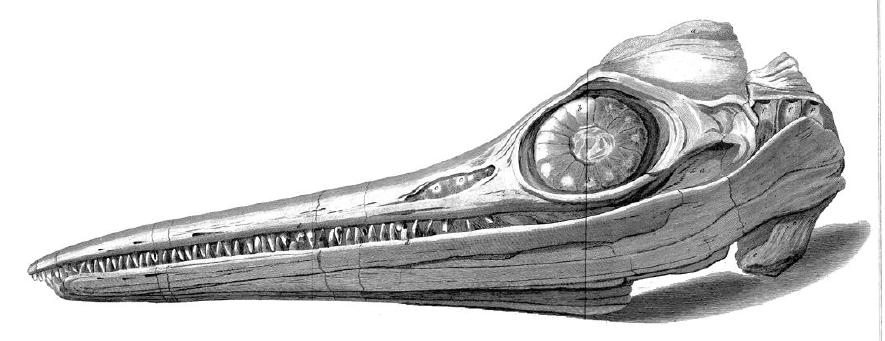
Left destitute by the death of their father in 1810, Mary and her brother Joseph turned to collecting fossils from the local coastline (now styled the Jurassic Coast: see recent Guardian pics) in the hope of selling them to amateur collectors. At the age of twelve, just a few months after her father's death, Mary made a spectacular find that brought her to the attention of the scientific community: the first complete skeleton of an ichthyosaur (a giant "fish lizard") ever found. Although Joseph had found the skull (shown here) a year before, Mary was responsible for locating the rest of the fossil.

Her subsequent discoveries included the first plesiosaur (her own drawing shown here) in 1821 and a remarkable specimen of an extinct ray-finned fish, Dapedium politum, in 1828. Anning also described the first complete skeleton of a flying reptile, the pterosaur Dimorphodon macronyx.

Later in life, Anning’s fame secured her financial support from the British Association for the Advancement of Science and honorary membership of the Geological Society of London—the only woman in an exclusively male club.

The chief impact of Anning’s work was that her fossils established beyond doubt the concept of extinction, proving that some extinct animals looked nothing like anything alive today. Anning died from breast cancer in her forties and is buried with her brother at St Michael’s Church, Lyme Regis, where a stained-glass window is dedicated to her memory.

Galton or Weismann first to continuity of the germ-plasm?

While researching the previous post, my curiosity was piqued over a comment by Frank Darwin about his relative Francis Galton (who BTW was apprenticed here in Birmingham). While researching The Rough Guide to Evolution, I soon realised that many quotations are misattributed (here is one telling example) or quoted out of context and so good scholarship requires that one actually dig out the source and confirm that it says what it is purported to say. In the last few years, and even more so since I wrote the book, this has become a whole lot easier, largely thanks to the Google books initiative.

So, let's return to what Frank wrote:

“But in science the credit goes to the man who convinces the world, not to the man to whom the idea first occurs. Not the man who finds a grain of new and precious quality, but to him who sows it, reaps it, grinds it and feeds the world on it.”


which I and others have cited in the context of his father's theory of evolution.

But if you look at the whole paragraph, it is clear that Frank was talking about an article in the Macmillan's Magazine by Francis Galton and the fact that Galton got to the theory of germ-plasm and what is often called the Weismann barrier earlier than August Weismann (who got there in the 1890s and is generally credited with priority):
"With regard to the machinery of reproduction the essay is remarkable for containing what is practically identical with Weismann’s continuity of the germ-cell, and Galton’s priority is acknowledged by that author. But in science the credit goes to the man who convinces the world, not to the man to whom the idea first occurs. Not the man who finds a grain of new and precious quality, but to him who sows it, reaps it, grinds it and feeds the world on it. This is true of this very Macmillan’s Magazine article. Who would know of these admirable views on Hereditary Genius and Eugenics, if this were Galton’s only utterance? This is the grain which has increased and multiplied: and it is to-day familiar nutriment, and is now assiduously cultivated by the Eugenics Education Society. But if Natural Inheritance, and Hereditary Genius had not been written; if the papers on eugenics had not appeared, and especially if he had not convinced the world of his seriousness by creating a eugenic foundation at University College, where his friend Professor Karl Pearson carries on the Galtonian traditions—why then the paper in Macmillan would have counted for very little. But it was not quite unnoticed. By my father it is referred to in the Variation of Animals and Plants under Domestication. Galton was encouraged and reassured by Darwin’s appreciation of his work: his words in Hereditary Genius are, “I feel assured that, inasmuch as what I then wrote was sufficient to earn the acceptance of Mr. Darwin . . . the increased amount of evidence submitted in the present volume is not likely to be gainsaid.” He was characteristically generous in owning his debt to the author of the Origin of Species, and characteristically modest in the value he ascribed to my father’s words."
So, does this mean the textbooks (and wikipedia) need re-writing? Should Weismann be demoted in the pantheon of the history of science? Well, a few moments with Google turns up the article that Frank was discussing and here is the relevant passage:
"If we examine the question from the opposite side, a list of life-long habits in the parents might be adduced which leave no perceptible trace on their descendants. I cannot ascertain that the son of an old soldier learns his drill more quickly than the son of an artizan. I am assured that the sons of fishermen, whose ancestors have pursued the same calling time out of mind, are just as sea-sick as the sons of landsmen when they first go to sea. I cannot discover that the castes of India show signs of being naturally endowed with special aptitudes. If the habits of an individual are transmitted to his descendants, it is, as Darwin says, in a very small degree, and is hardly, if at all, traceable.

We shall therefore take an approximately correct view of the origin of our life, if we consider our own embryos to have sprung immediately from those embryos whence our parents were developed, and these from the embryos of their parents, and so on for ever. We should in this way look on the nature of mankind, and perhaps on that of the whole animated creation, as one continuous system, ever pushing out new branches in all directions, that variously interlace, and that bud into separate lives at every point of interlacement.

This simile does not at all express the popular notion of life. Most persons seem to have a vague idea that a new element, specially fashioned in heaven, and not transmitted by simple descent, is introduced into the body of every newly-born infant. Such a notion is unfitted to stand upon any scientific basis with which we are acquainted. It is impossible it should be true, unless there exists some property or quality in man that is not transmissible by descent."
(NB I should at this stage distance myself from all the racist twaddle proffered elsewhere in Galton's article).

Well, there is a nice separation between embryo and soma here, and even a hint of Dawkin's Selfish Gene / river of DNA out of Eden. And it appears that Weismann did himself write to Galton in 1889:
"You have exposed in your paper an in idea which is in one essential point nearly allied to the main idea contained in my theory of the continuity of germ-plasm"

But another Google books link reveals an interesting analysis by Bulmer in his biography of Galton. Bulmer's verdict is that Galton foreshadowed Weismann "only in a weak sense", because his language and ideas were less precise.

Nonetheless, perhaps Galton should be edged into the textbooks and encyclopaedias on this? Or is this just another example of "precursorism"? What do you think?

Darwin: serial plagiarizer or revolutionary genius?

Stephen Jay Gould once joked that “precursoritis" (or should it be "precursorism") is the bane of historiography. Nonetheless, it is clear that there were precursors to Darwin in describing natural selection and other components of his theory of evolution.

In 1941, Conway Zirkle wrote a remarkable (and long) paper Natural Selection before the "Origin of Species" (available in full via Google books) in which he collated and discussed over two dozen descriptions of natural selection and associated ideas that pre-dated Darwin.

Although most of these earlier authors lacked Darwin’s clear conception of the implications of natural selection for the origin of species, some of their passages are strikingly prescient of Darwin’s ideas. Take, for example, this passage from French freethinker Jean-Jacques Rousseau (1712–78):

… children, bringing with them into the world the excellent constitution of their parents, and then confirming it by the same exercises which first produced it, would thus acquire all that strength and vigour, of which the human frame is capable. Nature in this case treats them exactly as Sparta treated the children of her citizens: those of them who came well formed into the world, she renders strong and robust, and destroys all the rest...

Or this passage from the German philosopher Johann Gottfried Herder (1744–1803):

In short, every species extends its possession of the Earth in proportion to its capacity, cunning, strength, or courage… the whole creation is at war, and the most opposite powers are found so close to each other… Each strives with each, as each is pressed upon; each must provide for his own subsistence, and defend his own life. Why acts Nature thus and why does she thus crowd her creatures one upon another? Because she would produce the greatest number and variety of living beings in the least space, so that one crushes another,and an equilibrium of powers can alone produce peace in the creation.


In the Temple of Nature, Charles Darwin’s grandfather, Erasmus Darwin provides a poetic description of the Struggle for Existence, culminating in a graphic rhyming couplet:

In ocean's pearly haunts, the waves beneath
Sits the grim monarch of insatiate Death;
The shark rapacious with descending blow
Darts on the scaly brood, that swims below;
The crawling crocodiles, beneath that move,
Arrest with rising jaw the tribes above; 60
With monstrous gape sepulchral whales devour
Shoals at a gulp, a million in an hour.
—Air, earth, and ocean, to astonish'd day
One scene of blood, one mighty tomb display!
From Hunger's arm the shafts of Death are hurl'd,
And one great Slaughter-house the warring world!

While in Zoonomia he obliquely references Sexual Selection and Natural Selection:

The birds, which do not carry food to their young, and do not therefore marry, are armed with spurs for the purpose of fighting for the exclusive possession of the females, as cocks and quails. It is certain that these weapons are not provided for their defence against other adversaries, because the females of these species are without this armour. The final cause of this contest amongst the males seems to be, that the strongest and most active animal should propagate the species, which should thence become improved.

Two other early descriptions of natural selection have been unearthed since Zirkle’s paper. One comes from a densely written inaccessible book (Principles of Knowledge: see review here) by one of Darwin’s heroes, the geologist James Hutton, who rejected evolution of species, but described natural selection:

If an organised body is not in the situation and circumstances best adapted to its sustenance and propagation, then, in conceiving an indefinite variety among the individuals of that species, we must be assured, that, on the one hand, those which depart most from the best adapted constitution, will be most liable to perish, while, on the other hand, those organised bodies, which most approach to the best constitution for the present circumstances, will be best adapted to continue, in preserving themselves and multiplying the individuals of their race.

The second comes from an unlikely source—Natural Theology (1809), where William Paley (the irritant that gave rise to Darwin's pearl) proposed natural selection, only later to reject it:

There is another answer which has the same effect as the resolving of things into chance; which answer would persuade us to believe, that the eye, the animal to which it belongs, every other animal, every plant, indeed every organized body which we see, are only so many out of the possible varieties and combinations of being, which the lapse of infinite ages has brought into existence; that the present world is the relict of that variety: millions of other bodily forms and other species having perished, being by the defect of their constitution incapable of preservation, or of continuance by generation.

Charles Darwin acknowledged the role of earlier thinkers such as Geoffrey St. Hilaire in very first edition of the Origin. He also clearly drew inspiration from agriculturalist Sir John Sebright, who he cites several times for his work on breeding. However, Darwin fails to mention in publication a passage penned by Sebright in 1809
The greatest number of females will, of course, fall to the share of the most vigorous males; and the strongest individuals of both sexes, by driving away the weakest, will enjoy the best food, and the most favourable situations, for themselves and for their offspring. A severe winter, or a scarcity of food, by destroying the weak and the unhealthy, has had all the good effects of the most skilful selection.
even though Darwin alluded to it in his C notebook of1838:
Sir J. Sebright — pamphlet most important showing effects of peculiarities being long in blood.++ thinks difficulty in crossing race — bad effects of incestuous intercourse. — excellent observations of sickly offspring being cut off so that not propagated by nature. — Whole art of making varieties may be inferred from facts stated

Two others were credited only in later editions of the Origin for their prior descriptions of natural selection. William Wells was a Scottish-American physician who described the role of natural selection in the evolution of humans in the appendix to an essay on dew published in 1818, while Patrick Matthew was a Scottish fruit grower who proposed natural selection as mechanism of evolution in his On Naval Timber and Arboriculture (1831) over a quarter-century before Darwin and Wallace.


So, it is clear that Darwin was not the first to propose all the ideas that made up later came to be known as the Darwinian Theory of Evolution. However, any attempt to detract from his revolutionary achievements by arguing that he was simply a serial plagiarist or intellectual scavenger is as senseless as claiming that Shakespeare was a second-rate playwright merely because he reused some old existing plotlines!!

It was Darwin’s genius to weave many disparate ideas (such as variation under domestication, Malthusian population pressure and the oddities of biogeography) into a unique combination that is still largely thought to be accurate today, while other combinations of similar concepts, for example, Lamarck's or Spencer's theories of evolution, have been abandoned.

In addition, Darwin was able to articulate these ideas, and the evidence for them, with such unprecedented clarity and forcefulness that within a few short years most naturalists and much of the wider society had come to accept biological evolution as a fact, proven beyond reasonable doubt. Furthermore, there is an abundant documentary evidence trail to show that Darwin generally did not rely on precursors in his thinking, and where he did, he acknowledged it.

Peter Bowler, Professor of History of Science at Queen’s University Belfast makes the point forcefully in his book Evolution, the History of an Idea:
“Simple priority is not enough to earn a thinker a place in the history of science: one has to develop the idea and convince others of its value to make a real contribution. Darwin's notebooks confirm that he drew no inspiration from Matthew or any of the other alleged precursors.”
Darwin’s own son Frank Darwin made a similar point in the first Galton Lecture in 1914 (albeit moaning about Weismann gaining credit when Francis Galton had priority over on the continuity of the germ cell) :
“In science the credit goes to the man who convinces the world, not to the man to whom the idea first occurs. Not the man who finds a grain of new and precious quality, but to him who sows it, reaps it, grinds it and feeds the world on it”
The last word on this subject should go to Darwin himself, who in an 1860 letter to Rev. Baden Powell (father of the scoutmaster) states that
"No person, not even the most ignorant, could suppose that I meant to arrogate to myself the origination of the doctrine that species had not been independently created. The only novelty in my work is the attempt to show how species become modified, and to a certain extent how the theory of descent explains certain large classes of facts; and in these respects I received no assistance from my predecessors."


Sources and related links

Monday, August 8, 2011

Minimum requirements for a PhD thesis

I am getting tired of having to examine sub-standard PhD theses and then having to write the same old comments in the report on the thesis, so I have decided to set down the minimum requirements for a PhD thesis. Anyone who is contemplating asking me to examine a thesis should read these and comply with them or stop wasting my time. And be warned, you don't want to get me cross by wasting my time with substandard theses that are an insult to my intelligence!

As most of those who read this blog are also academics, please feel free to add comments if you think I have been too harsh or lenient or when there are additional requirements that you would usually insist on. These requirements apply primarily to theses in molecular bacteriology and related disciplines and may not all apply in other disciplines.

The thesis as a whole

The thesis should comply with the regulations as regards margin sizes, order of front material and length of abstract. It should have been carefully proofread by someone experienced in the use of scientific English before submission.

The front material should include a declaration that all the work presented was performed by the student except where indicated and should list all the cases where the work presented in the thesis was not performed wholly by the student. Text from a multi-author paper, particularly if not primarily written by the student, should not be reproduced verbatim in the thesis without a clear description of where the student’s work ended and that of other authors began.

My suspicions will be aroused if the thesis is too short (<200 pages) or too long (>300 pages). It is almost never necessary to present a thesis that spans two volumes.

All sections of the thesis should comply with the usual conventions of scholarly scientific discourse. The thesis should be free of typographical, spelling, grammatical and stylistic errors. A consistent approach to typography (e.g. to fonts, use of capital letters in headings, justification of margins, line spacing and marking of paragraph breaks) and to formatting of references should be adopted throughout.

Latin binomials and gene names should be used correctly and italicised throughout, including in the table of contents and references. “E. coli” or any other species name should be treated as a singular noun. Proper use of nouns derived from Greek and Latin should be employed throughout, with care taken to avoid use of plural forms of the noun when the singular form is appropriate (e.g. do NOT write “the mitochondria is a bacteria”, “the culture media used was LB”). The terms “sequence homology” and “sequence similarity” should not be confused. Similarly, never say ORF when you mean protein-coding sequence or CDS!

Abbreviations should be spelt out at first use and defined in a list of abbreviations. Abbreviations should be avoided in the title of the thesis.

Throughout the thesis, when statements of scientific fact are made that have not been derived from the student’s own experimental work, they should be backed up by reference to peer-reviewed scientific publications. These may include review articles for subjects peripheral to the main thrust of the thesis, but should include original articles, with due credit for historical priority, for mainstream topics. References should be up-to-date and it should be clear that the student has kept up-to-date in the field right up until the submission date.

For the thesis as a whole and for each chapter, there should be a clear separation between the kind of material that belongs in the Introduction, in the Methods section, in the Results section and in the Discussion. There should be minimal repetition. In particular, the Introduction and Discussion sections of each results chapter should contain just enough reference to material introduced earlier in the thesis to maintain a narrative flow, but must not repetitively restate basic facts.

The Introduction

The Introduction should include extensive reference to the scientific literature, present a logical flow of ideas, with no non-sequiturs, and provide a rationale for the work that has been done. This need not consist solely of long stretches of text; instead, whenever appropriate, tables and figures should be used to convey the student’s understanding and knowledge of the field as succinctly as possible. The Introduction should be drafted in such a way as to provide evidence that the student had read and understood most of primary literature relevant to the thesis, rather than relying heavily on a handful of review articles. The student should also demonstrate an ability to make critical judgements on key issues. Irrelevant material should be excluded and students should from refrain from attempting encyclopaedic coverage.

In general, diagrams and figure legends should not be reproduced unchanged from papers and certainly not without the copyright holder’s permission. Instead these should be drafted from fresh or at least re-drafted to demonstrate that the student has grasped the concepts and facts illustrated or tabulated and has incorporated up-to-date findings and nomenclature.

The Introduction should close with a statement of aims and/or research questions waiting to be addressed at the outset of the project.

Methods and Results

Enough details should be provided of materials and methods so that someone expert in the field could reproduce the work—preferably without burrowing through a long chain of references Wherever possible, all data and analyses should be provided in the thesis, so that their veracity can be checked by the examiner. Where this might interrupt the narrative flow of the thesis, these should be presented in an appendix or, if datasets are large, they should be provided on a DVD.

Each line of experimental work should be given its own results chapter, with a brief introduction, a results section and a discussion section for each of the chapters. Methods specific to a given chapter might also feature in a dedicated methods section, although a Methods chapter dedicated to commonly used methods could be included.

The introduction to each results chapter should describe and justify the rationale for the programme of experimental work described in that chapter. Careful consideration should be given to what appears in the Introduction to the thesis as a whole and what should be reserved for the introduction to a specific results chapter, so as to present the most logical flow of ideas, while avoiding repetition. The narrative describing the progress of experiments and interpretation of data should deliver a simple and coherent description of the work undertaken. Long verbose descriptions of results should be avoided—instead, material should be summarised effectively in tables, figures or in crisp and lively prose.

Students should avoid over-interpretation of results—the student should distinguish between situations where the data are merely consistent with a given interpretation and where they actually provide convincing evidence for it.

Results from experimental controls should be presented whenever relevant. The number of replicates carried out for each experiment should be described and the reproducibility of techniques discussed. The potential for technical errors should be discussed together with the steps that the student took—or might have taken—to avoid them.

Where, for historical or financial reasons, the student has not adopted the most direct or most informative approach to a problem, this should be explained carefully. The student should attempt to evaluate the importance and shortcomings of each piece of work, in terms of how far it tells us new things about the world, represents an achievement in method development and/or provides resources for subsequent work.

Discussion

The thesis should conclude with a single Discussion chapter, which evaluates whether the body of research presented has fulfilled the aims set out at the end of the Introduction, examines how it fits into the broader scientific picture and assesses whether it is likely to stand the test of time in the light of recent technical and scientific developments. Repetition of material presented earlier in the thesis and a simple description of what has been done should be avoided.

Viva

During the viva, the candidate must demonstrate knowledge and understanding of all the work that has been done and the background to it. In addition, the student must demonstrate a sound grasp of basic concepts in microbiology and molecular biology (e.g. transcription, translation, the genetic code, Koch’s postulates), such as could be obtained from relevant undergraduate textbooks, and a critical approach to the definition of key terms (e.g. virulence, pathogenicity island).

Remember: the examiner's word is final and there is no appeal against academic judgment, so get it right before you submit the thesis and certainly before you start the viva!