Tuesday, August 30, 2011

The evolution of biblical manuscripts

In an ironic twist of fate that might infuriate creationist fundamentalist Christians, evolutionary thinking dominates scholarly studies of biblical manuscripts, particularly attempts to reconstruct original texts of the New Testament in the face of copying errors!

The New Testament of the King James Bible is a seventeenth-century English translation of the Textus Receptus, a Greek text prepared by Dutch theologian Erasmus in the sixteenth century from a few late-medieval manuscripts.

In the late nineteenth century, Birmingham-born theologian Brook Westcott and his Dublin-born collaborator Fenton Hort tried to improve on the Textus Receptus, publishing The New Testament in The Original Greek (1881), which incorporated information from a wide range of manuscripts, including the oldest fragments known at the time.

Crucially, they adopted a genealogical view of manuscript affiliation that directly parallels the tree-like branching descent with modification seen in Darwin’s theory of evolution. In their own words:

“All trustworthy restoration of corrupted texts is founded on the study of their history, that is, of the relations of descent or affinity which connect the several documents.”

However, Westcott and Hort also recognized the potential for horizontal transfer between lineages, viewing the Byzantine textual lineage as a fusion of the two earlier traditions (the western and Alexandrian).

In the early twentieth century, British theologian Burnett Streeter proposed a theory of local texts, in which textual traditions diverged as a result of geographical separation – a parallel with allopatric speciation in evolutionary biology.

From the 1950s onwards, American biblical scholar Ernest Colwell attempted to bring quantitative methods into the analysis of New Testament textual traditions. Cladistic approaches borrowed from evolutionary biology now sit at the cutting edge of studies of New Testament manuscripts: exponents include David Parker, a theologian at the University of Birmingham, Gerd Mink at the Institute for New Testament Textual Research, Münster, Germany and among American scholars, Stephen Carlson.

So, in conclusion, evolutionary thinking even illuminates the origins of the text of the Bible!

Wednesday, August 24, 2011

Some Darwinian poetry to make you smile

Charles Darwin's grandfather Eramus Darwin was a brilliant but seriously bonkers chap--a kind of 18th Century English Rasta. You can read all about his interests on the relevant Wikipedia page, but I cannot help sharing these few lines from the Temple of Nature in which he sees the fruits of past (sensual or sexual) pleasure in geological sediments? What was he smoking?

"HEAR, O ye Sons of Time! your final doom,
And read the characters, that mark your tomb:
The marble mountain, and the sparry steep,
Were built by myriad nations of the deep, --
Age after age, who form'd their spiral shells,
Their sea-fan gardens and their coral cells;
Till central fires with unextinguished sway
Raised the primeval islands into day; --
The sand-fill'd strata stretch'd from pole to pole;
Unmeasured beds of clay, and marl, and coal,
Black ore of manganese, the zinky stone,
And dusky steel on his magnetic throne,
In deep morass, or eminence superb,
Rose from the wrecks of animal or herb;
These from their elements by Life combined,
Form'd by digestion, and in glands refined,
Gave by their just excitement of the sense
The Bliss of Being to the vital Ens.

"Thus the tall mountains, that emboss the lands,
Huge isles of rock, and continents of sands,
Whose dim extent eludes the inquiring sight,
ARE MIGHTY MONUMENTS OF PAST DELIGHT;
Shout round the globe, how Reproduction strives
With vanquish'd Death, -- and Happiness survives;
How Life increasing peoples every clime,
And young renascent nature conquers Time;
And high in golden characters record
The immense munificence of NATURE'S LORD!
For a roots reggae reinterpretation of some of Ras D's anti-slavery poetry, have a listen at this rough and ready bit of whimsy I cooked up a few years ago with a Jamaican friend.

Thursday, August 11, 2011

Mary Anning: Fossil hunter extraordinaire

Anyone off to Lyme Regis for their holidays should spare a thought for Mary Anning (1799-1847), who hailed from this English coastal town. Geologist and historian of science Hugh Torrens describes her as “the greatest fossilist the world ever knew”.

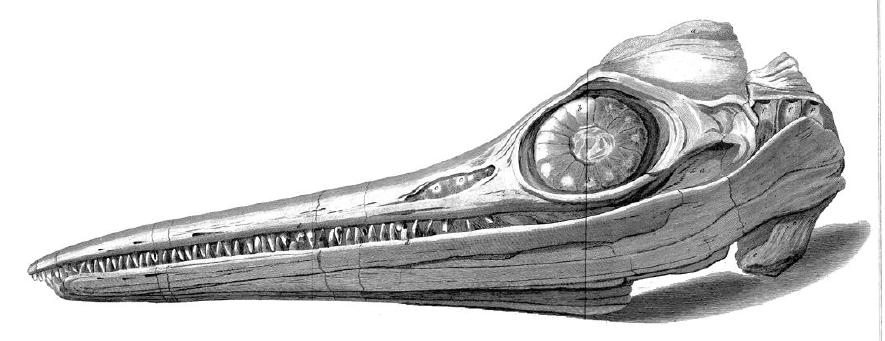
Left destitute by the death of their father in 1810, Mary and her brother Joseph turned to collecting fossils from the local coastline (now styled the Jurassic Coast: see recent Guardian pics) in the hope of selling them to amateur collectors. At the age of twelve, just a few months after her father's death, Mary made a spectacular find that brought her to the attention of the scientific community: the first complete skeleton of an ichthyosaur (a giant "fish lizard") ever found. Although Joseph had found the skull (shown here) a year before, Mary was responsible for locating the rest of the fossil.

Her subsequent discoveries included the first plesiosaur (her own drawing shown here) in 1821 and a remarkable specimen of an extinct ray-finned fish, Dapedium politum, in 1828. Anning also described the first complete skeleton of a flying reptile, the pterosaur Dimorphodon macronyx.

Later in life, Anning’s fame secured her financial support from the British Association for the Advancement of Science and honorary membership of the Geological Society of London—the only woman in an exclusively male club.

The chief impact of Anning’s work was that her fossils established beyond doubt the concept of extinction, proving that some extinct animals looked nothing like anything alive today. Anning died from breast cancer in her forties and is buried with her brother at St Michael’s Church, Lyme Regis, where a stained-glass window is dedicated to her memory.

Galton or Weismann first to continuity of the germ-plasm?

While researching the previous post, my curiosity was piqued over a comment by Frank Darwin about his relative Francis Galton (who BTW was apprenticed here in Birmingham). While researching The Rough Guide to Evolution, I soon realised that many quotations are misattributed (here is one telling example) or quoted out of context and so good scholarship requires that one actually dig out the source and confirm that it says what it is purported to say. In the last few years, and even more so since I wrote the book, this has become a whole lot easier, largely thanks to the Google books initiative.

So, let's return to what Frank wrote:

“But in science the credit goes to the man who convinces the world, not to the man to whom the idea first occurs. Not the man who finds a grain of new and precious quality, but to him who sows it, reaps it, grinds it and feeds the world on it.”


which I and others have cited in the context of his father's theory of evolution.

But if you look at the whole paragraph, it is clear that Frank was talking about an article in the Macmillan's Magazine by Francis Galton and the fact that Galton got to the theory of germ-plasm and what is often called the Weismann barrier earlier than August Weismann (who got there in the 1890s and is generally credited with priority):
"With regard to the machinery of reproduction the essay is remarkable for containing what is practically identical with Weismann’s continuity of the germ-cell, and Galton’s priority is acknowledged by that author. But in science the credit goes to the man who convinces the world, not to the man to whom the idea first occurs. Not the man who finds a grain of new and precious quality, but to him who sows it, reaps it, grinds it and feeds the world on it. This is true of this very Macmillan’s Magazine article. Who would know of these admirable views on Hereditary Genius and Eugenics, if this were Galton’s only utterance? This is the grain which has increased and multiplied: and it is to-day familiar nutriment, and is now assiduously cultivated by the Eugenics Education Society. But if Natural Inheritance, and Hereditary Genius had not been written; if the papers on eugenics had not appeared, and especially if he had not convinced the world of his seriousness by creating a eugenic foundation at University College, where his friend Professor Karl Pearson carries on the Galtonian traditions—why then the paper in Macmillan would have counted for very little. But it was not quite unnoticed. By my father it is referred to in the Variation of Animals and Plants under Domestication. Galton was encouraged and reassured by Darwin’s appreciation of his work: his words in Hereditary Genius are, “I feel assured that, inasmuch as what I then wrote was sufficient to earn the acceptance of Mr. Darwin . . . the increased amount of evidence submitted in the present volume is not likely to be gainsaid.” He was characteristically generous in owning his debt to the author of the Origin of Species, and characteristically modest in the value he ascribed to my father’s words."
So, does this mean the textbooks (and wikipedia) need re-writing? Should Weismann be demoted in the pantheon of the history of science? Well, a few moments with Google turns up the article that Frank was discussing and here is the relevant passage:
"If we examine the question from the opposite side, a list of life-long habits in the parents might be adduced which leave no perceptible trace on their descendants. I cannot ascertain that the son of an old soldier learns his drill more quickly than the son of an artizan. I am assured that the sons of fishermen, whose ancestors have pursued the same calling time out of mind, are just as sea-sick as the sons of landsmen when they first go to sea. I cannot discover that the castes of India show signs of being naturally endowed with special aptitudes. If the habits of an individual are transmitted to his descendants, it is, as Darwin says, in a very small degree, and is hardly, if at all, traceable.

We shall therefore take an approximately correct view of the origin of our life, if we consider our own embryos to have sprung immediately from those embryos whence our parents were developed, and these from the embryos of their parents, and so on for ever. We should in this way look on the nature of mankind, and perhaps on that of the whole animated creation, as one continuous system, ever pushing out new branches in all directions, that variously interlace, and that bud into separate lives at every point of interlacement.

This simile does not at all express the popular notion of life. Most persons seem to have a vague idea that a new element, specially fashioned in heaven, and not transmitted by simple descent, is introduced into the body of every newly-born infant. Such a notion is unfitted to stand upon any scientific basis with which we are acquainted. It is impossible it should be true, unless there exists some property or quality in man that is not transmissible by descent."
(NB I should at this stage distance myself from all the racist twaddle proffered elsewhere in Galton's article).

Well, there is a nice separation between embryo and soma here, and even a hint of Dawkin's Selfish Gene / river of DNA out of Eden. And it appears that Weismann did himself write to Galton in 1889:
"You have exposed in your paper an in idea which is in one essential point nearly allied to the main idea contained in my theory of the continuity of germ-plasm"

But another Google books link reveals an interesting analysis by Bulmer in his biography of Galton. Bulmer's verdict is that Galton foreshadowed Weismann "only in a weak sense", because his language and ideas were less precise.

Nonetheless, perhaps Galton should be edged into the textbooks and encyclopaedias on this? Or is this just another example of "precursorism"? What do you think?

Darwin: serial plagiarizer or revolutionary genius?

Stephen Jay Gould once joked that “precursoritis" (or should it be "precursorism") is the bane of historiography. Nonetheless, it is clear that there were precursors to Darwin in describing natural selection and other components of his theory of evolution.

In 1941, Conway Zirkle wrote a remarkable (and long) paper Natural Selection before the "Origin of Species" (available in full via Google books) in which he collated and discussed over two dozen descriptions of natural selection and associated ideas that pre-dated Darwin.

Although most of these earlier authors lacked Darwin’s clear conception of the implications of natural selection for the origin of species, some of their passages are strikingly prescient of Darwin’s ideas. Take, for example, this passage from French freethinker Jean-Jacques Rousseau (1712–78):

… children, bringing with them into the world the excellent constitution of their parents, and then confirming it by the same exercises which first produced it, would thus acquire all that strength and vigour, of which the human frame is capable. Nature in this case treats them exactly as Sparta treated the children of her citizens: those of them who came well formed into the world, she renders strong and robust, and destroys all the rest...

Or this passage from the German philosopher Johann Gottfried Herder (1744–1803):

In short, every species extends its possession of the Earth in proportion to its capacity, cunning, strength, or courage… the whole creation is at war, and the most opposite powers are found so close to each other… Each strives with each, as each is pressed upon; each must provide for his own subsistence, and defend his own life. Why acts Nature thus and why does she thus crowd her creatures one upon another? Because she would produce the greatest number and variety of living beings in the least space, so that one crushes another,and an equilibrium of powers can alone produce peace in the creation.


In the Temple of Nature, Charles Darwin’s grandfather, Erasmus Darwin provides a poetic description of the Struggle for Existence, culminating in a graphic rhyming couplet:

In ocean's pearly haunts, the waves beneath
Sits the grim monarch of insatiate Death;
The shark rapacious with descending blow
Darts on the scaly brood, that swims below;
The crawling crocodiles, beneath that move,
Arrest with rising jaw the tribes above; 60
With monstrous gape sepulchral whales devour
Shoals at a gulp, a million in an hour.
—Air, earth, and ocean, to astonish'd day
One scene of blood, one mighty tomb display!
From Hunger's arm the shafts of Death are hurl'd,
And one great Slaughter-house the warring world!

While in Zoonomia he obliquely references Sexual Selection and Natural Selection:

The birds, which do not carry food to their young, and do not therefore marry, are armed with spurs for the purpose of fighting for the exclusive possession of the females, as cocks and quails. It is certain that these weapons are not provided for their defence against other adversaries, because the females of these species are without this armour. The final cause of this contest amongst the males seems to be, that the strongest and most active animal should propagate the species, which should thence become improved.

Two other early descriptions of natural selection have been unearthed since Zirkle’s paper. One comes from a densely written inaccessible book (Principles of Knowledge: see review here) by one of Darwin’s heroes, the geologist James Hutton, who rejected evolution of species, but described natural selection:

If an organised body is not in the situation and circumstances best adapted to its sustenance and propagation, then, in conceiving an indefinite variety among the individuals of that species, we must be assured, that, on the one hand, those which depart most from the best adapted constitution, will be most liable to perish, while, on the other hand, those organised bodies, which most approach to the best constitution for the present circumstances, will be best adapted to continue, in preserving themselves and multiplying the individuals of their race.

The second comes from an unlikely source—Natural Theology (1809), where William Paley (the irritant that gave rise to Darwin's pearl) proposed natural selection, only later to reject it:

There is another answer which has the same effect as the resolving of things into chance; which answer would persuade us to believe, that the eye, the animal to which it belongs, every other animal, every plant, indeed every organized body which we see, are only so many out of the possible varieties and combinations of being, which the lapse of infinite ages has brought into existence; that the present world is the relict of that variety: millions of other bodily forms and other species having perished, being by the defect of their constitution incapable of preservation, or of continuance by generation.

Charles Darwin acknowledged the role of earlier thinkers such as Geoffrey St. Hilaire in very first edition of the Origin. He also clearly drew inspiration from agriculturalist Sir John Sebright, who he cites several times for his work on breeding. However, Darwin fails to mention in publication a passage penned by Sebright in 1809
The greatest number of females will, of course, fall to the share of the most vigorous males; and the strongest individuals of both sexes, by driving away the weakest, will enjoy the best food, and the most favourable situations, for themselves and for their offspring. A severe winter, or a scarcity of food, by destroying the weak and the unhealthy, has had all the good effects of the most skilful selection.
even though Darwin alluded to it in his C notebook of1838:
Sir J. Sebright — pamphlet most important showing effects of peculiarities being long in blood.++ thinks difficulty in crossing race — bad effects of incestuous intercourse. — excellent observations of sickly offspring being cut off so that not propagated by nature. — Whole art of making varieties may be inferred from facts stated

Two others were credited only in later editions of the Origin for their prior descriptions of natural selection. William Wells was a Scottish-American physician who described the role of natural selection in the evolution of humans in the appendix to an essay on dew published in 1818, while Patrick Matthew was a Scottish fruit grower who proposed natural selection as mechanism of evolution in his On Naval Timber and Arboriculture (1831) over a quarter-century before Darwin and Wallace.


So, it is clear that Darwin was not the first to propose all the ideas that made up later came to be known as the Darwinian Theory of Evolution. However, any attempt to detract from his revolutionary achievements by arguing that he was simply a serial plagiarist or intellectual scavenger is as senseless as claiming that Shakespeare was a second-rate playwright merely because he reused some old existing plotlines!!

It was Darwin’s genius to weave many disparate ideas (such as variation under domestication, Malthusian population pressure and the oddities of biogeography) into a unique combination that is still largely thought to be accurate today, while other combinations of similar concepts, for example, Lamarck's or Spencer's theories of evolution, have been abandoned.

In addition, Darwin was able to articulate these ideas, and the evidence for them, with such unprecedented clarity and forcefulness that within a few short years most naturalists and much of the wider society had come to accept biological evolution as a fact, proven beyond reasonable doubt. Furthermore, there is an abundant documentary evidence trail to show that Darwin generally did not rely on precursors in his thinking, and where he did, he acknowledged it.

Peter Bowler, Professor of History of Science at Queen’s University Belfast makes the point forcefully in his book Evolution, the History of an Idea:
“Simple priority is not enough to earn a thinker a place in the history of science: one has to develop the idea and convince others of its value to make a real contribution. Darwin's notebooks confirm that he drew no inspiration from Matthew or any of the other alleged precursors.”
Darwin’s own son Frank Darwin made a similar point in the first Galton Lecture in 1914 (albeit moaning about Weismann gaining credit when Francis Galton had priority over on the continuity of the germ cell) :
“In science the credit goes to the man who convinces the world, not to the man to whom the idea first occurs. Not the man who finds a grain of new and precious quality, but to him who sows it, reaps it, grinds it and feeds the world on it”
The last word on this subject should go to Darwin himself, who in an 1860 letter to Rev. Baden Powell (father of the scoutmaster) states that
"No person, not even the most ignorant, could suppose that I meant to arrogate to myself the origination of the doctrine that species had not been independently created. The only novelty in my work is the attempt to show how species become modified, and to a certain extent how the theory of descent explains certain large classes of facts; and in these respects I received no assistance from my predecessors."


Sources and related links

Monday, August 8, 2011

Minimum requirements for a PhD thesis

I am getting tired of having to examine sub-standard PhD theses and then having to write the same old comments in the report on the thesis, so I have decided to set down the minimum requirements for a PhD thesis. Anyone who is contemplating asking me to examine a thesis should read these and comply with them or stop wasting my time. And be warned, you don't want to get me cross by wasting my time with substandard theses that are an insult to my intelligence!

As most of those who read this blog are also academics, please feel free to add comments if you think I have been too harsh or lenient or when there are additional requirements that you would usually insist on. These requirements apply primarily to theses in molecular bacteriology and related disciplines and may not all apply in other disciplines.

The thesis as a whole

The thesis should comply with the regulations as regards margin sizes, order of front material and length of abstract. It should have been carefully proofread by someone experienced in the use of scientific English before submission.

The front material should include a declaration that all the work presented was performed by the student except where indicated and should list all the cases where the work presented in the thesis was not performed wholly by the student. Text from a multi-author paper, particularly if not primarily written by the student, should not be reproduced verbatim in the thesis without a clear description of where the student’s work ended and that of other authors began.

My suspicions will be aroused if the thesis is too short (<200 pages) or too long (>300 pages). It is almost never necessary to present a thesis that spans two volumes.

All sections of the thesis should comply with the usual conventions of scholarly scientific discourse. The thesis should be free of typographical, spelling, grammatical and stylistic errors. A consistent approach to typography (e.g. to fonts, use of capital letters in headings, justification of margins, line spacing and marking of paragraph breaks) and to formatting of references should be adopted throughout.

Latin binomials and gene names should be used correctly and italicised throughout, including in the table of contents and references. “E. coli” or any other species name should be treated as a singular noun. Proper use of nouns derived from Greek and Latin should be employed throughout, with care taken to avoid use of plural forms of the noun when the singular form is appropriate (e.g. do NOT write “the mitochondria is a bacteria”, “the culture media used was LB”). The terms “sequence homology” and “sequence similarity” should not be confused. Similarly, never say ORF when you mean protein-coding sequence or CDS!

Abbreviations should be spelt out at first use and defined in a list of abbreviations. Abbreviations should be avoided in the title of the thesis.

Throughout the thesis, when statements of scientific fact are made that have not been derived from the student’s own experimental work, they should be backed up by reference to peer-reviewed scientific publications. These may include review articles for subjects peripheral to the main thrust of the thesis, but should include original articles, with due credit for historical priority, for mainstream topics. References should be up-to-date and it should be clear that the student has kept up-to-date in the field right up until the submission date.

For the thesis as a whole and for each chapter, there should be a clear separation between the kind of material that belongs in the Introduction, in the Methods section, in the Results section and in the Discussion. There should be minimal repetition. In particular, the Introduction and Discussion sections of each results chapter should contain just enough reference to material introduced earlier in the thesis to maintain a narrative flow, but must not repetitively restate basic facts.

The Introduction

The Introduction should include extensive reference to the scientific literature, present a logical flow of ideas, with no non-sequiturs, and provide a rationale for the work that has been done. This need not consist solely of long stretches of text; instead, whenever appropriate, tables and figures should be used to convey the student’s understanding and knowledge of the field as succinctly as possible. The Introduction should be drafted in such a way as to provide evidence that the student had read and understood most of primary literature relevant to the thesis, rather than relying heavily on a handful of review articles. The student should also demonstrate an ability to make critical judgements on key issues. Irrelevant material should be excluded and students should from refrain from attempting encyclopaedic coverage.

In general, diagrams and figure legends should not be reproduced unchanged from papers and certainly not without the copyright holder’s permission. Instead these should be drafted from fresh or at least re-drafted to demonstrate that the student has grasped the concepts and facts illustrated or tabulated and has incorporated up-to-date findings and nomenclature.

The Introduction should close with a statement of aims and/or research questions waiting to be addressed at the outset of the project.

Methods and Results

Enough details should be provided of materials and methods so that someone expert in the field could reproduce the work—preferably without burrowing through a long chain of references Wherever possible, all data and analyses should be provided in the thesis, so that their veracity can be checked by the examiner. Where this might interrupt the narrative flow of the thesis, these should be presented in an appendix or, if datasets are large, they should be provided on a DVD.

Each line of experimental work should be given its own results chapter, with a brief introduction, a results section and a discussion section for each of the chapters. Methods specific to a given chapter might also feature in a dedicated methods section, although a Methods chapter dedicated to commonly used methods could be included.

The introduction to each results chapter should describe and justify the rationale for the programme of experimental work described in that chapter. Careful consideration should be given to what appears in the Introduction to the thesis as a whole and what should be reserved for the introduction to a specific results chapter, so as to present the most logical flow of ideas, while avoiding repetition. The narrative describing the progress of experiments and interpretation of data should deliver a simple and coherent description of the work undertaken. Long verbose descriptions of results should be avoided—instead, material should be summarised effectively in tables, figures or in crisp and lively prose.

Students should avoid over-interpretation of results—the student should distinguish between situations where the data are merely consistent with a given interpretation and where they actually provide convincing evidence for it.

Results from experimental controls should be presented whenever relevant. The number of replicates carried out for each experiment should be described and the reproducibility of techniques discussed. The potential for technical errors should be discussed together with the steps that the student took—or might have taken—to avoid them.

Where, for historical or financial reasons, the student has not adopted the most direct or most informative approach to a problem, this should be explained carefully. The student should attempt to evaluate the importance and shortcomings of each piece of work, in terms of how far it tells us new things about the world, represents an achievement in method development and/or provides resources for subsequent work.

Discussion

The thesis should conclude with a single Discussion chapter, which evaluates whether the body of research presented has fulfilled the aims set out at the end of the Introduction, examines how it fits into the broader scientific picture and assesses whether it is likely to stand the test of time in the light of recent technical and scientific developments. Repetition of material presented earlier in the thesis and a simple description of what has been done should be avoided.

Viva

During the viva, the candidate must demonstrate knowledge and understanding of all the work that has been done and the background to it. In addition, the student must demonstrate a sound grasp of basic concepts in microbiology and molecular biology (e.g. transcription, translation, the genetic code, Koch’s postulates), such as could be obtained from relevant undergraduate textbooks, and a critical approach to the definition of key terms (e.g. virulence, pathogenicity island).

Remember: the examiner's word is final and there is no appeal against academic judgment, so get it right before you submit the thesis and certainly before you start the viva!


Thursday, July 28, 2011

Survival of the aptest: evolutionary turns of phrase

The terms adaptation and evolution pre-date Darwin. The term “adapt” comes from the Latin adaptare, to make fit. William Paley used the terms “adapted” and “adaptation” repeatedly in Natural Theology (1809):

“The eyes of fishes also, compared with those of terrestrial animals, exhibit certain distinctions of structure, adapted to their state and elements.”

The word “evolution” stems from the Latin evolutio meaning “unfolding”, particularly “the unrolling and reading of a scroll, the reading of a book”. The term has acquired a general meaning covering any process of formation or growth or development; in biology it was first used as a term to describe embryological development. The word “evolution” was first used in connection with the development of species in 1762 by Swiss naturalist Charles Bonnet, who developed a theory of pre-formation (females carry within them all future generations in a miniature form) and catastrophism.

Curiously, Darwin, in the first edition of The Origin, never used the term “evolution”; instead his preferred phrase for the idea was “descent with modification”. He did use the term “evolved”, however, as the very last word of his text.

The term “natural selection” originates with Darwin, but was criticized as being too anthropomorphic, breathing agency into an inanimate process – selection implies a selector. Darwin in a letter to his geologist friend Lyell, a year or so after completing The Origin, states that if he were starting afresh he would have used the term “natural preservation”.

However, the phrase that caught the public’s imagination, then and now, is survival of the fittest, which originates not with Darwin, but with his contemporary Herbert Spencer. Alfred Russel Wallace regularly urged Darwin to dump the term natural selection and replace it with Spencer’s phrase. Darwin went half way – in the fifth edition of The Origin he added “or Survival of the Fittest” to “Natural Selection” in the title of Chapter 4 and used the phrase several times in the text.

Despite its popularity with the public, the phrase “survival of the fittest” is now seldom if ever used by professional biologists and has been eliminated from any serious presentation of Darwin’s ideas. There are several problems with it. A modern reading misunderstands Darwin’s meaning: in Darwin’s time, the word “fittest” primarily meant “best suited” or “most appropriate” rather than, as now, “in best physical shape”.

But more troublesome, the phrase has helped fuel the excesses of Social Darwinism, erroneously suggesting that evolution provides moral justification for “might makes right” and for the mistreatment and even murder of those designated “unfit”. In addition, if the fittest are defined as those best equipped to survive, the phrase becomes an uninformative tautology that obscures the essential features of natural selection.

Instead, when it comes to the survival of the aptest, “natural selection” has emerged as clear winner!

Darwin’s captain: Robert FitzRoy

Robert FitzRoy (1805–65) entered the Royal Navy at age thirteen and, after passing exams with full marks, moved quickly up the ranks. In 1828, he became temporary captain of the Beagle, returning the ship to England in October 1830. The following May, FitzRoy stood unsuccessfully as Tory candidate for Ipswich. A few weeks later, the Beagle and her captain were commissioned for a second South American Survey.

Fitzroy knew that he was prone to bouts of morbid depression and was haunted by two recent suicides. The first was that of his uncle Viscount Castlereagh, a brilliant but controversial politician who, as Foreign Secretary, had helped bring peace to Europe in the wake of the Napoleonic Wars (Shelley damns him in his brilliant Masque of Anarchy). In 1822, Castlereagh fell victim to a real or imagined gay sex scandal, claiming to the king that he was being blackmailed. His mind unhinged, three days later he slit his own throat with a letter opener.

The second incident occurred a few years later, during the Beagle’s first survey of the southern hemisphere under the command of Captain Pringle Stokes. In August 1828, during the gloomy southern winter, Stokes locked the door to his cabin, shot himself in the head, and then took an agonizing twelve days to die.

Mindful of these dangerous precedents, FitzRoy took Darwin along as his gentleman companion and changed the course of history. Nonetheless, FitzRoy did succumb to despair part way through the second Beagle journey, resigning his captaincy for a short while before being persuaded to resume command.

But FitzRoy was more than just a bit player in Darwin’s story. In the 1840s, he served as the Tory MP for Durham before serving disastrously as the second Governor of New Zealand – during his term, the colony almost became bankrupt and a new war broke out.

However, FitzRoy is justly celebrated for his pioneering contributions to meteorology: he invented the storm glass (a device for predicting the weather), developed new and improved barometers and invented weather forecasts and gale warnings for fisherman.

FitzRoy retired in 1863 with the rank of Vice-Admiral. But, at the age of sixty, the depression he had so feared aboard the Beagle finally caught up with him – one morning, FitzRoy got out of bed, went to his washroom and, echoing his uncle’s demise, slit his own throat with a razor.

Friday, July 22, 2011

Don't let Rough Guides let The Rough Guide to Evolution go out of print!

Is it possible to be very happy and very disappointed at the same time? That is about how I am feeling right now!!

Why am I happy?
Well, as I pointed out a few posts back, my university, the University of Birmingham, has taken the bold step of buying 6000 copies of my book The Rough Guide to Evolution and will be giving a copy to every new undergraduate student at the start of the next academic year in September.

This is a wonderful initiative--just imagine students, studying every subject we teach (and all their lecturers), all reading about evolution and its impact on every aspect of human thought at the very same time in the very same week!! Has there ever been anything like it?!! Other universities have had student books, but these have always been novels or memoirs. This is the first time, a whole cohort of students has been simultaneously reading one factual book and, Darwin and evolution fans, rejoice in the fact that it is on evolution!!

And to cap it all, we are having a series of events at the University allied to the launch of this "Great Read" initiative, including a talk from the award-winning Ken Miller, subject of so many positive tweets for his recent talk at the Evolution 2011 conference in Norman, Oklahoma and Darwin descendant and novelist Emma Darwin talking about the evolution of a novel!

So, why am I disappointed?
Because the University has now emptied the warehouse at Rough Guides of copies of the book and so this initiative will drive the book out of print, unless Rough Guides agree to a reprint. The minimum reprint is 3000 copies and I shouldn't imagine Rough Guides are paying more than a couple of quid per copy to be printed, so we are talking only a few thousand pounds of investment here.

So how have Rough Guides responded?
They have said that it is too risky for them to print another 3000 copies, because they cannot be certain of the demand! :-(

And why does it matter if the Rough Guide to Evolution is now out of print?
It seems very sad to me that the Rough Guide to Evolution will soon be out of print, when ideally you the public should be at least be getting a reprint and at best a new edition. All those five star reviews and for nothing!

And then there is the fact that the Great Read initiative will soon be communicated to hundreds of thousands of our alumni, many of whom are likely to want to buy their own copies of The Rough Guide to Evolution.

And some of the parents of students coming here are going to want their own copies.

And so will some of our university staff who are not teaching first years, and so don't get a copy of the Rough Guide to Evolution for free!

And what about all those who hear of the initiative via media reports?

And finally there is all you evolution fans out there in the blogosphere and twittersphere and on Facebook.

If you don't have one already, wouldn't you still like to be able to buy a copy for yourself?

And if you do have your own copy, wouldn't you recommend The Rough Guide to Evolution to friends and family?

And if you work for an organisation that defends evolution and science (e.g. the NCSE), wouldn't you want to continue to be able to recommend it--or even buy it for use in--your outreach programme?

An experiment
So, dear reader, why don't we do an experiment to see how much support and demand their is for a reprint, just from you people reading this, let alone all those alumni and parents?

If you are on twitter, please tweet or retweet "@roughguides please don't let #roughguidetoevolution go out of print; I want a copy; please reprint now!" with a link to this page. I will retweet the message each day for a week!

If you are not on twitter, please add a comment to this blog (and follow the link to get here if reading on Facebook) confirming that you don't want the Rough Guide to Evolution to go out of print and why.

If you feel particularly strongly about this, please e-mail Rough Guides editor Andrew Lockett (Andrew.Lockett@uk.roughguides.com) politely expressing your dismay and providing evidence for the value of keeping The Rough Guide to Evolution in print.

So, let's see how it goes. If we get only a few dozen statements of support, then Rough Guides are right not to do a reprint. If we get hundreds, that will give them pause for thought, but probably won't be enough. But if we get thousands, then they will have to take notice.

And if all my twitter followers retweet the message that and then all their followers retweet it, we could have thousands of tweets in days!

The game's afoot--get tweeting!

Thursday, July 21, 2011

Another five star review


5.0 out of 5 stars A Grand and Glorious Guide to Evolution,
By John Kwok (New York, NY USA)

Why is evolution one of the most important ideas of science? Who was Charles Darwin, and why should he be seen as one of the greatest scientists of all time? How has evolutionary thought influenced sciences other than biology? What impact has evolutionary thought made on the humanities and arts? Why is evolution controversial? These are the principal questions addressed by British microbiologist Mark Pallen in "The Rough Guide to Evolution". It is a relatively terse masterpiece of scientific writing and content, which tells the story of evolution and its fundamental importance to human society and culture in barely more than three hundred twenty pages. "The Rough Guide to Evolution" deserves a place on the bookshelves of everyone, both the scientifically literate, and especially, those who are not, simply for the compelling story it tells about the origins, history and current thinking with regards to evolution.

The largest, most important, section is entitled "Part 1: Ideas and Evidence", tracing the history of evolutionary thought, from antiquity to the very present. The first three chapters summarize early thinking on evolution and, of course, Darwin's life and career. Pallen's biographical chapters on Darwin (2 and 3) are especially noteworthy for dispelling myths about Darwin's life and work, and for succinctly presenting the main concepts of his theory of evolution via natural selection (which was discovered independently by Wallace). Chapter 4 is a most admirable summary of the major lines of evidence for evolution, covering everything from biogeography to missing links in the fossil record, vestigial organs in humans, and the significance of homology. In Chapter 5 ("Evolutionary Biology"), Pallen offers among the best written accounts I have read on the nature of speciation (accompanied by simple, well-executed diagrams illustrating the major types) and of phylogenetic systematics (more popularly known as "cladistics"), emphasizing how much modern evolutionary biology has advanced considerably since the joint publication of Darwin and Wallace's ideas on natural selection in 1858 (The only glaring omissions appear to be extensive discussions of coevolution and of ecology, especially of the important species area effect, noted first by one of Darwin's heroes, Baron Alexander von Humboldt.).

A relatively brief section on the history of life (Part 2) is subtitled, "The Greatest Story Ever Told". Much to my surprise, in one long chapter (6), Pallen discusses not only the origin of life on Earth, but also a surprisingly thorough summary of the entire Phanerozoic Eon (the history of life since the dawn of the Cambrian Period, approximately 550 million years ago), which notes not just the major innovations in that history (evolution of the earliest metazoans and the successive invasions of the land by plants and animals), but such, quite literally, Earth-shattering, events as the terminal Permian and Cretaceous mass extinctions, which, respectively, wiped out approximately 96 and 50 percent of Earth's biota (There's an extensive discussion too on the probable causes of mass extinctions, which, amazingly, refers to the important 1982 paper by American invertebrate paleontologists J. John Sepkoski and David M. Raup.). Human evolution is covered extensively in the following chapter (7), and this may be as noteworthy for both the socio-political aspects of paleoanthropology and, of course, its fossil evidence.

Part 3 ("Impact") emphasizes evolution's influence on other sciences, humanities and the arts, and its still controversial relationship to certain religions. For these reasons alone, readers may find this the most interesting, most compelling, section of this Rough Guide. In Chapter 8, Pallen truly covers a vast terrain, emphasizing how natural selection is influencing modern cosmology, computer science, and even, economics (which, I suppose, isn't surprising, given how early modern economics - in the form of Adam Smith's thinking - influenced Darwin's own conception of the "economy of nature"). He also devotes much attention to the still controversial evolutionary psychology and its intellectual ancestor, sociobiology (Incidentally Pallen neglects to mention American entomologist E. O. Wilson's seminal contribution to ecology; the MacArthur - Wilson model of equilibrium island biogeography. One might argue persuasively that this very concept has had as much importance in modern biology - especially in the realm of conservation biology - as has sociobiology.). Chapter 9, devoted to evolution's impact on philosophy and the arts, covers everything from late 19th Century Victorian fiction to science fiction, and even, rock and roll and reggae. Chapter 10, on evolution's uneasy relationship with politics, not only discusses at length, Herbert Spencer's Social Darwinism (It was he, not Darwin, who coined the phrase "survival of the fittest".), but also lays to rest the ridiculous canard that, somehow, Darwinian thought inspired Hitler and his fellow Nazis towards committing the Holocaust. Chapter 11 traces evolution's peculiar history with Western religions, including Islam, and provides a most concise overview of the American creationist movement, from the 1925 Scopes Trial to the 2005 Dover Trial, refuting every major argument made by creationists against evolution, especially those by Intelligent Design creationists.

Last, but not least, Part 4 ("Resources") is an all too brief coda to this splendid book, outlining the extensive print, other media, and online resources available to those interested in exploring further, both evolution and its intellectual and cultural impact on contemporary societies. Chapter 12 is written especially for the diehard Darwin fan, describing most of the buildings in London and elsewhere associated with Darwin. Chapter 13 discusses primarily the commemorative events associated each year with his birthday (February 12), especially this bicentennial year. Chapter 14 summarizes the extensive literature on Darwin - and should be invaluable as a bibliographic guide alone, even if it's not nearly as complete as I would have wished - and other media references. Finally, at the very end, Chapter 15 is a superb glossary of key evolutionary biology scientific terms and concepts.

If one is seeking a one-stop, all inclusive, guide to evolution and its intellectual and cultural impact on contemporary society, then buy this book. Trust me. Without a doubt, Mark Pallen has demonstrated most persuasively, and most brilliantly, how and why evolution is so important.


Wednesday, July 20, 2011

Charles Darwin senior: cause of death and place of burial

Following up from on my previous post, a picture is now available of Charles Darwin senior's last resting place, thanks to Kim Traynor


And has been incorporated into the Wikipedia entry, which has also been greatly expanded by Dave Souza.

Dave asked me to explain why I thought that it was almost certain that CD Senior died from meningococcal disease. The clues stem from the passage I mentioned earlier:
"About the end of April, Mr. Darwin had employed the greatest part of a day in accurately dissecting the brain of a child which had died of hydrocephalus, and which he had attended during its life. That very evening he was seized with severe head-ach. This, however, did not prevent him from being present in the Medical Society, where he mentioned to Dr. Duncan the dissection he had made, and promised the next day to furnish him with an account of all the circumstances in writing. But the next day, to his headach there supervened other febrile symptoms. And, in a short time, from the hemorrhagies, petechial eruption, and foetid loose stools which occurred,his disease manifested a very putrescent tendency."
The clues are two-fold:

1. meningococcal disease is commonest in childhood and adolescence, so it is one of the likeliest causes of a fatal infection of the brain in a child
2. The petechial haemorrhages are a give-away: as recent clinical guidelines state: "fever plus a petechial rash is meningococcaemia until proven otherwise"


Curiously, I cannot find any other case reports of meningooccal infection acquired from a postmortem examination. This 1995 guidance from the Communicable Disease Report places cadavers with meningococcal disease in an intermediate risk category, whereas this more recent guidance from the HPA is rather more dismissive: "No cases have been reported following post-mortem contact with a case of meningococcal
disease"

But all in all, I still conclude that meningococcal disease is by far and away the most likely cause of death here.

Sunday, July 17, 2011

Last resting place of Charles Darwin rediscovered

OK, so you are wondering what I am going on about with that title, as we all know that Charles Darwin (1809-1882), the famous naturalist and father of evolution is buried in Westminster Abbey!?!

But I am talking about the first Charles Darwin, the naturalist's uncle, who lived from 1758 to 1778. This Charles Darwin was the eldest son of Erasmus Darwin and Mary Pole (who incidentally died from an overdose of morphine). Here is what the younger Charles Darwin wrote about his uncle:
"His [Erasmus's] eldest son, Charles (born September 3, 1758), was a young man of extraordinary promise, but died (May 15, 1778) before he was twenty-one years old from the effects of a wound received whilst dissecting the brain of a child. He inherited from his father a strong taste for various branches of science, for writing verses, and for mechanics. "Tools were his playthings," and making machines was one of the first efforts of his ingenuity, and one of the first sources of his amusement." *

He also inherited stammering. With the hope of curing him, his father sent him to France when about eight years old (1766-67), with a private tutor, thinking that if he was not allowed to speak English for a time, the habit of stammering might be lost; and it is a curious fact that in after years when speaking French he never stammered. At a very early age he collected specimens of all kinds. When sixteen years old he was sent for a year to Oxford, but he did not like the place, and "thought (in the words of his father) that the vigour of the mind languished in the pursuit of classical elegance, like Hercules at the distaff, and sighed to be removed to the robuster exercise of the medical school of Edinburgh."

He stayed three years at Edinburgh, working hard at his medical studies, and attending "with diligence all the sick poor of the parish of Waterleith, and supplying them with the necessary medicines." The Esculapian Society awarded him its first gold medal for an experimental enquiry on pus and mucus. Notices of him appeared in various journals; and all the writers agree about his uncommon energy and abilities. He seems, like his father, to have excited the warm affection of his friends. Professor Andrew Duncan, in whose family vault Charles was buried, cut a lock of hair from the corpse, and took it to a jeweller, whose apprentice, afterwards the famous Sir H. Raeburn, set it in a locket for a memorial.* The venerable professor spoke to me about him with the warmest affection forty-seven years after his death, when I was a young medical student in Edinburgh. The inscription on his tomb, written by his father, says, with more truth than is usual on such occasions: "Possessed of uncommon abilities and activity, he had acquired knowledge in every department of medical and philosophical science, much beyond his years." 'Harveian Discourse,' by Professor A. Duncan, 1824.

Dr. [Erasmus] Darwin was able to reach Edinburgh before Charles died, and had at first hopes of his recovery; but these hopes, as he informed my father, "with anguish, soon disappeared. Two days afterwards he wrote to Wedgwood to the same effect, ending his letter with the words, God bless you, my dear friend, may your children succeed better." Two and a half years afterwards he again wrote to Wedgwood, I am rather in a situation to demand than to administer consolation."
A more detailed description of CD the elder's death strongly supports a diagnosis of meningococcal disease:
"About the end of April, Mr. Darwin had employed the greatest part of a day in accurately dissecting the brain of a child which had died of hydrocephalus, and which he had attended during its life. That very evening he was seized with severe head-ach. This, however, did not prevent him from being present in the Medical Society, where he mentioned to Dr. Duncan the dissection he had made, and promised the next day to furnish him with an account of all the circumstances in writing. But the next day, to his headach there supervened other febrile symptoms. And, in a short time, from the hemorrhagies, petechial eruption, and foetid loose stools which occurred,his disease manifested a very putrescent tendency."
Charles Darwin the elder is also notable because Erasmus Darwin claimed, after his son's death, that Charles had discovered the usefulness of digitalis/foxglove before William Withering, who is usually credited with this discovery (and who used to work here in Birmingham). This led to a longstanding feud between these two members of the Lunar Society of Birmingham.

And now to title of this post.

In a previous post (The evolutionary tourist in Edinburgh), I claimed that Charles Darwin senior was buried in St. Cuthbert’s Church, located in Lothian Road, at the eastern end of Princes Street. Now I have just received an email from veteran Wikipedian Dave Souza, who writes:
"Today an anon editor helpfully pointed out that we'd both got the wrong kirk, the Duncan family vault was in the graveyard of the Chapel of Ease built for St Cuthbert's Church on the South side of Edinburgh, and later renamed the Buccleuch Parish Church Burying Ground. It's sited at 33 Chapel Street, not far from the Old College of the University of Edinburgh."
Click on the two links above to see quite how far apart the two sites are.

So all we need now is for an enthusiastic Darwin fan in Edinburgh to visit the graveyard and capture a photo of CD the elder's tomb and I will post it here!

A five-star review

This from Howard Kornberg via the Amazon.co.uk site:


5.0 out of 5 stars Everything Evolutionary, 6 May 2009
This review is from: The Rough Guide to Evolution (Rough Guide Science/Phenomena) (Paperback)
If you're only going to purchase and read one book about Evolution, this has GOT to be the book. Pallen's great achievement is that he's been able to create a virtual encyclopaedia of information about Darwinian science, history and influence in a mere 340 pages. This does not mean that the treatment of any part of the subject is at all superficial; Pallen's great talent (aside from producing such clear and readable text) is his ability to get to the heart of the matter in such a direct and concise way. For the non-scientifically inclined reader this means that he/she can come to grips with these not so obvious concepts without what seems a long, confusing and tedious uphill grind. Nor is the excellent treatment of how the mechanisms of Evolution work done at the cost of less focus on the implications of Evolution on Philosophy, Politics, Religion, the Arts and even modern hip culture. Pallen brings to life the histories and character profiles of the great evolutionary scientists - Darwin himself, Mendel, Bill Hamilton, John Maynard Smith and many others, making the subject all the more human.

Pallen's treatment of the subject of the "science wars" of Creationism vs. Evolution and Religion vs. Science, where such an understanding is so necessary these days for a well-informed reader, is unparalleled in both clarity and conciseness. Pallen also provides many light-hearted Evolutionary diversions, e.g. a "top-10" evolutionary iPod playlist, evolution based games, entertainments, and one of the best reference reading guides around.

The book can be read "cover to cover" or even by just skipping about, without losing any understanding of the topic; indeed the book is an entirely enticing and tasty smorgasbord of information about this important and fascinating subject. The book is not just an excellent introductory read for the newcomer to the subject, even someone who have done some quite a lot of serious reading on the subject of Evolution is still certain to broaden, clarify or update his/her subject knowledge by reading Rough Guide. All-in-all a wonderful read by someone who not only writes well, but also an author who really knows and loves his entire subject.

Tuesday, July 5, 2011

The phoenix rises from the ashes, the coelacanth from the ocean!

Apologies, dear reader. This blog has been dormant for over a year...

There were a couple of reasons for this
  1. I felt the need to re-focus my efforts on my "day job" in bacterial pathogenomics rather than devote myself to things Darwinian and evolutionary
  2. I also did somewhat max out on Darwin and evolution during the Darwin bicentenary year.
However, in the last eighteen months, I have had some success in getting grants in and papers out (although papers still lagging behind grants), what with an MRC grant on Acinetobacter genomics, a BBSRC grant on the chicken gut microbiome and a major stake in an NIHR research centre for surgical reconstruction and microbiology. Plus the blog and twitter feeds associated with my research group (@pathogenomenick and @mjpallen) are now well established. So, there is now enough slack in the system for me to return to this blog!

But another more pressing reason presents itself—in fact, a new highly positive development. My University, the University of Birmingham, has adopted my book The Rough Guide to Evolution as the "Birmingham book", which will be given out to all new undergraduates starting this October (>5000 students!).

The book was selected after a due process involving judges from all over the University. I am very flattered that the selection panel agreed that the book covers the influence of evolutionary thinking across all disciplines and human endeavours, so it can form a talking point for tutorials and teaching in all sorts of courses. Its adoption by the University is a bold move, but our Vice-Chancellor has said that whether students agree with or disagree with, like or dislike the subject, they have to confront the big ideas of time and evolution is one of them. It is going to one huge evolution fest, with so many students and staff thinking about evolution all in the same place and at the same time. Does anyone know of any similar venture elsewhere in the world!?

Anyhow, with this new development, I am more conscious than ever of how events have moved on in the last couple of years since I wrote the book and how much needs updating. I have discussed the possibility of a second edition with the publishers, but it seems that the book trade is down on its luck at the moment and they won't commit to that just now.

So, I intend to fill in the gaps here, on this blog, reviewing all the exciting new publications and productions that stemmed from the bicentenary year, plus highlighting new discoveries that augment what is in the book, so that when students start in October they will have an online supplement to bring them right up to date. Please send me your suggestions for what I should review or discuss as the big discoveries or best publications/productions in evolution 2009-11!

I thank anyone who has kept me in your blogroll and ask all those who deleted it to restore it!

And to jump-start the renaissance of the blog, let me post my favourite top ten posts from the 180+ that I posted in 2008-9:

Wednesday, January 13, 2010

Rap Guides to Aquatic Biology

Here are two biological takes on Lonely Island's "I'm on a Boat" (on YouTube) that might amuse you. The first parodies Craig Venter's marine voyages, the second the ecology of ponds!